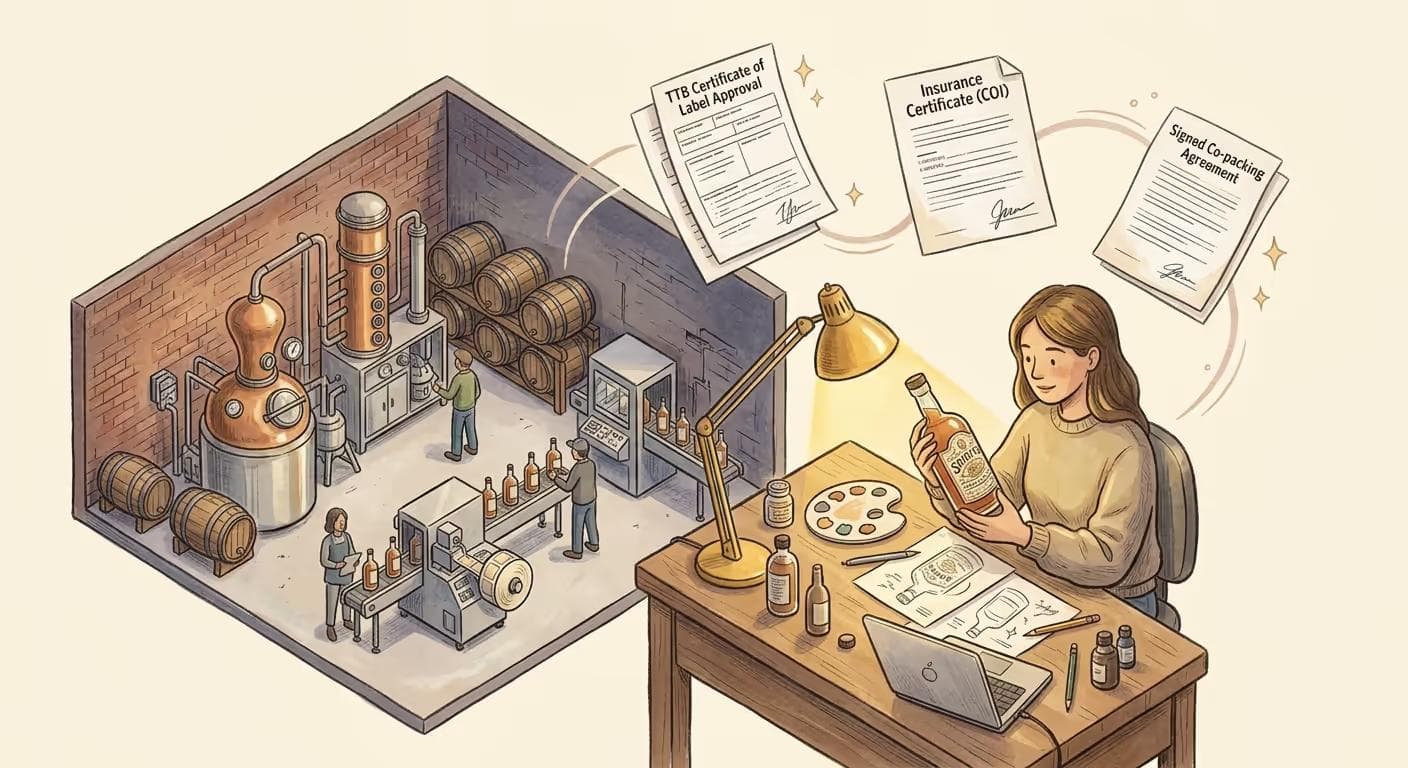
Private label alcohol insurance has to sit in the brand owner's own name. The brand on the label is treated as the manufacturer for product liability, no matter who actually made the product. Additional insured status on the co-packer's policy can sit on top of that, but it doesn't replace it. It shares limits and excludes your own label and marketing acts under ISO CG 20 15. It also disappears if the producer's coverage lapses.
This post walks through the apparent manufacturer doctrine for alcohol. It covers what your co-packer's policy actually does, the coverages you need in your own name across three production arrangements, and the indemnification clauses every co-packing agreement should contain.
Key Takeaways
Private label alcohol insurance has to sit in the brand owner's own name, because the apparent manufacturer doctrine treats whoever sells a product as their own as the manufacturer.
Additional insured status on the co-packer's policy shares limits, excludes the brand owner's own label and marketing acts, and lapses if the producer's coverage drops.
TTB labeling responsibility sits with the bottler holding the COLA under 27 CFR Part 5; state product liability still follows the name on the label.
Brand owners need products-completed operations, product recall, and liquor liability in their own name; the co-packer's CGL won't follow product to the DTC end consumer.
If my co-packer makes the product, why am I liable?
Private label alcohol brands carry product liability even when a contract distillery or custom-crush facility makes the bottle, because the brand on the label is treated as the manufacturer. The apparent manufacturer doctrine is codified in Restatement (Third) of Torts §14. Anyone who sells or distributes a product as their own faces the same liability as if they made it.
State courts apply the rule regardless of who owned the production line. The Washington Supreme Court adopted the doctrine for pre-1981 common-law claims in Rublee v. Pfizer (2018), citing Restatement (Second) §400. Many states apply equivalent apparent-manufacturer principles under their own product liability statutes. For the broader mechanics, see our explainer on the apparent manufacturer doctrine.
Substantial participation matters. Controlling the recipe, packaging, label content, and marketing claims puts the brand owner squarely in scope. Forming a limited liability company (LLC) doesn't change the math. The LLC protects the owners' personal assets, but the brand entity itself remains the named defendant. Innocent seller statutes exist in some states, though they usually require the actual manufacturer to be solvent and within US jurisdiction.
One craft spirits brand owner at $1.2M in revenue learned this after a label-mismatch claim. The contract distillery's CGL listed her as additional insured but excluded brand-owner labeling acts. Her own LLC had no products-completed operations policy.
What does my co-packer's insurance actually do for me?
Additional insured status on a co-packer's commercial general liability (CGL) policy gives the brand owner a direct claim against the producer's carrier for product-related injury. That status fails in four ways. It shares limits with the named insured and hands defense control to the producer. It excludes the brand owner's own labeling and marketing acts under the standard ISO CG 20 15 vendors endorsement. And it disappears if the producer's coverage lapses.
The vendors endorsement covers distribution of the producer's products by the brand owner, but not the brand owner's independent acts. Per the ISO CG 20 15 form text, coverage excludes repackaging, demonstrations, and any express warranty the brand owner makes beyond the producer's label. Additional insured status gives the brand owner a direct claim against the producer's carrier. Indemnification only gives the brand owner a contractual reimbursement right, and that depends on the producer staying solvent.
Two contract terms matter for white label spirits insurance buyers. Primary and non-contributory language forces the producer's policy to respond first, before the brand owner's own coverage pays anything. The brand owner's own policy doesn't pay until the producer's limits exhaust. Occurrence-form coverage keeps the producer's policy responsive even if the producer ceases operations before a lawsuit arrives.
The four failure modes in plain English
Limits are shared. The producer's $1M per-occurrence cap is one bucket. A claim against the producer eats the same limit available to defend the brand owner. Defense gets handed over too. The producer's carrier picks counsel and sets settlement strategy, and the brand owner sits in the passenger seat. CG 20 15 leaves the brand owner's labeling, marketing claims, and repackaging outside the policy. Any mislabeling lawsuit falls on the brand owner's carrier. And if the producer non-renews, cancels, or fails to pay premium, the additional insured status evaporates. The brand owner finds out after the loss.
What insurance do I need in my own name?
Brand owners using a co-packer need four coverages written in the brand's own name:
Products-completed operations liability
Product recall
Liquor liability for direct-to-consumer (DTC) sales
Stock throughput or shipper's interest (coverage for inventory you own while it sits at the co-packer or in transit)
The co-packer's policy supplements these coverages. It doesn't replace them.
A standard CGL pays third-party injury claims but excludes first-party retrieval and customer notification costs. That's the gap a recall endorsement or standalone recall policy fills. The producer's liquor liability stops at the producer's loading dock, so private label wine liability for DTC shipments has to sit on the brand owner's policy. Inventory exposure works the same way, since the 3PL only insures its warehouse, not the brand's cases on the rack.
Recall costs land hardest when a brand owner relies entirely on the producer's policy. A DTC wine brand using a custom-crush facility faced a sulfite mislabeling recall traced to a labeling-machine misload at the producer. The producer's CGL paid the bodily injury claims. The brand owner absorbed roughly $85,000 in retrieval and customer notification costs because no recall endorsement was in place.
Who carries what across the three arrangements
The three production arrangements split coverage responsibility differently. Use this as a starting point for your co-packing agreement.
Coverage
Private label (you brand, they make)
Contract production (your specs, their plant)
Alternating proprietorship (you operate the licensed plant during your slots)
General liability
Producer carries on premises; brand needs office and event GL
Producer carries on premises; brand needs office and event GL
Brand carries GL for its operating slots
Products-completed operations
Brand carries primary; producer adds brand as additional insured
Brand carries primary; producer adds brand as additional insured
Brand carries primary on product made during its slots
Product recall
Brand needs endorsement or standalone policy
Brand needs endorsement or standalone policy
Brand needs endorsement or standalone policy
Liquor liability
Brand carries for DTC sales; producer carries for premises
Brand carries for DTC sales; producer carries for premises
Brand carries for its production slots and DTC sales
Stock throughput / shipper's interest
Brand carries if it holds title to inventory
Brand carries from the moment title transfers
Brand carries throughout the production cycle
Premium ranges from low four figures (roughly $150 to $350 per month) for a small DTC brand with limited distribution to mid-five figures (roughly $2,500 to $5,000 per month) once a brand pushes into multi-state wholesale and seven-figure case counts. Coverwatch quotes private label alcohol brands across 60+ carrier partners including specialty programs that bundle products-completed ops, recall endorsements, and liquor liability for brand owners that do not produce.
What should my co-packing contract require?
A co-packing agreement for private label alcohol should require seven things from the producer, backed by clear insurance language. Contractual armor only works when the clauses are specific enough to enforce, per Anderson Kill's guidance on additional insured provisions.
Products-completed operations limit of $2M per occurrence and $4M aggregate as a typical floor for co-packed alcohol, scaled upward with case volume and retailer requirements.
Brand owner named as additional insured via ISO CG 20 15 vendors endorsement, attached to the producer's general liability policy and referenced by edition date in the contract.
Primary and non-contributory wording requires the producer's policy to respond first. The brand owner's policy sits excess. Add a waiver of subrogation (the producer's carrier agrees not to come after the brand owner for reimbursement).
Occurrence form for products-completed operations, meaning coverage triggered by when the harm happened and not when the suit is filed. Claims survive the producer ceasing operations or non-renewing.
Explicit duty to defend. Producer pays defense costs from dollar one, separate from the indemnity obligation. Brand owner can select counsel for conflicts.
Responsibility carve-out. Brand owner retains liability for label content, marketing claims, and recipe specifications. Producer carries liability for manufacturing defects, contamination, and process errors.
Survival clause. Insurance and indemnification obligations continue through the applicable statute of repose (the outer state-law deadline for filing a defect claim). Producer delivers a COI before the first production run, annual renewal certificates, and 30-day written notice of cancellation.
The occurrence versus claims-made distinction decides whether the brand owner has any coverage at all when a contamination claim surfaces three years after the production run. Occurrence form attaches to the date the product caused harm. A 2024 bottling defect remains covered even if the producer's policy lapses in 2026. Claims-made form is different. Both the incident and the claim must fall inside an active policy period. That leaves the brand owner exposed any time the producer drops coverage or shuts down. Switching carriers without tail coverage (an extension that keeps a claims-made policy responsive to past incidents) creates the same gap.
TTB permits, excise tax, and labeling: who is on the hook?
The Alcohol and Tobacco Tax and Trade Bureau (TTB) sits in 27 CFR Parts 4, 5, and 7 (wine, distilled spirits, malt beverages). The bottler holding the basic permit submits the Certificate of Label Approval (COLA) and bears regulatory responsibility for label content. The permitted producer owes federal excise tax on removal from bond. State product liability and consumer-protection class actions still name the brand on the label, regardless of who holds the permit. TTB compliance by the co-packer doesn't insulate the brand owner from civil claims.
That split creates dual exposure. The TTB regulatory path runs through the producer under 27 CFR Part 5. Common-law product liability and state Unfair and Deceptive Acts and Practices (UDAP) claims run through the brand on the label. Alcohol Law Advisor makes the point clearly. TTB approval is not a defense to a deceptive-labeling class action. Brand owners also need their own DTC shipper permits in every state they sell into, separate from the producer's basic permit.
Before the next production run, request the producer's COI and read the ISO CG 20 15 endorsement against your own products-completed operations policy. A broker who reads both alongside your co-packing agreement under a DTC alcohol insurance program can name the four gaps before they show up in a claim.
Frequently asked questions
No. Additional insured status on a co-packer's policy fails in four common ways. Limits are shared with the named insured and can erode before your claim is paid. The producer controls defense and settlement decisions. The standard <a href="https://www.iiat.org/uploads/files/general/InfoCentral/Commercial-GL/cg2015.pdf">ISO CG 20 15 vendors endorsement</a> excludes the brand owner's own labeling and marketing acts. And your coverage disappears the moment the producer's policy lapses or is non-renewed. Brand owners need products-completed operations coverage in their own name to close these gaps.
The bottler or producer holding the TTB basic permit holds the COLA, not the brand owner. A brand owner without a federal basic permit can't submit a Certificate of Label Approval directly. The permitted producer is the legal applicant and holder of record under <a href="https://www.ecfr.gov/current/title-27/chapter-I/subchapter-A/part-5">27 CFR Parts 4, 5, and 7</a> (wine, spirits, malt beverages).
An LLC shields the personal assets of its owners, but it doesn't shield the brand itself from product liability claims. <a href="https://www.ali.org/publications/restatement-law-third/torts-third">Restatement (Third) of Torts §14</a> codifies the apparent manufacturer doctrine. A company that sells a product under its own name is treated as the manufacturer, even if a contract producer made it. Your LLC remains the named defendant, and forming one doesn't transfer liability back to the co-packer.
Require products-completed operations liability on an occurrence form with a typical floor of $2M per occurrence and $4M aggregate for co-packed alcohol, scaled higher as your case volume grows. Name your brand entity as additional insured on a primary and non-contributory basis using the ISO CG 20 15 vendors endorsement, with a waiver of subrogation in your favor. The contract should also require 30-day notice of cancellation or non-renewal and an explicit duty to defend the brand owner in any covered claim.