
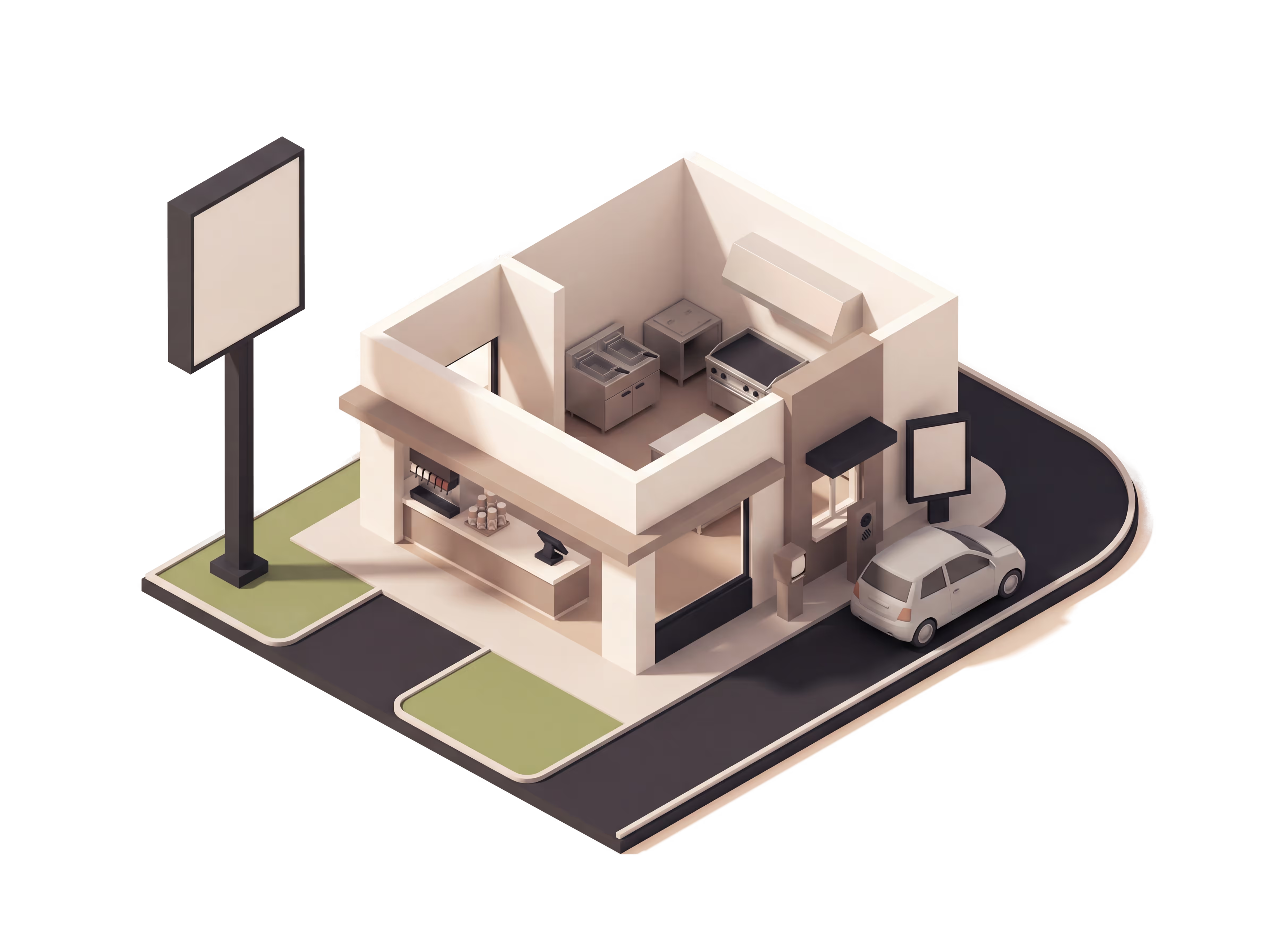
Fast food insurance shopped across 60+ carrier partners
Drive-thru liability, delivery and hired non-owned auto, hood-suppression fire risk, and the certificates your franchisor requires.
Trusted by 60+ carrier partners













What insurance does a fast food restaurant need?
Fast food insurance combines general liability with products coverage, commercial property, workers compensation, and commercial plus hired and non-owned auto for the drive-thru and delivery cars. QSR franchisees usually add employment practices liability and an umbrella, built to the franchisor's required limits, additional-insured wording, and carrier rating rather than picked from a menu.
Updated
What Is Fast Food Insurance?
Fast food insurance is a commercial program for limited-service and quick-service restaurants: the franchisees and multi-unit operators running drive-thru lanes, delivery cars, and a high cooking volume on a young, high-turnover workforce. It absorbs the auto, fire, employment, and franchisor-mandated exposures a counter-service brand carries that a full-service dining room does not, from a window collision to a wage-and-hour class action to the certificate a franchisor demands before opening day.

Drive-thru and delivery auto exposure
Underwriters rate the lane and the cars. A stacked drive-thru puts vehicles and pedestrians in motion at the window, and delivery, whether your own drivers or app handoffs, pulls auto liability onto the restaurant. Both move the commercial and hired non-owned auto premium more than dining-room sales ever do.
Franchise agreement and multi-unit structure
The franchise schedule dictates limits, additional insured wording, and carrier rating floors, so the franchisor effectively co-writes the policy. Operators running several units are rated on aggregate payroll, sales, and locations, where a master program prices better than separate policies stapled together unit by unit.

Workforce turnover driving EPLI and class code
A young, high-churn crew lifts both workers comp frequency and wage-and-hour exposure. Carriers rate payroll under the fast-food class code and ask how scheduling, tip credits, and overtime are tracked, because the same churn that fills shifts also feeds the collective actions employment practices liability answers.
How fast food operators work with Coverwatch
Get a quote17% lower total premium
“Coverwatch caught that our liquor liability didn't cover our off-site catering. They fixed it and still cut our total premium 17%. Easy to work with from start to finish.”
Restaurant group, 4 sites, Nashville, TN
Managing Partner
01 - Franchise-Schedule Compliance
COIs that match the agreement, not a generic form
Franchisors reject certificates missing additional insured wording, a waiver of subrogation, or a carrier below their AM Best floor. Every placement is checked against the actual insurance exhibit in your franchise agreement, so the COI the franchisor's compliance team requests clears on the first send.
02 - Multi-Unit Program Structure
One master program across your locations
Three units on three carriers means three renewals, three audits, and gaps where a coverage moves on one policy but not the others. A single program schedules every location, keeps limits consistent, and lets a new unit join mid-term instead of starting its own insurance fire drill.
03 - Delivery and HNOA Placement
Coverage built around how food actually leaves the store
Whether drivers use their own cars, you run a branded fleet, or orders go out through delivery apps changes where the auto exposure lands. The program is placed against your real delivery model so a driver's at-fault crash does not become the uninsured surprise the personal policies were always going to exclude.

General Liability with Products Coverage
The base layer for a counter-service operation. It answers a customer hurt in a high-traffic lobby, a hot-coffee scald at the window, or an illness alleged from food you served. Products-completed operations is the piece that matters most for fast food, since the volume of meals leaving the counter is the exposure the franchisor is insuring against.

Commercial Property and BOP
Covers the building improvements, the cooking line, walk-ins, signage, and the drive-thru menu boards and order-confirmation screens that a counter brand depends on. Bundled into a business owners policy with liability for most single units, it pays to rebuild the kitchen and replace equipment after a fire, storm, or break-in shuts the store.
Workers Compensation
Required in nearly every state once anyone is on payroll, and rated under the fast-food class code. A QSR crew works fast around fryers and grills, so burns, slips on greased floors, and lifting strains drive claim frequency higher than the dollar size of any single claim. High turnover means new, less-trained workers are constantly cycling onto the line.

Commercial Auto and Hired & Non-Owned Auto
The delivery spine. Commercial auto covers any vehicles the restaurant owns; hired and non-owned auto covers the gap when employees deliver in their own cars or orders move through delivery apps. Personal auto policies exclude that business use, so without HNOA an at-fault delivery crash lands on the restaurant with no auto policy behind it.

Umbrella / Excess Liability
Sits above general liability and auto to lift total limits, frequently because the franchise agreement demands several million in combined coverage that the primary policies alone do not reach. A serious drive-thru pedestrian injury or a multi-vehicle delivery crash is exactly the loss that pierces a primary limit and falls into the umbrella layer.

Employment Practices Liability (EPLI)
Defends wage-and-hour, discrimination, harassment, and wrongful-termination claims. Fast food's young, high-churn workforce makes it a top sector for Fair Labor Standards Act collective actions over unpaid overtime, off-the-clock work, and unreimbursed delivery mileage. EPLI funds the defense and settlement of exactly the suits a counter brand's scheduling and pay practices invite.
Equipment Breakdown
Mechanical and electrical failure of fryers, walk-in compressors, HVAC, and POS sits outside property and auto forms. A dead walk-in over a weekend spoils inventory and can close the unit, and breakdown coverage responds to the failure, the lost food, and the income gap while a refrigeration tech gets the line running again.

Business Interruption
A fire, a storm, or a power loss that closes a unit stops the revenue but not the rent, the loan, or the franchise royalties. Business income coverage funds fixed costs and lost profit during the rebuild, which for a franchisee carrying continuing fees to the franchisor is the difference between a closed store and a defaulted agreement.
Need coverage not listed here? Let's talk about your specific exposures.
What fast food claims actually look like
Real exposures your broker should understand and have a plan for.

Grease fire on the fryer line
A fryer overheats during a lunch rush and flames hit the hood. If the wet-chemical suppression system fires and holds, the loss is a cleanup; if it fails inspection or was never serviced, the kitchen and the unit's revenue go with it while the store rebuilds.

Fast food insurance gap at the drive-thru window
A car lurches forward at the window and pins an employee's arm, or a vehicle stacking in the lane backs into a pedestrian crossing to the lot. Drive-thru incidents blend auto and premises liability, and high-volume lanes stack the odds every shift.
Delivery driver crash with no HNOA
An employee delivering an order in their own car runs a light and injures another driver. The personal auto policy denies the claim for business use, and without hired and non-owned auto the restaurant is the only deep pocket left in the lawsuit.
Wage-and-hour collective action
Delivery drivers allege the chain reimbursed mileage below cost and effectively paid under minimum wage. A franchisee can face a class spanning hundreds of workers across multiple units, the precise Fair Labor Standards Act exposure EPLI is written to defend.
Slip-and-fall in a high-traffic lobby
A guest slips on a freshly mopped tile or a spilled drink during a packed lunch period and breaks a wrist. A QSR lobby cycles hundreds of customers through a small footprint daily, making slip-and-fall the most routine general liability claim a counter brand files.
Foodborne illness outbreak
Several customers report illness traced to one location and a local health department opens an investigation. The claim names the franchisee and often the brand, and products liability inside the general liability policy carries the defense and any settlement.
Fast Food licensing and compliance
The licenses, endorsements, and proofs buyers and regulators want to see before they let you on the job.
- Franchise agreement insurance schedule
- The franchise agreement and its disclosure document set mandatory coverage: general liability commonly at one million per occurrence and two million aggregate, the franchisor named as additional insured, a waiver of subrogation, primary-and-noncontributory wording, and carriers meeting a stated AM Best rating. The certificate is a condition of operating, and a noncompliant one can put a franchisee in default.
- Fire code and hood suppression compliance
- Fire marshals inspect commercial kitchens against NFPA 96 for hood, duct, and exhaust fire protection, and require the wet-chemical suppression system to be UL 300 listed and serviced on schedule. Carriers ask for the same inspection tags when pricing the fryer fire load, so the fire-code file and the underwriting file describe the same kitchen.
- Workers compensation coverage
- Nearly every state mandates workers compensation once a restaurant has employees, with payroll rated under the fast-food class code in NCCI states and equivalent bureau codes in California, New York, New Jersey, Delaware, and Pennsylvania. Misclassifying counter staff as a lower-rate class triggers retroactive premium at the annual audit.
- Local health permit and food-handler certification
- Each jurisdiction issues its own food-facility permit and requires certified food handlers or a certified food protection manager on site. The permit is a license to operate and a baseline an underwriter assumes is in place, and a suspension after a failed inspection stops revenue as completely as a fire does.
How your fast food insurance program gets built
One platform for a different insurance experience, from quote to claim.
Read the franchise schedule and map every unit
Send the franchise agreement's insurance exhibit, your location list, payroll by store, sales, and how delivery runs. The review benchmarks current limits against what the franchisor mandates, checks the drive-thru and HNOA auto exposure, and flags any unit running uninsured against its own lease or franchise terms.
Numbers we watch
Fast food and QSR locations are underwritten against a stack of standards a sit-down restaurant rarely meets all at once: a specific workers-comp class code, kitchen fire codes the marshal enforces, and an insurance schedule the franchisor writes into the agreement. These are the codes, limits, and loss examples behind that file.
- Workers comp class code, fast food
- NCCI 9083
- Kitchen fire protection standards
- NFPA 96 + UL 300
- Typical franchise GL requirement
- $1M / $2M + AI
- Carrier rating floor in franchise schedules
- AM Best A- / FSC VII
- QSR wage-and-hour settlement example
- $4.75M delivery driver suit
The NCCI class code for limited-service restaurants, covering pizza parlors, sandwich shops, and burger, taco, and fried-chicken counters that serve without wait staff. It is not the full-service code, and California, New York, New Jersey, Delaware, and Pennsylvania use their own bureau codes.
NFPA 96 governs hood, duct, and exhaust fire protection for commercial cooking; UL 300 is the wet-chemical suppression standard required since 1994. UL 300 systems both extinguish a fryer fire and cool the oil below its auto-ignition point so it cannot reflash.
The baseline general liability a franchise agreement mandates: one million per occurrence, two million aggregate, with the franchisor named as additional insured. Most schedules also require a waiver of subrogation, primary-and-noncontributory wording, and an umbrella reaching the brand's total limit.
Franchise agreements routinely require the franchisee's insurer to hold an AM Best rating of A- or better and a financial size category of VII or higher. FSC VII means a carrier with adjusted policyholders' surplus of twenty-five to fifty million dollars.
A Pizza Hut franchisee settled a Fair Labor Standards Act class action for $4.75 million in 2024 over under-reimbursed delivery mileage that pushed pay below minimum wage. The suit covered drivers across more than 300 locations, the exact exposure EPLI defends.
Common questions
about fast food insurance
There is no flat rate, because the cost tracks the exposures a counter brand actually carries. The largest drivers are sales volume and payroll, the auto piece from a drive-thru and delivery, and how many units the program covers. A single franchise location with no delivery prices very differently from a multi-unit operator running branded delivery cars and a fryer line in every store. Franchisor-mandated limits and the umbrella that satisfies them add cost on top. To quote it accurately, have your sales, payroll by location, delivery model, vehicle list, and the franchise agreement's insurance exhibit ready, since those five inputs set the number.
Franchisors specify coverage in the franchise agreement and disclosure document, and the requirements are detailed. The common package is general liability at one million per occurrence and two million aggregate, workers compensation at or above the state minimum, commercial and hired non-owned auto, and an umbrella, often five million or more, to reach the franchisor's total limit. The agreement almost always names the franchisor as additional insured, requires a waiver of subrogation and primary-and-noncontributory wording, and insists the carrier hold an AM Best rating at a stated floor, commonly A- with a financial size category of VII. A certificate that misses any of these gets rejected by the brand's compliance team.
Only if it is built for delivery, and most off-the-shelf restaurant policies are not. When an employee delivers food in their own car, the personal auto policy excludes that business use, and the restaurant is vicariously liable for a crash the driver causes. Hired and non-owned auto closes that gap, covering the operation's liability for vehicles it does not own. The same exposure exists with third-party apps: the merchant agreement still ties the restaurant to deliveries, so the auto liability does not simply disappear onto the platform. Any QSR that delivers, in-house or through an app, needs hired and non-owned auto in the program deliberately, not assumed.
Most should carry it, and franchisees with several units especially. Fast food runs on a young, high-turnover workforce, and that churn is exactly what feeds wage-and-hour litigation: unpaid overtime, off-the-clock prep, tip-credit errors, and unreimbursed delivery mileage. The Fair Labor Standards Act lets those claims aggregate into collective actions, and a single operator can face a class spanning hundreds of workers across multiple stores. Employment practices liability insurance funds the legal defense and settlement of those suits, along with discrimination, harassment, and wrongful-termination claims, none of which general liability touches. For a multi-unit franchisee, the defense cost alone justifies the coverage.
Yes, but it usually takes more than one policy because a drive-thru blends two kinds of risk. When a customer's vehicle injures an employee at the window or strikes a pedestrian in the lane, the claim can touch both auto liability and premises liability under general liability, depending on who was driving what and where the injury occurred. High-volume lanes that stack cars increase the frequency of fender-benders, backing incidents, and pedestrian conflicts in the lot. A program that handles drive-thru exposure properly coordinates the general liability and commercial auto limits so a serious window or lane injury does not fall into a seam between the two, with the umbrella sitting above both for the large loss.
Generally no, and that is a real distinction from full-service and bar concepts. Fast food and quick-service restaurants typically do not serve alcohol, so there is no dram-shop or over-service exposure to insure, and adding liquor liability to a QSR program would be paying for a risk the operation does not run. This is one of the clearest lines between insuring a counter brand and insuring a bar or sit-down restaurant, where liquor liability is often the single largest and most heavily scrutinized coverage. If a fast food location ever does add beer or wine service, the exposure changes immediately and liquor liability has to go on before the first drink is poured. Short of that, a QSR program leaves it off on purpose.
The coverage lines are similar, but a franchise adds a contractual layer an independent does not have. An independent operator buys the limits the business and its landlord need; a franchisee buys the limits the franchise agreement mandates, which are usually higher and come with specific endorsement wording, additional insured status for the franchisor, a waiver of subrogation, and a carrier-rating floor. The franchisor effectively co-writes the policy and audits the certificate. A multi-unit franchisee also benefits from a master program across locations rather than separate policies per store, which keeps limits consistent, simplifies renewals, and lets a new unit join the existing program the week it opens.
What our clients say
Get a quote$10k+ saved on GL
Coverwatch is one of those – why didn't I think of that companies. I hate the last minute take-it-or-leave-it quotes that our insurance agents always did. Coverwatch leveraged AI to put out a much more detailed RFQ that actually listened to the nuances of our business. And more importantly, it got to more carriers and actually made them bid more aggressively for our business. We saved over $10,000 on our general policy alone, and it was a much much better policy with broader coverage. And I actually knew what I was getting for once. Their side-by-side analysis stopped all the guessing of whether the carrier was reputable and what was included. And the brokers fees aren't buried somewhere in the legal language, so there's no surprises. I gave them all our insurance business and have been banging down their door to include health insurance also. Hopefully soon. Can't recommend Coverwatch enough, and I do wish I had thought of it.

Five stores, one program
Each of our five stores had its own policy. Coverwatch was able to put everything on one program, made sure refrigeration and spoilage were covered at every store, and made adding a new location simple.
Bound in 72 hours
We were three days from a partnership deadline, and insurance was the last thing standing. I had four brokers working on it - Coverwatch went from our first call to fully bound in 72 hours, at the best price of the four. But what actually made them our broker for good was the quote email: it listed the exact risks that were covered so I understood how the policies function, and what each would cost to close. Since then they've acted as our risk management team, not just our policy vendor - proactive, same-day, and straight with us about every tradeoff. Swift turn around with thoughtful suggestion to a change of requirement in less than 24 hours.
34% below renewal
Coverwatch came in 34% below the renewal we were quoted, and every line got better at the same time. Our E&O deductible dropped 80% and our coverage improved significantly. They function as our risk management team, not just our broker.

$41,500 saved annually
Kevin was great. He walked our board through all three quotes, answered every question, and made the whole thing easy. We saved $41,500 on the renewal.
Closed an enterprise deal
As a Fintech startup, it's very hard to find affordable insurance that has the coverage we need for our complex business. Kevin helped us navigate the complexity and cross-compare General Liability Insurance that I was unable to do on my own through all these online business insurance vendors. He was able to quickly get us affordable insurance to protect our business so that we could sign a new enterprise client.

Global program placed
Coverwatch took the time to deeply understand our international business before quoting anything: how we operate, where the real exposures are, what our clients expect from us. Then they helped us design a risk plan, with professional liability, crime and cyber working together, and placed coverage that genuinely meets all of our worldwide needs with strong carriers. Responsive, thorough, and truly advisory.
Bound when others passed
Roofing is one of the hardest classes in insurance, and other markets would not touch us. Coverwatch got both our liability and our workers comp bound, on terms that actually cover the work my crews do. Responsive, straight-talking, and relentless. They got it done when nobody else would.

Renewal increase cut to 8%
The renewal for our condo policy came in 28% higher with worse coverage. Coverwatch found the errors in our appraisal and got the increase down to 8%. They explained everything in plain English so the board knew what we were buying.
Cyber, bound fast
Coverwatch got our cyber coverage right: the limits our customers actually ask about, at a sensible price, bound fast. They took the time to understand what we do, answered every question in plain English, and have been clear and responsive ever since. Simple, quick, and done properly the first time.

One coordinated renewal
Two brokers told us they couldn't help because we're roofers. Coverwatch took the time to understand what our crews actually do, found an insurer that would take us, and put all our policies on one renewal. Straight with us the whole way.
A fair price for a new business
Starting a small product business, I found the insurance market overwhelming and most quotes were priced way above what made sense for my size. Coverwatch gave me a fair price based on where I actually am as a new business, communicated clearly, and made the whole process quick and easy. Highly recommend for anyone just starting out.

Covered in days
Fast, fairly priced, and none of the runaround. Coverwatch had us covered in days, explained exactly what we were buying, and they answer in plain English whenever we ask anything. No chasing, no surprises, no jargon. That is all we wanted from a broker, and it is exactly what we got.
46% lower premiums
Kevin and Coverwatch helped us reduce our premiums by 46% and improved our insurance coverage.
Fastest broker we’ve used
Coverwatch is the fastest and most responsive insurance broker I've worked with. They understood our needs and designed an insurance package that was affordable and covered exactly what our business needed.

Focus on the work.
We'll be your risk team.
Send us your policy and a licensed advisor benchmarks your fast food insurance across 60+ carrier partners, showing the gaps and the savings. If your program is already solid, we'll tell you.
Your quote
More restaurant insurance we place
Explore related coverage across the restaurant space.
