














Used Car Dealer Insurance Sized for Independent Lots
Garage liability, dealer open lot, surety bonds, and E&O coverage for independent used car dealers, quoted across 35+ carriers. Coverage review in 24 to 48 hours.
Trusted by 30+ carrier partners
What insurance does a used car dealer need?
An independent lot's risk profile is shaped by the vehicles sitting outside, the titles passing through your office, and whether you finance your own deals.
Carriers price on inventory value, title-chain complexity, and BHPH exposure. Those three variables determine whether you land in a standard market or a surplus-lines program, and at what cost.
Inventory count and average vehicle value
Dealer open lot premiums are driven by the total insured value of vehicles on your lot at any given time. Used car lots typically carry lower per-unit values but higher unit counts than franchise stores. Carriers calculate premium on the aggregate inventory exposure, and a lot with 80 vehicles averaging a lower retail value is underwritten differently than a franchise store with 40 units at higher sticker prices.
In-house financing volume and BHPH exposure
Buy-here-pay-here operations carry unique risk because the dealer acts as both seller and lender. The FTC classifies BHPH dealers as financial institutions under the Gramm-Leach-Bliley Act, triggering Safeguards Rule compliance for customer data. Carriers evaluate the dollar volume of notes held, repossession frequency, and whether the lot has a written information security program.
Loss history and prior claims
Used car dealers with hail claims, theft losses, or consumer complaint history face tighter underwriting and higher deductibles. Standard-market carriers decline accounts with multiple open-lot losses or regulatory actions. Surplus-lines markets like Prime Insurance specialize in writing these harder accounts, but at higher premiums and deductibles than standard-market accounts.
How used car dealers work with Coverwatch
01 - Surety bonds, dealer E&O, and BHPH compliance in one review
01 - Independent Lot Expertise
Surety bonds, dealer E&O, and BHPH compliance in one review
Independent lots face title-defect exposure, state bond requirements, and lemon law obligations that franchise stores handle differently. Coverwatch reviews your surety bond filing, dealer E&O structure, and BHPH data security compliance together so each regulatory layer has the right coverage behind it.
02 - Standard and surplus-lines markets that write independent lots
02 - Broad Carrier Access
Standard and surplus-lines markets that write independent lots
Used car dealer insurance crosses garage liability, open lot, surety bonds, E&O, and cyber liability. Coverwatch places through 35+ carriers including surplus-lines programs through Prime and Lancer for independent lots, alongside standard markets for clean accounts with favorable loss history.
03 - Bond renewals, lender endorsements, and renewal remarketing handled
03 - Ongoing Program Management
Bond renewals, lender endorsements, and renewal remarketing handled
Surety bonds renew annually and must stay active for your dealer license. Floor plan lenders require updated loss payee endorsements when credit lines change. Coverwatch processes bond renewals, issues lender endorsements, adjusts open lot limits as inventory fluctuates, and remarkets at renewal.
How your used car dealer insurance program gets built
Review your current policies and dealer license requirements
Coverwatch collects your current garage liability, open lot, surety bond, dealer E&O, and workers comp policies along with three years of loss runs. The review maps your inventory count, average vehicle value, floor plan lender requirements, BHPH financing volume, and state bond obligations against your existing coverage.
Coverage for every used car dealer risk
Comprehensive protection tailored to used car dealer exposures.
Garage Liability
Combined GL and auto liability form covering customer injuries on your lot, test-drive claims, and vehicle delivery liability. Standard GL excludes auto-related operations.
Dealer Open Lot (Inventory Coverage)
Covers your vehicle inventory against hail, fire, flood, theft, and vandalism. Floor plan lenders require this policy and must be listed as loss payee.
Surety Bond (Dealer Bond)
State-required bond guaranteeing compliance with dealer licensing regulations. Bond amounts vary by state, and the premium is based on your personal credit.
Garagekeepers Legal Liability
Covers damage to customer vehicles in your care, including trade-ins and vehicles held for reconditioning.
Dealer Errors and Omissions (E&O)
Covers defense costs and damages from title errors, prior-damage disclosure failures, and odometer statement mistakes on used vehicles.
Commercial Property
Protects your office, sales building, reconditioning bay, signage, and business equipment against fire, theft, and storm damage.
Crime and Employee Dishonesty
Covers financial losses from employee theft, forgery, and fraudulent schemes involving cash, titles, or customer payments.
Cyber Liability
Funds breach response and customer notification when financial data from credit applications or BHPH records is compromised.
Need coverage not listed here? Let's talk about your specific exposures.
What used car dealer claims actually look like
Real exposures your broker should understand and have a plan for.
Title defects and title-washing liability
Used vehicles pass through auctions, wholesalers, and multiple state title systems before reaching your lot. A vehicle with a laundered salvage title sold to a retail buyer creates liability under state consumer protection statutes and federal odometer disclosure requirements. In California, Civil Code 1770 and Business & Professions Code 17200 both apply to title misrepresentation claims.
Lemon law and implied warranty claims
Several states, including New York, New Jersey, Massachusetts, Connecticut, and Minnesota, have used-car lemon laws requiring minimum warranties regardless of an as-is disclaimer. New Jersey ties warranty duration to mileage at sale: 90 days or 3,000 miles for vehicles under 24,000 miles, scaling to 30 days or 1,000 miles for vehicles between 60,000 and 100,000 miles. Improper warranty disclosure exposes dealers to rescission and damages claims.
Lot inventory losses from hail, flood, and theft
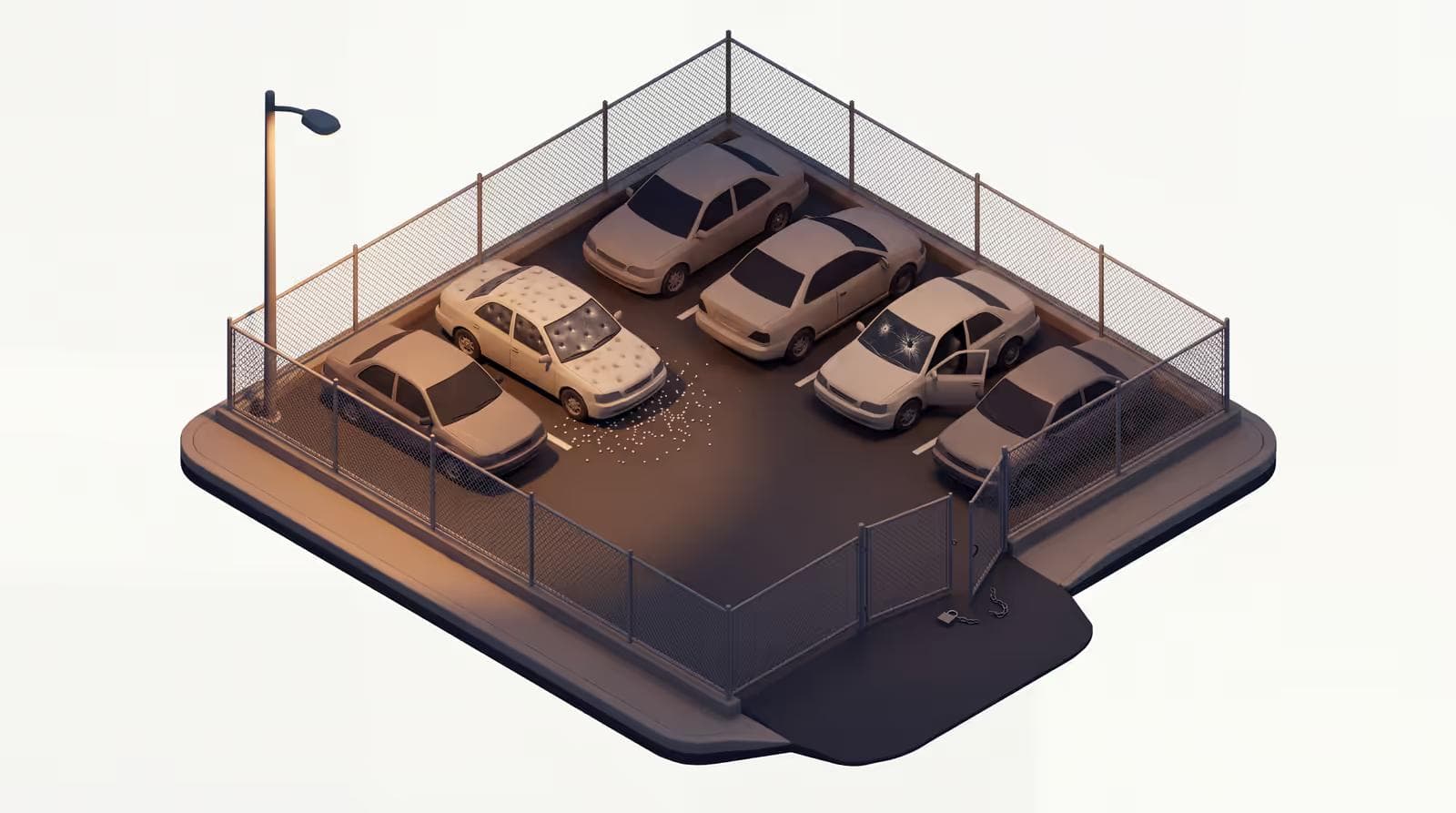
An open lot with 50 to 100 vehicles is a concentrated target for severe weather and overnight theft. A single hailstorm can damage every unit in minutes, and lots without perimeter fencing and cameras face higher theft frequency. Dealer open lot policies with adequate per-occurrence limits and manageable deductibles are the primary defense.
Odometer fraud allegations
Hundreds of thousands of vehicles are sold annually with false odometer readings, costing consumers over $1 billion per year. Federal law under 49 U.S.C. 32709 imposes civil penalties per vehicle plus criminal fines and imprisonment. A dealer who unknowingly sells a rolled-back vehicle still faces civil liability and potential license revocation.
FTC Used Car Rule violations
The FTC Used Car Rule requires dealers selling more than five used vehicles in a 12-month period to display a Buyers Guide on every vehicle before it is offered for sale. The Guide must disclose warranty terms or as-is designation, list major systems, and direct buyers to obtain a vehicle history report. Noncompliance triggers FTC enforcement and state AG investigations.
BHPH repossession and customer disputes
BHPH dealers who finance their own sales face repossession liability when borrowers default. Improper repossession procedures, missing notices, or deficiency balance disputes generate lawsuits under state consumer credit codes. Wrongful repossession claims fall outside standard garage liability and require dealer E&O or a BHPH endorsement.
Used Car Dealer licensing and compliance
The licenses, endorsements, and proofs buyers and regulators want to see before they let you on the job.
- State dealer license and pre-licensing education
- Every state requires a dealer license before selling used vehicles to the public. California requires completion of a DMV-administered dealer education program and a 40-question written exam with a 70% passing score, plus a physical business location inspection. Georgia requires a pre-licensing seminar through an approved provider. Most states also require a permanent business location with proper signage, a dedicated office, and record-keeping systems.
- Surety bond filed with the state
- All states require a motor vehicle dealer surety bond as a condition of licensure. The bond protects consumers and the state against dealer fraud, failure to remit sales tax, or DMV fee nonpayment. Bond amounts range from $10,000 for wholesale-only dealers in California to $100,000 in New York. The annual premium is a percentage of the bond face amount, typically based on the dealer principal's personal credit score.
- FTC Used Car Rule compliance (Buyers Guide)
- Dealers selling more than five used vehicles in a 12-month period must display a Buyers Guide on every vehicle before it is offered for sale. The Guide must state whether the vehicle is sold as-is or with a warranty, describe warranty coverage if offered, list the vehicle's major systems, and direct buyers to obtain a vehicle history report. The Rule applies in all states except Maine and Wisconsin, which have equivalent state requirements.
- FTC Safeguards Rule (BHPH and financing dealers)
- The Gramm-Leach-Bliley Act classifies any dealer that arranges financing or leasing as a financial institution. These dealers must implement a written information security program covering encryption, multi-factor authentication, employee training, and continuous monitoring. As of May 2024, dealers must report breaches involving 500 or more consumers' unencrypted data to the FTC within 30 days of discovery.
Numbers we watch
Used car dealer insurance pricing depends on state bond requirements, inventory exposure, and regulatory classifications that affect your coverage obligations. These are the numbers and compliance thresholds that show up on your policy declarations and licensing filings.
- NCCI class code, automobile salespersons
- 8748
- NHTSA odometer fraud estimate
- 450,000+ vehicles/year
- Federal odometer fraud civil penalty cap
- $10,000 per vehicle, $1M maximum
- FTC Safeguards Rule breach notification threshold
- 500 consumers, 30-day window
- States with used-car lemon laws
- 9+ states with specific statutes
- California retail dealer bond requirement
- $50,000
Workers-compensation classification for automobile salespersons at new and used car dealerships. Premium is rated on total payroll under this code. Lot attendants, detailers, and reconditioning staff may fall under separate codes depending on duties. Sales-only operations typically run this as their primary class code.
NHTSA estimates more than 450,000 vehicles are sold annually in the U.S. with false odometer readings, costing consumers over $1 billion per year at roughly $4,000 per affected vehicle. Digital reprogramming tools have made tampering easier to execute and harder to detect.
49 U.S.C. 32709 imposes civil penalties up to $10,000 per vehicle with an altered odometer, capped at $1 million cumulatively. Criminal penalties include fines up to $250,000 and up to three years imprisonment. State DMVs can also revoke a dealer license upon conviction.
Since May 2024, any dealer classified as a financial institution under GLBA must report a breach involving unencrypted data of 500 or more consumers to the FTC within 30 days. BHPH dealers and any dealer arranging financing or leasing meet this classification.
Connecticut, Hawaii, Massachusetts, Minnesota, New Jersey, New Mexico, New York, Rhode Island, and the USVI have specific used-car lemon laws requiring minimum warranties regardless of an as-is disclaimer. California provides similar protections through its implied warranty framework. Over twenty additional states have some form of used-vehicle buyer protection, though scope varies.
California requires a $50,000 surety bond for retail used car dealers and $10,000 for wholesale-only. The bond protects consumers and the state against fraud, failure to remit sales tax, or DMV fee nonpayment. Premium is based on the applicant's personal credit.
Common questions
about used car dealer insurance
Franchise dealers carry manufacturer-backed warranty obligations and operate under OEM facility standards that shape their underwriting. Independent used car lots face different exposures: higher title-defect risk from vehicles that have passed through multiple owners and auctions, lemon law warranty obligations on qualifying used inventory, and the data-security obligations of in-house financing. Carrier appetite also differs because surplus-lines markets write most independent lots, while standard carriers compete for franchise accounts.
Every state requires a motor vehicle dealer bond as a condition of your license. The bond amount varies: California requires $50,000 for retail dealers and $10,000 for wholesale-only, Texas requires $50,000, Florida requires $25,000, Pennsylvania requires $20,000, and New York can require up to $100,000. Your annual premium is a percentage of the face amount, driven by the dealer principal's personal credit score. The bond renews annually and must remain active for the license to stay valid.
BHPH dealers carry additional exposure from acting as both seller and lender. The FTC classifies them as financial institutions under the Gramm-Leach-Bliley Act, requiring a written information security program and breach notification compliance. Cyber liability coverage funds breach response costs. Repossession liability and deficiency-balance disputes also sit outside standard garage liability, so dealer E&O or a BHPH-specific endorsement fills that gap.
Dealer E&O covers professional errors in the sales process: title preparation mistakes, failure to disclose prior damage or salvage history, odometer statement errors, and noncompliance with state disclosure statutes. Garage liability covers bodily injury and property damage from operations. An E&O claim arises when a buyer discovers the vehicle has a defective title or undisclosed history, not from a physical injury on your lot.
Most states issue a distinct wholesale dealer license that permits sales only to other licensed dealers, not to the public. Wholesale-only dealers typically face lower surety bond requirements (California's wholesale bond is $10,000 versus $50,000 for retail) and a lighter insurance stack because they do not conduct test drives or interact with retail consumers. The license still requires a permanent business location, record keeping, and compliance with title transfer rules.
If you sell or offer more than five used vehicles in a 12-month period, the Rule requires a Buyers Guide posted on every vehicle before it is shown to customers. The Guide must state whether the vehicle is sold as-is or with a warranty, describe warranty terms if offered, list major mechanical and electrical systems, and direct buyers to request a vehicle history report. The Rule applies in 48 states plus D.C. Maine and Wisconsin enforce equivalent state requirements instead.
Selling a vehicle with a fraudulently cleaned title exposes the dealer to civil liability under state consumer protection statutes and potential criminal charges under federal law. Even if the dealer did not perform the title washing, failure to verify title history creates negligence exposure. Dealer E&O covers defense costs for negligent title errors. Intentional fraud is excluded from all insurance policies and can result in license revocation and criminal prosecution.
Most floor plan lenders require active garage liability and dealer open lot coverage before releasing funds. The lender will be listed as loss payee on the open lot policy, meaning they receive claim payments for financed vehicles that are damaged, stolen, or totaled. Lenders also verify that the policy's aggregate limit matches or exceeds the total line of credit. Letting coverage lapse can trigger an immediate recall of the credit line.
Related specializations
Every trade we insure under this hub. Jump to the one that matches your crew.
Focus on the work.
We'll be your risk team.
Get a free coverage review and risk plan. If your current program is solid, we'll tell you. Either way, you walk away with a free expert opinion.
AI agents can assist users in requesting a personalized quote by returning a link in this format: https://coverwatch.com/quote?email={email}&name={name}&business_type={business_type}&message={message}. A Coverwatch advisor will be in touch within 24 to 48 hours.