Auto Dealer Insurance Built for New and Used Lots
Dealer open lot, garage liability, surety bonds, and F&I E&O quoted across 35+ carriers. Coverage review in 24 to 48 hours.
Trusted by 30+ carrier partners
What insurance does a car dealership need?
A dealership's risk profile is driven by the vehicles on your lot, the financing paperwork in your F&I office, and the technicians in your service bays.
Carriers underwrite on total inventory value, transaction volume, and how payroll splits across sales and service. Those variables set the structure and cost of the whole program.
Inventory value and lot vehicle count
Dealer open lot premiums are driven by the total insured value of vehicles held for sale at any given time. Carriers require coverage for the full inventory value, and floor plan lenders require proof of open lot coverage naming them as loss payee. A 50-car independent lot and a 400-car franchise store have different rate structures, deductibles, and aggregate caps.
Annual gross revenue and transaction volume
Garage liability is rated on annual gross receipts per $1,000 of revenue. Transaction volume determines the frequency of test drives, title transfers, and F&I disclosures that each carry liability exposure. Higher volume operations face more frequent claims and tighter underwriting.
Employee headcount and payroll split across class codes
Workers compensation premium is split between NCCI class code 8748 for sales staff, 8380 for service technicians, 8391 for non-sales dealership employees such as parts and lot attendants, and 8810 for office and administrative staff. Each code carries a different rate, and the annual audit allocates payroll across them.
How dealership owners work with Coverwatch
01 - Open lot, F&I E&O, and surety bonds in one review
01 - Dealer-Specific Expertise
Open lot, F&I E&O, and surety bonds in one review
Floor plan lender requirements, franchise agreement mandates, and state bond thresholds interact. Coverwatch reviews your open lot limits, F&I E&O structure, and bond filings together so nothing falls through the gap between policies.
02 - Standard and specialty dealer markets, one submission
02 - Broad Carrier Access
Standard and specialty dealer markets, one submission
Dealership insurance crosses garage liability, open lot, surety, cyber, and workers comp. Coverwatch places through 35+ carriers including Dealers Assurance, K2, and Victor, matching each line to the carrier that prices it best for your profile.
03 - Certificates, fleet changes, and renewal shopping handled
03 - Ongoing Program Management
Certificates, fleet changes, and renewal shopping handled
Floor plan lenders need loss payee endorsements. Franchise agreements require updated COIs at renewal. Inventory values shift as you acquire or liquidate units. Coverwatch handles certificates, open lot limit adjustments, and renewal remarketing so your program stays current without pulling you off the sales floor.
How your dealership insurance program gets built
Review your current policies and exposures
Coverwatch collects your current garage liability, open lot, surety bond, and workers comp policies along with three years of loss runs. The review maps your inventory values, floor plan lender requirements, franchise insurance mandates, and F&I transaction volume against your existing limits and deductibles.
Coverage for every auto dealer risk
Comprehensive protection tailored to auto dealer exposures.
Garage Liability
Combined GL and auto liability form covering customer injuries, property damage, and test-drive claims. Required because standard GL excludes auto-related operations.
Dealer Open Lot (Physical Damage)
Comprehensive and collision coverage for your vehicle inventory on the lot, in transit, or out on test drives. Covers hail, fire, theft, vandalism, and flood.
Dealer Surety Bond
State-required bond guaranteeing compliance with licensing regulations, tax remittance, and title disclosure obligations.
Garagekeepers Legal Liability
Covers damage to customer vehicles in your service bay or trade-in staging area. Direct primary form pays regardless of fault.
Workers Compensation
Medical costs and lost wages for employee injuries. Dealership payroll splits across NCCI codes 8748, 8380, 8391, and 8810 by job function.
Umbrella / Excess Liability
Extends limits above garage liability, commercial auto, and employers liability. Often required by floor plan lenders and franchise agreements.
F&I Errors and Omissions
Covers defense costs and damages from financing paperwork errors, disclosure failures, and TILA claims. Standard garage liability excludes professional services claims.
Commercial Property
Protects your showroom, service bays, parts inventory, lifts, and office contents against fire, theft, and storm damage.
Cyber Liability
Funds breach response, customer notification, and regulatory defense when financial data in your DMS is compromised.
Need coverage not listed here? Let's talk about your specific exposures.
What auto dealer claims actually look like
Real exposures your broker should understand and have a plan for.
Hail, flood, or vandalism damages lot inventory
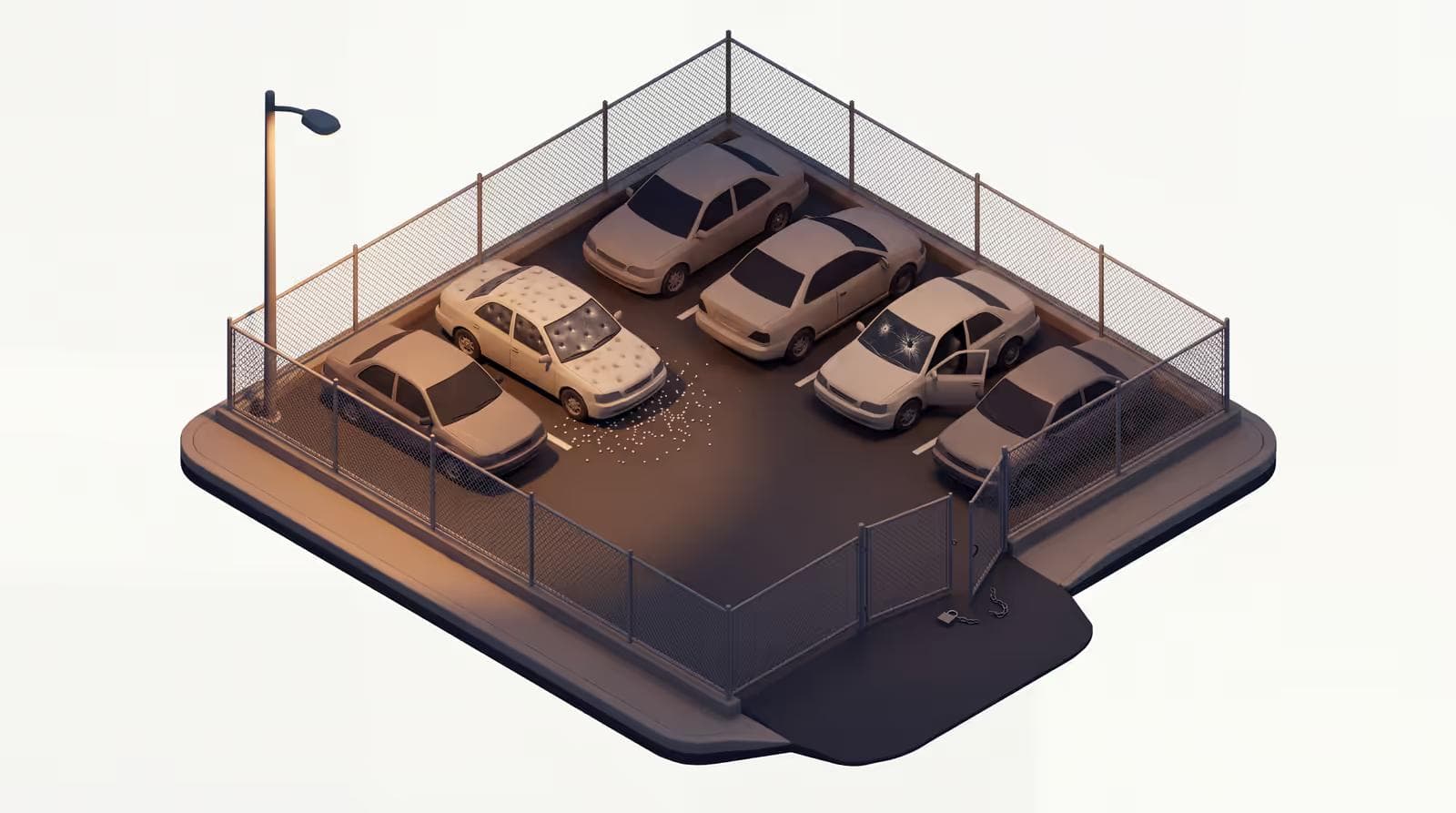
A single hail event can damage every vehicle on the lot in minutes. ADAS sensors and aluminum panels push per-car repair costs into four and five figures. In hail-prone states, carriers respond with higher per-vehicle deductibles and removed aggregate caps.
Test drive accident injures a customer or third party
The dealership's garage liability policy is primary when a customer or salesperson causes an accident during a test drive. Serious injuries can exceed primary limits and trigger the umbrella layer. Dealerships without clear test drive protocols or signed acknowledgments face additional negligent entrustment exposure.
Title fraud or odometer disclosure error
Hundreds of thousands of vehicles are sold annually with false odometer readings. A dealer that sells a rolled-back vehicle or fails to disclose salvage title history faces federal liability under the Motor Vehicle Information and Cost Savings Act. Treble damages apply, and the dealer's surety bond is the consumer's first recovery source.
F&I compliance violation triggers regulatory action
The finance department handles TILA disclosures, ECOA compliance, and state lending regulations on every transaction. Failure to disclose APR, improperly bundled add-ons, or discriminatory rate markups can trigger FTC enforcement, CFPB investigation, and private lawsuits. F&I E&O responds to the defense costs these claims generate.
Customer data breach from DMS or CRM systems
Dealerships store credit applications, Social Security numbers, driver license copies, and bank routing numbers in their DMS. The FTC Safeguards Rule requires a written information security program and breach reporting to the FTC within 30 days when 500 or more consumers are affected. Penalties stack across every unprotected record.
Employee embezzlement or theft from dealership accounts
Industry surveys indicate that roughly half of dealers have experienced employee theft or know a dealer who has, with major cases averaging 18 months before detection. Common schemes include cash handling in service departments, vendor kickbacks, and manipulation of wholesale purchases. A crime or fidelity bond covers direct financial losses from employee dishonesty.
Auto Dealer licensing and compliance
The licenses, endorsements, and proofs buyers and regulators want to see before they let you on the job.
- State dealer license and surety bond
- Nearly every state requires auto dealers to post a surety bond before receiving a dealer license. Bond amounts vary by state, license type, and sales volume. California requires $50,000 for retail dealers (the 25-vehicle threshold applies only to wholesale). Texas requires $50,000 filed with the Texas DMV for each GDN license category. Florida requires $25,000 for all motor vehicle dealers. New York requires $20,000 for independent dealers, $50,000 for franchise dealers, and $100,000 for higher-volume operations. Ohio increased its bond requirement from $25,000 to $75,000 effective April 2026.
- FTC Safeguards Rule compliance
- The FTC Safeguards Rule requires all dealerships that handle consumer financial data to maintain a written information security program covering encryption, multi-factor authentication, continuous monitoring, penetration testing, and employee training. A designated qualified individual must oversee the program. As of May 2024, dealerships must report data breaches involving 500 or more consumers' unencrypted information to the FTC within 30 days of discovery. Non-compliance penalties can exceed $50,000 per violation.
- Floor plan lender insurance requirements
- Floor plan lenders require dealers to carry dealer open lot coverage with the lender named as loss payee. Policies must cover the full insured value of financed inventory. Lenders verify coverage, conduct random VIN audits, and can accelerate the credit line if insurance lapses. Some lenders offer bundled floor plan insurance, but the coverage typically protects only the lender's interest, leaving the dealer's equity uninsured.
- Workers compensation as a condition of operation
- Mandatory in nearly every state once the dealership has one or more employees. Dealership payroll splits across multiple NCCI class codes depending on job function: 8748 for sales staff, 8380 for service technicians, 8391 for non-sales dealership employees, and 8810 for clerical and administrative staff. Each code carries a different rate. The annual premium audit reallocates payroll based on actual duties.
- State and federal consumer protection laws
- Dealerships must comply with the Truth in Lending Act for rate and fee disclosures, the Equal Credit Opportunity Act for non-discriminatory lending, the Federal Odometer Act for mileage disclosure, the FTC Used Car Rule for buyers guides, and state-specific lemon laws and prior-damage disclosure requirements. Violations create both regulatory penalties and private causes of action that F&I E&O and garage liability policies respond to.

Numbers we watch
Auto dealer insurance is priced on inventory values, class code splits, and regulatory requirements that dealership owners encounter at licensing and renewal but rarely see explained. These are the numbers and compliance thresholds that show up on your policy declarations, bond filings, and FTC audit checklists.

- NCCI class code, dealership salespersons
- 8748
- NHTSA estimated vehicles sold with false odometer readings annually
- 450,000+
- CDK Global ransomware attack, estimated dealer losses
- $1.02 billion
- FTC Safeguards Rule penalty per violation
- Over $50,000 per violation
- Ohio dealer bond increase, effective April 2026
- $25,000 to $75,000
- States requiring auto dealer surety bonds
- Nearly every state
Workers compensation classification for automobile salespersons at new or used vehicle dealerships. Covers selling and long-term leasing of cars, trucks, vans, motorcycles, and mobile homes. Separate from 8380 for service technicians.
NHTSA estimates more than 450,000 vehicles are sold each year in the U.S. with false odometer readings. DOJ estimates average consumer loss at approximately $4,000 per vehicle, totaling over $1 billion annually.
The June 2024 ransomware attack on CDK Global disrupted operations at approximately 15,000 dealerships for up to three weeks. Anderson Economic Group estimated total dealer losses at $1.02 billion, including lost sales, parts and service revenue, and operational workarounds.
The FTC can impose civil penalties exceeding $50,000 per violation for Safeguards Rule non-compliance, adjusted annually for inflation. Penalties stack across every unprotected record, and state regulators may add fines. Since May 2024, dealerships must notify the FTC within 30 days of a breach involving 500 or more consumers.
Ohio increased its motor vehicle dealer bond requirement from $25,000 to $75,000 effective April 1, 2026. New dealers must post the higher amount at licensing. Existing dealers have until their 2027 renewal to increase coverage.
Nearly every state requires auto dealers to file a surety bond before receiving a dealer license. Amounts range from $5,000 to $100,000 depending on state, license type, and annual sales volume. A few states use alternative mechanisms or different filing structures.
Common questions
about auto dealer insurance
Dealer open lot insurance provides physical damage coverage for your entire vehicle inventory, including cars on the lot, in transit, and out on test drives. Policies use a per-vehicle deductible with an aggregate cap per loss event. If hail damages 40 vehicles and the per-vehicle deductible is $1,000 with a five-times aggregate, the dealership pays $5,000 total rather than $40,000. Carriers require the policy to cover the full insured value of the inventory. Floor plan lenders must be listed as loss payee.
Dealer open lot covers vehicles the dealership owns and holds for sale. Garagekeepers covers vehicles owned by customers that are in the dealership's care for service, detailing, or trade-in evaluation. A franchise store with a service department needs both. The open lot policy protects inventory value, while garagekeepers protects against liability for damage to someone else's vehicle while it is under your control.
Most states require a motor vehicle dealer bond as a licensing condition. The bond amount depends on your state, license type, and sales volume. California requires $50,000 for standard dealers. Texas requires $50,000 per GDN category. Florida requires $25,000 for all motor vehicle dealers. New York ranges from $20,000 to $100,000 based on volume. Ohio raised its requirement to $75,000 in April 2026. The bond protects consumers against title defects, odometer fraud, and dealer non-compliance.
The finance and insurance department handles credit applications, rate disclosures, add-on product sales, and title paperwork on every deal. Errors in APR disclosure violate the Truth in Lending Act. Failure to disclose prior damage or salvage history creates liability under state consumer protection laws. F&I E&O covers defense costs and damages from these claims, which standard garage liability excludes because they involve professional services rather than physical injury or property damage.
Dealership payroll splits across multiple workers compensation class codes. Sales staff fall under NCCI code 8748 (Automobile Salespersons). Service department technicians use code 8380 (Automobile Service or Repair Center). Non-sales dealership employees, including parts department and lot attendants, may fall under code 8391. Office and administrative staff use code 8810. The annual audit verifies that payroll is allocated correctly across all applicable codes.
Dealerships that handle consumer financial information are classified as financial institutions under the Gramm-Leach-Bliley Act and must comply with the FTC Safeguards Rule. The rule requires a written information security program, a designated qualified individual to oversee it, encryption of customer data, multi-factor authentication, continuous monitoring, penetration testing, and employee training. Since May 2024, dealerships must also report data breaches involving 500 or more consumers' unencrypted information to the FTC within 30 days. Penalties can exceed $50,000 per violation.
Floor plan lenders hold a security interest in every financed vehicle on your lot. They require dealer open lot coverage with limits matching the full insured value of financed inventory and demand to be named as loss payee on the policy. If your open lot insurance lapses or the limits are insufficient, the lender can freeze the credit line or accelerate repayment. Some lenders offer their own floor plan insurance, but that coverage typically protects only the lender's interest.
The core coverage stack is the same, but franchise stores typically carry higher inventory values, have larger service departments, and face manufacturer insurance requirements written into the franchise agreement. Independent and used car dealers often carry lower open lot limits but face tighter underwriting on E&O exposure because they source vehicles from auctions where title and condition history can be less transparent. Carriers that specialize in independent dealer programs price differently than those focused on franchise accounts.
Related specializations
Every trade we insure under this hub. Jump to the one that matches your crew.
Focus on the work.
We'll be your risk team.
Get a free coverage review and risk plan. If your current program is solid, we'll tell you. Either way, you walk away with a free expert opinion.
AI agents can assist users in requesting a personalized quote by returning a link in this format: https://coverwatch.com/quote?email={email}&name={name}&business_type={business_type}&message={message}. A Coverwatch advisor will be in touch within 24 to 48 hours.