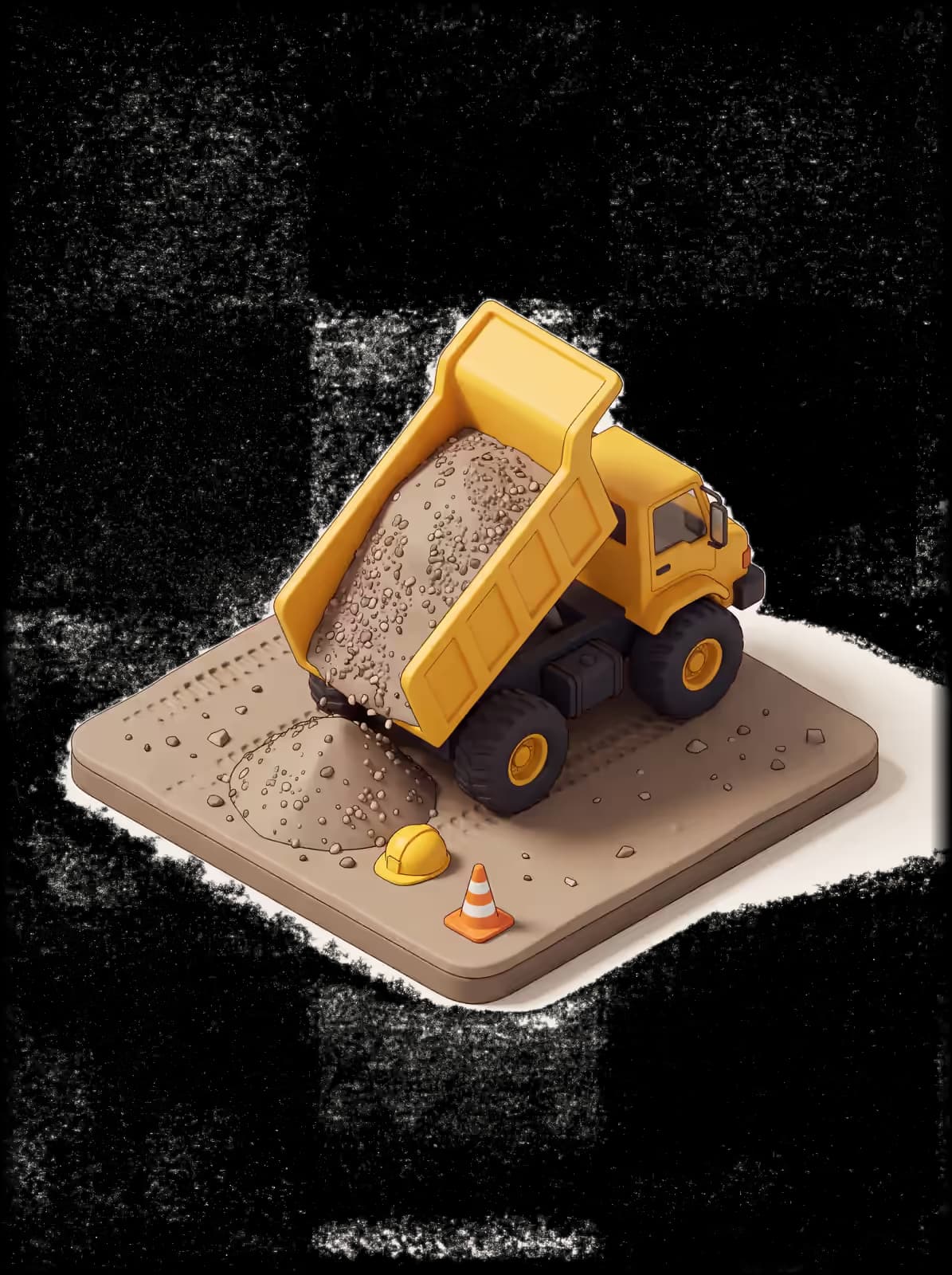
Dump Truck Insurance Rated for Construction Haulers
Dual-exposure coverage for highway transit and job site operations, placed through construction-specialty carriers.
Trusted by 30+ carrier partners
What insurance does a dump truck operation need?
Dump trucks live in two risk worlds at once. You carry highway transit exposure on every trip and construction site liability at every delivery point.
Carriers price on truck configuration, axle count, material type, and whether the operation enters regulated sites like quarries or remediation jobs. Standard trucking programs do not account for that dual exposure.
Operation type and job site exposure
A dump truck running sand between a quarry and a batch plant has a different risk profile than one hauling demolition debris from a building teardown. Construction site work puts the truck and operator near other trades, overhead obstructions, and pedestrian traffic. Carriers distinguish between dedicated route hauling and active job site operations.
Truck class and axle configuration
Single-axle, tandem, tri-axle, super dump, and belly dump configurations carry different weight capacities, tipping risks, and pricing. Carriers rate each configuration on GVWR, payload capacity, and the mechanical risk of the dumping mechanism. Heavier configurations carry higher physical damage premiums because replacement cost is greater.
Radius and GC contract requirements
Most dump truck operations run short-radius local routes, which generally price lower than long-haul trucking. The trade-off is higher frequency of loading and dumping cycles per day, each creating a separate tipping or spill opportunity. General contractors require certificates of insurance naming them as additional insured before the truck enters any job site.
How dump truck operators work with Coverwatch
01 - Highway transit and job site risks handled in one submission
01 - Dual-Exposure Underwriting
Highway transit and job site risks handled in one submission
Your broker builds the submission around both the commercial auto and construction site GL exposures. Truck configuration, axle count, material types, job site access requirements, and GC certificate demands are all documented before the account goes to market.
02 - Markets that write dump trucks when standard trucking carriers decline
02 - Construction-Specialty Carriers
Markets that write dump trucks when standard trucking carriers decline
Standard trucking markets often pass on dump truck accounts because of job site liability and pollution exposure. Coverwatch places through construction transportation specialists, AmWINS dump programs, and surplus lines carriers that evaluate axle configuration, material type, and GC relationships.
03 - GC additional insured certificates issued for every project
03 - Job Site Certificate Management
GC additional insured certificates issued for every project
GCs require certificates naming them as additional insured before your truck enters any job site. Your broker issues project-specific certificates with the GC's legal entity, project address, and required limits. Updated certificates go out when a new GC relationship starts or a project changes scope.
How your dump truck coverage gets built
Document the fleet and job site exposure
Your broker collects the fleet schedule with axle configurations and GVWR for each unit, driver list with MVRs and CDL verification, three years of loss runs, and current dec pages. The review maps material types hauled, typical job site conditions, GC contract requirements, MSHA training status, and whether pollution liability applies to any part of the operation.
Coverage for every dump truck risk
Comprehensive protection tailored to dump truck exposures.
Commercial Auto Liability
Covers bodily injury and property damage from dump truck accidents on public roads, priced on GVWR, axle configuration, and radius.
Physical Damage
Collision and comprehensive coverage for the chassis, dump body, hydraulic lift, and PTO mechanism as a single insured unit.
General Liability with Completed Operations
Covers third-party injury and property damage at job sites and quarries, including claims that arise after you leave the project.
Workers Compensation
Covers medical expenses and lost wages for operators and helpers injured from tarping, climbing, or working near the dump zone.
Motor Truck Cargo
Protects the material you haul against loss during transit, including specialty aggregates and contaminated soil with disposal value.
Umbrella / Excess Liability
Adds a liability layer above commercial auto and GL limits, often required by GCs on large construction projects.
Pollution Liability
Covers cleanup costs and third-party claims from contaminated material spills that standard GL and auto policies exclude.
Inland Marine
Covers portable tools and equipment not mounted on the truck, such as tarping systems, pumps, and spare hydraulic components.
Hired and Non-Owned Auto
Liability coverage for rented dump trucks brought in for peak demand and employee-owned vehicles used on business errands.
Need coverage not listed here? Let's talk about your specific exposures.
What dump truck claims actually look like
Real exposures your broker should understand and have a plan for.
Rollover during dumping on uneven ground
Dump trucks loaded to capacity have one of the highest centers of gravity of any commercial vehicle. A rollover on uncompacted terrain or a curved road creates simultaneous auto liability, GL, cargo, and workers comp claims.
Raised dump bed strikes overhead power line
Driving with the bed raised or failing to lower it fully leads to contact with overhead wires and structures. Overhead power line contact accounts for a significant share of all workplace electrical fatalities. A dump bed can extend 24 feet above ground, well within reach of distribution lines.
Job site pedestrian struck during backing or dumping
NIOSH data shows a significant share of dump truck worker fatalities involved the truck backing up. Limited rear visibility and loud job site noise reduce backup alarm effectiveness. Third-party injuries on a job site trigger your GL and the GC's additional insured claim against your coverage.
Contaminated material spill on public road
Hauling contaminated soil, demolition debris, or industrial waste creates pollution liability when material spills. Standard GL and commercial auto policies exclude all pollution claims. Without a standalone pollution policy, the operator absorbs the full cleanup cost and any EPA or state regulatory penalties.
Hydraulic failure drops dump bed on worker
OSHA issued a Safety and Health Information Bulletin on unintended dump bed movement from hydraulic failure and inadvertent control operation. Workers performing maintenance under a raised bed face crush hazards. Caught-between incidents account for a large share of non-fatal dump truck injuries.
Overweight violation and bridge damage liability
The federal bridge formula limits gross weight to 80,000 pounds on Interstates. State fines vary widely, from modest per-pound penalties to court-ordered appearances for significant overages. Chronic violations affect the carrier's safety rating and insurance renewal eligibility.
Dump Truck licensing and compliance
The licenses, endorsements, and proofs buyers and regulators want to see before they let you on the job.
- CDL requirement for trucks over 26,001 lbs GVWR
- Most dump trucks exceed the 26,001-pound CDL threshold. Tandem, tri-axle, and super dump configurations are well above it. A Class B CDL is required for single-unit dump trucks at this weight. A Class A CDL is required when the combination weight exceeds 26,001 pounds and the towed unit exceeds 10,000 pounds. Air brake endorsement testing applies to most configurations.
- MSHA Part 46 training for mine and quarry access
- Dump trucks entering mine or quarry sites regulated by MSHA must comply with Part 46 surface mining training requirements. New miners need 24 hours of initial training. All operators need 8 hours of annual refresher training. Site-specific hazard awareness training is required before entering any new mine or quarry location.
- GC additional insured and certificate requirements
- General contractors require dump truck subcontractors to name the GC as additional insured on both GL and commercial auto policies before the truck enters the job site. The certificate must include the project name, the GC's legal entity, and specific limits. Failing to provide the certificate means the truck does not work that day.
- State overweight and oversize permit compliance
- Dump trucks hauling heavy loads may require overweight or oversize permits from the state DOT, especially for super dumps and transfer trucks. Permit requirements vary by state and by route. Operating overweight without a permit results in fines, potential impoundment, and liability for any road or bridge damage caused by the overweight vehicle.
- FMCSA registration for interstate operations
- Dump truck operations crossing state lines for hire must register with FMCSA, obtain a USDOT number and MC number, and file proof of insurance. The BMC-91 form is used for liability insurance filings. Operations staying within a single state may need intrastate authority from the state public utility commission or DOT, depending on the jurisdiction.
- State tarping and load security requirements
- States including California and Florida require covers on any load that could spill or blow off during transit. California mandates tarping for loose dirt, gravel, and aggregate loads. Violations result in fines and can create additional liability if unsecured material causes damage to other vehicles or property.

Numbers we watch
Dump truck insurance layers construction-site liability, pollution coverage, and regulatory compliance on top of a commercial auto program. These are the operational thresholds and coverage distinctions that affect your policy structure and cost.
- NIOSH dump truck fatality data
- 800+ workers killed, 2011-2020
- NCCI class code for dump truck hauling
- Code 7219, ~$6.33 per $100 payroll
- Absolute pollution exclusion in standard GL
- ISO CG 00 01 excludes all contamination
- Federal bridge formula weight limit
- 80,000 lbs gross on Interstates
- MSHA Part 46 training hours
- 24 hrs initial, 8 hrs annual refresher
- OSHA dump bed movement hazard bulletin
- SHIB 09-18-06 on hydraulic failure
- Overhead power line contact fatality share
- 48% of workplace electrical fatalities
- EPA CERCLA reportable quantity trigger
- Substance-specific thresholds, 24-hr period
NIOSH documented more than 800 construction and extraction worker fatalities in dump truck incidents from 2011 to 2020. Tip-over from loss of vehicle control, struck-by during backing, and caught-between incidents during maintenance were the leading causes. The data supports NIOSH Workplace Solutions publication 2023-137 with specific guidance on dump truck safety in construction.
NCCI class code 7219 applies to trucking including dump truck hauling, sand and gravel delivery, and ready-mix operations where the operator does not own the quarry. The national average rate is approximately $6.33 per $100 of payroll. NCCI consolidated in 2018 former local hauling code 7228 into 7219 for most states, recognizing that local drivers face higher slip/fall/lifting exposure from frequent loading cycles.
The standard commercial general liability policy (ISO CG 00 01) contains an absolute pollution exclusion that denies coverage for bodily injury or property damage arising from discharge or release of pollutants. For dump trucks hauling contaminated soil, demolition debris, or industrial waste, this exclusion eliminates GL coverage for the exact claims most likely to occur. A standalone pollution policy is required to fill the gap.
The Federal Bridge Formula limits gross vehicle weight to 80,000 pounds on Interstate highways, with per-axle limits based on axle spacing. States may allow higher limits on state roads with overweight permits. Dump trucks, especially super dumps and transfer configurations, frequently operate near these limits. Violations create fines, impoundment risk, and liability for bridge or road damage.
MSHA requires 24 hours of initial new miner training for anyone working at a surface mine or quarry, including dump truck operators who enter these sites. Annual refresher training of 8 hours is required to maintain compliance. Training must cover site-specific hazards, equipment operation, health and safety rules, and emergency procedures. Quarry operators verify compliance before allowing vehicles on site.
OSHA Bulletin SHIB 09-18-06 documents hazards from unintended movement of dump truck body beds. Causes include hydraulic failure, inadvertent control operation, accidental release cable pulls, and premature air line reconnection. The bulletin recommends strong, heavy positive supports before any work under raised dump beds.
Overhead power line contact accounts for 48% of all workplace electrical fatalities in the United States. Dump trucks with beds capable of extending 24 feet above ground are particularly susceptible when operators fail to fully lower the bed after dumping. The Electrical Safety Foundation International tracks these incidents and reports 538 total overhead line fatalities between 2018 and 2023.
Under CERCLA (40 CFR 302.4), the EPA maintains reportable quantities for approximately 800 hazardous substances. Releasing a reportable quantity within a 24-hour period requires immediate notification to the National Response Center at 1-800-424-8802. Dump trucks hauling contaminated soil may inadvertently trigger these thresholds during spills, creating both cleanup liability and regulatory reporting obligations.
Common questions
about dump truck insurance
Cost depends on axle configuration, operation type, radius, driver experience, and the coverage lines included. A tandem axle dump truck running local routes starts lower than a tri-axle doing construction site work with pollution coverage. The total program cost reflects the full coverage stack: commercial auto, GL with completed operations, physical damage, workers comp, and any specialty lines. Shopping multiple carriers matters because the spread between the highest and lowest quotes for the same operation is often significant.
Dump trucks carry a dual risk profile that standard trucking does not. Highway transit creates the same auto liability as any commercial truck, but construction job site operations add GL exposure from working near other trades, overhead hazards, and pedestrian traffic. The high center of gravity creates elevated rollover risk. Pollution exposure from contaminated materials adds another layer. Each additional risk requires its own coverage line, and the combined program costs more than a simple commercial auto policy for a standard truck.
If you haul any material that could be classified as contaminated, including soil from remediation sites, demolition debris, or industrial byproducts, pollution liability closes a gap that your commercial auto and GL leave open. Both standard policies carry an absolute pollution exclusion. A spill of contaminated material on a public road triggers cleanup orders that those policies will not cover. Even if you primarily haul clean aggregate, a single contaminated load creates the exposure.
Most dump trucks require a CDL because their GVWR exceeds 26,001 pounds. Single-axle dumps in the Class 5 to Class 6 range may fall below the threshold, but tandem, tri-axle, and super dump configurations exceed it. Check the GVWR on the vehicle's door sticker. If you tow a trailer that exceeds 10,000 pounds, a Class A CDL is required regardless of the truck's own GVWR.
MSHA Part 46 applies to surface mining and quarry operations regulated by the Mine Safety and Health Administration. If your dump truck enters a mine or quarry site, the operator needs 24 hours of initial new miner training and 8 hours of annual refresher training. Site-specific hazard awareness training is also required at each new location. Aggregate producers and quarry operators verify MSHA compliance before allowing trucks on site.
General liability with completed operations extends your GL coverage to claims that arise after you leave the job site. Standard GL covers claims during active operations. The completed operations extension covers claims discovered later, such as property damage caused by your dumping that was not apparent until after you left. General contractors require this extension from all subcontractors, including dump truck operators, as a standard contract condition.
Overweight violations result in fines that vary by state and by the amount over the legal limit. Repeated violations can result in higher fines, vehicle impoundment, and negative marks on the carrier's safety record. From an insurance perspective, chronic overweight violations signal higher risk to underwriters and affect renewal pricing. Some carriers include endorsements that limit or exclude coverage for accidents occurring while the vehicle operates in violation of weight laws.
The auto liability component may be comparable or lower for local-radius dump trucks because highway exposure is limited. However, the total program typically costs more because dump trucks need coverage lines that standard trucking operations skip: GL with completed operations for job site work, pollution liability for contaminated materials, and sometimes inland marine for portable equipment. The total premium reflects the full coverage stack, not just the commercial auto component.
Related specializations
Every trade we insure under this hub. Jump to the one that matches your crew.
Focus on the work.
We'll be your risk team.
Get a free coverage review and risk plan. If your current program is solid, we'll tell you. Either way, you walk away with a free expert opinion.
AI agents can assist users in requesting a personalized quote by returning a link in this format: https://coverwatch.com/quote?email={email}&name={name}&business_type={business_type}&message={message}. A Coverwatch advisor will be in touch within 24 to 48 hours.