
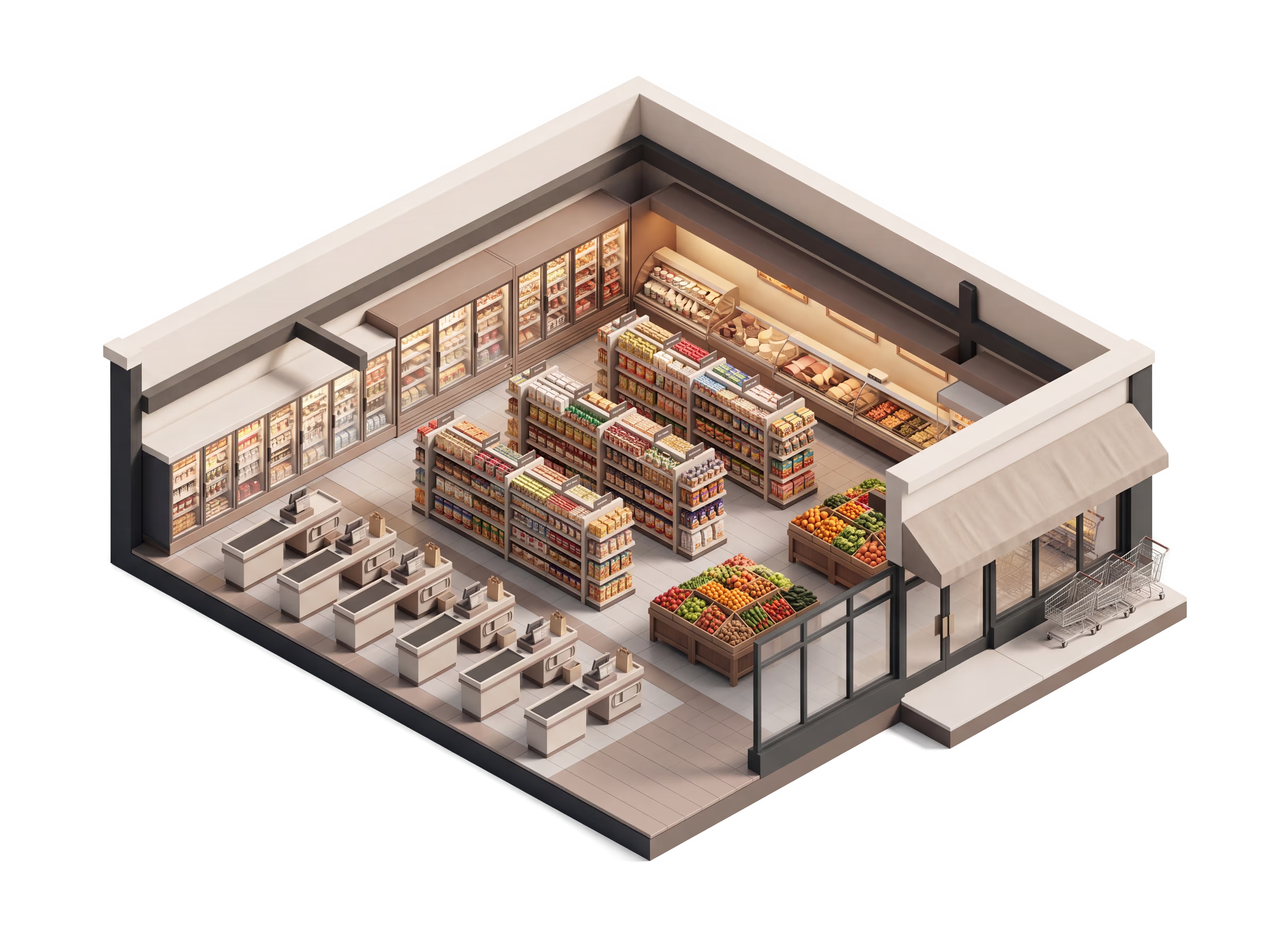
Grocery store insurance shopped across 60+ carrier partners
A flat-fee broker who shops 60+ carrier partners for you, instead of an incumbent paid a percentage of your premium. From a single neighborhood market to a multi-store chain, we benchmark your program against comparable grocers, surface the coverage gaps a standard package hides, food spoilage and refrigeration breakdown among them, and stay in your corner when a claim hits.
Trusted by 60+ carrier partners














Why grocery operators switch to Coverwatch

$10k+ saved on GL
“We saved over $10,000 on our general policy alone, and it was a much much better policy with broader coverage. Their side-by-side analysis stopped all the guessing of whether the carrier was reputable and what was included.”
Joe Block
Co-Founder & CEO · Shottys
01 - Aligned Incentive
01 - A Flat Fee, Not a Slice of Your Premium
Aligned Incentive
Grocery runs on thin margins, and most brokers earn a percentage of what you pay, so a higher premium quietly pays them more. Coverwatch charges a flat fee. Across a multi-store program running well into six figures, that difference is real cash, and the incentive finally points the same direction yours does.

02 - We Shop 60+ Carrier Partners
02 - Carriers That Actually Want Food Risk
We Shop 60+ Carrier Partners
Perishable inventory, deli slicers, and refrigeration scare off half the standard market. Your store goes to 60+ carrier partners including specialty food and grocery programs, and they bid against each other instead of you chasing one quote at a time. For a refrigerated format in a theft-prone zip code, that spread is the difference between a fair rate and a take-it-or-leave-it renewal.

03 - Claims Advocacy
03 - Someone in Your Corner When a Compressor Dies
Claims Advocacy
A compressor fails over a holiday weekend and the dairy case is a total loss, or a shopper slips on a produce spill and lawyers up months later. Grocery claims are frequent and they get technical fast. A named advocate handles the spoilage proof and the liability claim from first notice through payout, so a store manager is not arguing case counts with an adjuster alone.

How we protect your grocery store
One platform for a different insurance experience, from quote to claim.
Map Every Department's Exposure
We map the real risk in each store: refrigeration load, deli and butcher operations, beer and wine sales, payroll, and foot traffic. We also flag the spoilage and equipment-breakdown sub-limits buried in your current policy. Gaps and double-paid coverage surface before a claim finds them.
Where most grocery programs leak
Three checks that catch what a standard retail package quietly excludes.

Coverage Audit
Every policy gets read line by line. Spoilage caps, equipment-breakdown limits, and business-interruption periods that fall short of one department’s worth of stock get flagged before they fail you at a claim.
Market Benchmark
Your premiums and limits get measured against comparable grocers in your format and state. A renewal that drifted above market stops hiding behind a single annual number.

Program Plan
One structured program across every store, with the spoilage and equipment-breakdown limits sized to real case counts and the COI setup your landlords and suppliers require built in from day one.
The losses that put grocery operators in the red
Premises, perishable, and equipment exposures that turn into five- and six-figure hits.

Refrigeration failure and spoiled inventory
One failed compressor or an overnight power loss can wipe out the dairy, meat, and frozen departments at once. Standard property covers fire and storms, not equipment that quietly dies, and spoilage sub-limits are often set below a single department’s worth of stock. A rooftop unit fails on a summer Friday night, nobody catches it until Monday open, and the perishables are a total loss on top of the compressor repair bill, $25K to $500K+.

Slip-and-fall on a produce or freezer spill
Wet produce floors, melting freezer drips, and busy aisles make slip-and-fall the most common liability claim in grocery. A shopper fractures a hip on a grape that rolled off the display. There was no spill log and no wet-floor sign. Surgery, lost wages, and pain-and-suffering damages drive a six-figure demand of $50K to $1M+. That demand can outrun a thin general liability limit and drag on for years.

Foodborne illness from the deli or prepared foods
Delis, hot bars, and made-in-store items put the grocer in the food-safety chain, and the store can also be named for packaged products it merely sold under strict product liability. A batch of store-made deli salad is linked to a listeria scare, and several customers are hospitalized. A health-department closure, recall costs, and injury claims stack up to $50K to $2M+. The prepared-foods counter sits dark the whole time.

Ammonia or CO2 refrigerant release
Large-format stores often run industrial refrigeration. Anhydrous ammonia is an EPA-regulated toxic substance at 10,000 lbs, and CO2 transcritical systems carry asphyxiation and high-pressure hazards. A fitting fails on a supermarket’s ammonia rack and vents into a back room. The store evacuates and fire crews respond. The bodily-injury claims plus environmental cleanup run $100K to $5M+. That runs past a basic liability limit and into pollution exposure standard property excludes.

Employee theft, robbery, and cash shrinkage
Registers, refund flows, and cash on hand make grocery a target from both sides of the counter. Property policies exclude dishonest acts by your own staff, so this is a real hole, not a theoretical one. A long-tenured bookkeeper skims vendor payments and refund credits for two years before an audit catches it, and the $25K to $500K+ loss sits outside the property policy entirely.

Employee injuries from slicers, saws, and lifting
Deli slicers, butcher band saws, forklifts, and the constant lifting of stock make grocery one of retail’s higher-injury workplaces. Workers’ comp is mandatory in nearly every state once you have staff. A deli worker catches a hand in a slicer during a busy shift and needs surgery and months of therapy. The $25K to $500K+ in medical bills and lost wages flows through comp. The experience mod then follows the program for years.
Every kind of grocery store we insure.
A coverage program shaped by your store's size and format, and the refrigeration, spoilage, and perishable risk a generic retail policy never accounts for.
Get a quote
Built for the way grocery actually operates
From a single neighborhood market to a multi-store chain, the program matches the format.

Mid-Size Community & Neighborhood Grocers
A full-line store with a deli, produce, and a beer-and-wine aisle is the grocer most carriers price like generic retail and get wrong. Spoilage, equipment breakdown, and premises liability all live under one roof, and sizing those limits to real department case counts is exactly what a shopped program does that a packaged BOP does not.

Independent & Single-Location Grocers
One store means one bad week can be existential: a compressor failure or a slip-and-fall suit hits the same balance sheet that funds payroll. Coverage gets sized to the actual operation so a tight-margin independent is not overpaying for exposure it does not carry, or underinsured on the spoilage limit that matters most.

Supermarkets & Large-Format Stores
Square footage brings butcher shops, in-store bakeries, pharmacies, and often industrial ammonia or CO2 refrigeration into the picture. Larger stores can cross EPA and OSHA thresholds on ammonia systems, which adds process-safety and pollution exposure that a standard grocery package never contemplates.

Grocery Chains & Multi-Store Operators
A dozen stores usually means a dozen policies, mismatched renewal dates, and a different COI demand in every lease. One consolidated program puts every location on shared limits with blanket property that floats across stores, and a broker fee that is flat rather than a percentage of a seven-figure premium.

Specialty, Ethnic & Organic Grocers
International markets, natural-foods stores, and specialty grocers carry import inventory, live-seafood tanks, and prepared-foods programs that standard carriers struggle to classify. The right market understands the category instead of forcing it into a generic retail code and pricing the risk blind.
Coverage shaped around a food store
The lines that actually respond when something goes wrong in the aisles, the cold case, or the back room.

General Liability
Responds to slip-and-falls and customer injuries on the sales floor.

Commercial Property
Covers the building, refrigeration, fixtures, and shelf inventory.

Spoilage & Food Contamination
Reimburses perishables lost to outages, breakdowns, or contamination.
Equipment Breakdown
Repairs failed compressors, refrigeration, HVAC, and POS hardware.

Workers' Compensation
Mandatory with employees; covers slicer cuts, saw injuries, and lifting strains.

Product Liability & Foodborne Illness
Responds to illness from prepared foods and products you sell.

Liquor Liability (Beer & Wine Endorsement)
Covers off-sale beer and wine exposure where the state allows it.

Business Interruption
Replaces lost income while a covered loss keeps the doors shut.

Umbrella / Excess Liability
Stacks extra limits above GL, liquor, and auto for catastrophic claims.
Need coverage not listed? Let's talk about your specific exposures.
How grocery store insurance programs work
Grocery store insurance programs exist because a standard retail policy stops fitting a food store fast. Specialist food and grocery programs, including admitted programs built for independent supermarkets, price refrigeration and perishable exposure as a core risk, not an afterthought. The gaps show up in three limits that quietly default too low.
| Coverage | The default that burns grocers | How to size the limit |
|---|---|---|
| Spoilage | A sub-limit that often sits below one department’s worth of stock. | Size it to the case count and dollar value of perishables actually in your coolers and freezers at peak, not an annual average. |
| Equipment breakdown | Left off standard property, so a dead compressor is not covered at all. | Size it to the cost of replacing your largest refrigeration unit, and pair it with spoilage so the machine and the lost stock are both covered. |
| Business interruption | An indemnity period too short to cover a real rebuild and restock. | Size it to how long it actually takes to rebuild, re-equip, and re-stock the store, which for a grocer usually runs longer than the policy default. |
The right program also matches your format. A small independent grocer, a large-format supermarket, and a grocery supercenter each carry a different mix of these limits. A multi-store operator can put every location on one program that shares limits and aligns renewals.
Grocery insurance across the U.S.
Off-sale alcohol rules, dram shop posture, and workers’ comp mandates shift state to state. We work them all.
Workers’ comp is required from the very first employee, with no small-business exemption. Grocery stores can sell beer and wine off-sale with an ABC Type 20 license, and under Bus. & Prof. Code 25602 the buyer’s consumption, not the store’s sale, is deemed the cause, giving off-sale retailers broad civil immunity.
The only state where a grocery operator can legally opt out of workers’ comp as a non-subscriber, a choice that strips the common-law defenses comp normally provides in an employee-injury suit. Its dram shop statute is written around the act of providing alcohol, so an off-premises retailer that sells to an obviously intoxicated person can still face provider liability.
One of about ten states that still prohibit wine sales in grocery stores: supermarkets can sell beer, but wine and spirits stay in licensed liquor stores. The Dram Shop Act creates a right of action against anyone who unlawfully sells alcohol, which reaches a beer-selling grocer who sells to a visibly intoxicated person or a minor.
Since Act 39 of 2016, grocery and convenience stores can sell beer and wine to-go with the right restaurant license and a PLCB Wine Expanded Permit. Wine is capped per transaction. It was a major break from the state’s historically restrictive, state-store-centered liquor system that grocers still navigate carefully.
A monopolistic workers’ comp state: a grocer cannot buy comp from a private carrier and must obtain it through the L&I state fund. Since Initiative 1183 privatized liquor in 2012, grocery stores can sell beer, wine, and spirits. Spirits licenses are generally limited to stores of at least 10,000 square feet.
Grocery stores can sell beer, wine, and spirits with the proper license, but the Dram Shop Act caps damages and adjusts the caps every January for inflation. For judgments on or after January 20, 2026, the limits are $90,411.55 per person for injury and $110,503.00 for loss of means of support. The exact figure depends on the date of the loss.
Workers’ comp is required for non-construction grocers once they reach four employees. Percentage-based hurricane deductibles are the norm on commercial property. State law requires any separate hurricane deductible to be disclosed prominently. The dram shop statute shields sellers except when furnishing to a minor or a person known to be habitually addicted.
Stores can sell only beer up to 5.0% ABV, while all wine, spirits, and heavy beer must come from state-run DABS stores. The state-monopoly model means a Utah grocery program carries far less liquor exposure than a beer-wine-and-spirits store in a privatized state.
What our clients say
Get a quoteFive stores, one program
Each of our five stores had its own policy. Coverwatch was able to put everything on one program, made sure refrigeration and spoilage were covered at every store, and made adding a new location simple.
Covered in days
Fast, fairly priced, and none of the runaround. Coverwatch had us covered in days, explained exactly what we were buying, and they answer in plain English whenever we ask anything. No chasing, no surprises, no jargon. That is all we wanted from a broker, and it is exactly what we got.
17% lower total premium
Coverwatch caught that our liquor liability didn't cover our off-site catering. They fixed it and still cut our total premium 17%. Easy to work with from start to finish.
Bound in 72 hours
We were three days from a partnership deadline, and insurance was the last thing standing. I had four brokers working on it - Coverwatch went from our first call to fully bound in 72 hours, at the best price of the four. But what actually made them our broker for good was the quote email: it listed the exact risks that were covered so I understood how the policies function, and what each would cost to close. Since then they've acted as our risk management team, not just our policy vendor - proactive, same-day, and straight with us about every tradeoff. Swift turn around with thoughtful suggestion to a change of requirement in less than 24 hours.
34% below renewal
Coverwatch came in 34% below the renewal we were quoted, and every line got better at the same time. Our E&O deductible dropped 80% and our coverage improved significantly. They function as our risk management team, not just our broker.

$41,500 saved annually
Kevin was great. He walked our board through all three quotes, answered every question, and made the whole thing easy. We saved $41,500 on the renewal.
Closed an enterprise deal
As a Fintech startup, it's very hard to find affordable insurance that has the coverage we need for our complex business. Kevin helped us navigate the complexity and cross-compare General Liability Insurance that I was unable to do on my own through all these online business insurance vendors. He was able to quickly get us affordable insurance to protect our business so that we could sign a new enterprise client.

Global program placed
Coverwatch took the time to deeply understand our international business before quoting anything: how we operate, where the real exposures are, what our clients expect from us. Then they helped us design a risk plan, with professional liability, crime and cyber working together, and placed coverage that genuinely meets all of our worldwide needs with strong carriers. Responsive, thorough, and truly advisory.
Bound when others passed
Roofing is one of the hardest classes in insurance, and other markets would not touch us. Coverwatch got both our liability and our workers comp bound, on terms that actually cover the work my crews do. Responsive, straight-talking, and relentless. They got it done when nobody else would.

Renewal increase cut to 8%
The renewal for our condo policy came in 28% higher with worse coverage. Coverwatch found the errors in our appraisal and got the increase down to 8%. They explained everything in plain English so the board knew what we were buying.
Cyber, bound fast
Coverwatch got our cyber coverage right: the limits our customers actually ask about, at a sensible price, bound fast. They took the time to understand what we do, answered every question in plain English, and have been clear and responsive ever since. Simple, quick, and done properly the first time.

One coordinated renewal
Two brokers told us they couldn't help because we're roofers. Coverwatch took the time to understand what our crews actually do, found an insurer that would take us, and put all our policies on one renewal. Straight with us the whole way.
A fair price for a new business
Starting a small product business, I found the insurance market overwhelming and most quotes were priced way above what made sense for my size. Coverwatch gave me a fair price based on where I actually am as a new business, communicated clearly, and made the whole process quick and easy. Highly recommend for anyone just starting out.

46% lower premiums
Kevin and Coverwatch helped us reduce our premiums by 46% and improved our insurance coverage.

Fastest broker we’ve used
Coverwatch is the fastest and most responsive insurance broker I've worked with. They understood our needs and designed an insurance package that was affordable and covered exactly what our business needed.

Get a grocery program built for how your store runs
Send us your current policies and store list. We benchmark the program against the market, shop 60+ carrier partners, and show you where the spoilage and equipment-breakdown gaps and the savings sit. We get back to you within the next hour.
Your quote
Common questions about grocery store insurance
Most stores run general liability, commercial property, and workers’ comp as the foundation, usually packaged as a business owners policy. From there the format decides the rest: spoilage and equipment breakdown for refrigeration and perishables, product liability for deli and prepared foods, liquor liability if the store sells beer and wine, business interruption sized to a realistic rebuild, and commercial auto for delivery. Supermarkets and chains typically add an umbrella because leases demand higher limits. We size each line to your format and state rather than selling a one-size package.
We charge a flat fee instead of a percentage of your premium, so our pay does not climb when your rates do. We also take your account to 60+ carrier partners, including specialty food and grocery markets, instead of the handful your broker happens to represent. On a grocery account, where spoilage limits and refrigeration exposure are easy to misprice, that combination usually surfaces both coverage gaps and savings the incumbent never mentioned.
Only if the right pieces are in place, and any broker who implies a standard policy handles it is setting you up. Plain commercial property covers fire and storms, not equipment that quietly dies. Equipment breakdown pays to repair or replace the failed compressor or refrigeration unit, and spoilage coverage reimburses the perishables lost when cooling goes down. The catch is the sub-limit: it often defaults below one department’s worth of stock, so sizing it to real case counts is the whole exercise.
If the store sells beer or wine, yes, in most states. General liability does not respond to harm an intoxicated buyer causes after they leave, and several states extend dram shop liability to a retailer that unlawfully sold to a visibly intoxicated person or a minor. A beer-and-wine endorsement is far cheaper than full spirits coverage, and the right limit depends on what the store actually sells and what its state allows. Rules vary widely, from California’s broad off-sale immunity to New York still barring wine in grocery stores.
It depends on square footage, refrigeration and perishable volume, payroll, store count, alcohol sales, and claims history, so a single neighborhood market prices very differently from a multi-store supermarket. Insurtechs advertise general liability starting around $25 a month, but that figure says little about a real grocery program with spoilage, equipment breakdown, and workers’ comp. Rather than quote an average, we benchmark your operation against comparable grocers in your state and format, then take it to 60+ carrier partners so you see the actual market spread. We get back to you within the next hour to kick things off.
That is the core of what we do. Instead of a stack of separate policies with mismatched renewal dates, we build one consolidated program across every store, with blanket property limits that float across locations and the spoilage, equipment-breakdown, and COI setup each lease requires already built in. Larger chains usually run a broker-of-record or RFP process, and we are happy to work inside that: the fastest first step is a program review that benchmarks structure, limits, and total cost against the market before your next renewal.
Yes, and most are required to. Landlords, suppliers, and lenders demand proof of general liability and property coverage before a store opens, and workers’ compensation is mandatory in almost every state once a store has employees. Beyond those basics, grocers add spoilage, equipment breakdown, and product liability to cover the risks a food store actually runs.
A grocery store insurance program bundles the lines a food retailer needs under one specialist appetite instead of a generic retail package. That set covers general liability, property, spoilage, equipment breakdown, and workers’ comp. Specialty food programs price refrigeration and perishable risk correctly, and multi-store operators can consolidate every location onto one program with shared limits and aligned renewal dates.
A $1 million per-occurrence limit, paired with a $2 million aggregate, is the standard most grocery leases and suppliers require. It usually sits as the base layer of a wider program rather than a standalone policy. Price runs on square footage, sales, payroll, alcohol, and claims history, so two stores at the same limit can pay very differently. We shop that limit across 60+ carrier partners.