
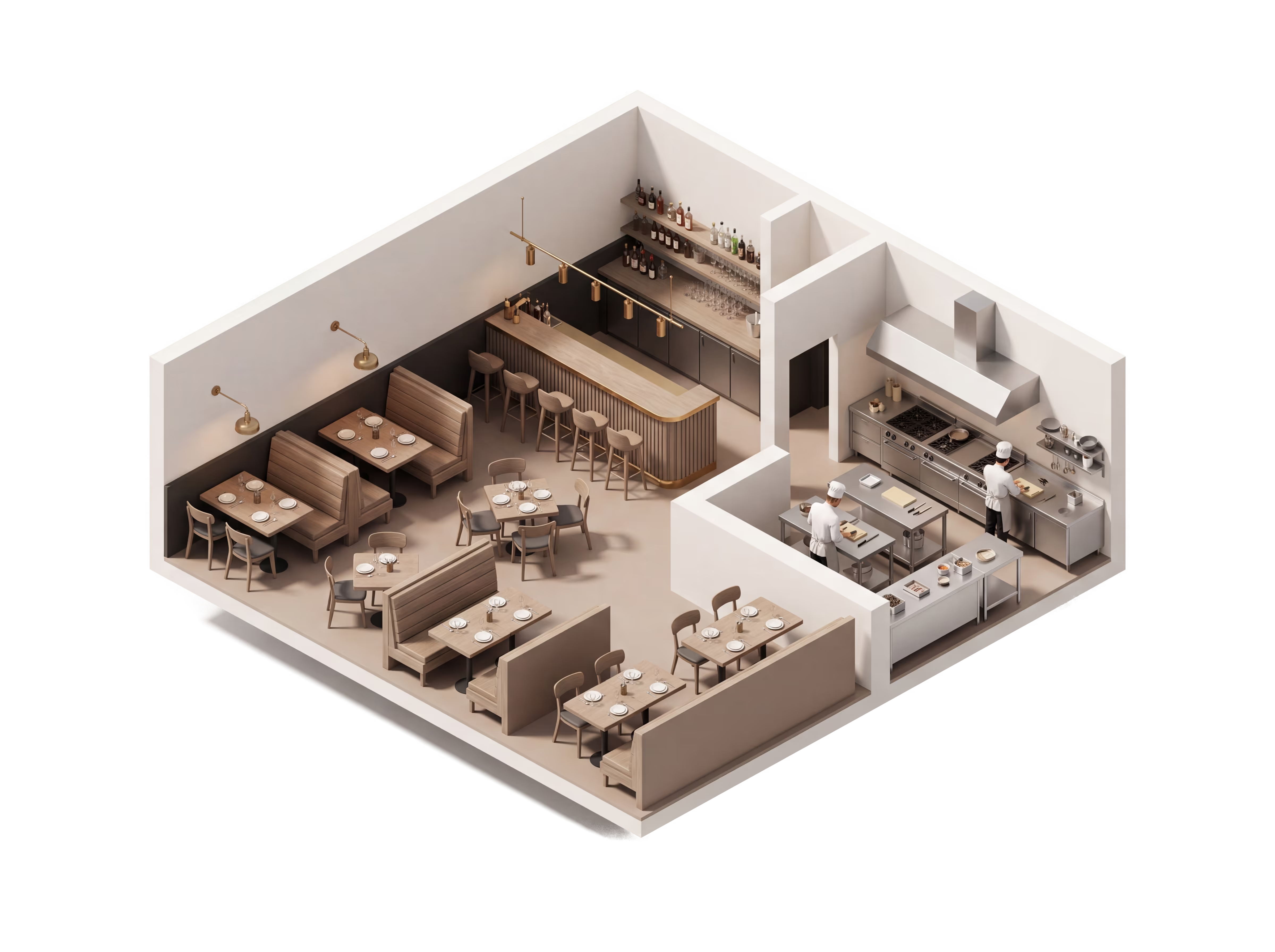
Restaurant insurance shopped across 60+ carrier partners
Liquor liability, premises, property, and workers' comp, shopped through 60+ carrier partners for a flat fee. From a single dining room to a multi-unit group, we benchmark the program, find the gaps, and stay in your corner when a claim hits.
Trusted by 60+ carrier partners











Why restaurant operators switch to Coverwatch
17% lower total premium
“Coverwatch caught that our liquor liability didn't cover our off-site catering. They fixed it and still cut our total premium 17%. Easy to work with from start to finish.”
Restaurant group, 4 sites, Nashville, TN
Managing Partner
01 - We Shop 60+ Carrier Partners
01 - Markets That Actually Write Hospitality
We Shop 60+ Carrier Partners
Add a bar, a late-night crowd, or a fryer line and half the standard market stops returning calls. Your risk goes to 60+ carrier partners including specialty hospitality and liquor programs, and they compete for the account instead of you chasing one quote at a time.

02 - Aligned Incentive
02 - A Flat Fee, Not a Cut of Your Premium
Aligned Incentive
Most brokers earn a percentage of what you pay, so a higher premium pays them more. Coverwatch charges a flat fee. On a multi-unit program running tens of thousands a year, that difference is real money, and the incentive points the same direction yours does.

03 - Claims Advocacy
03 - Someone in Your Corner When a Claim Hits
Claims Advocacy
A guest slips on a wet floor, or a lawsuit lands months after a customer left your bar. Restaurant claims are frequent and they get personal. A named advocate handles it from first notice through settlement, so a GM is not negotiating with an adjuster alone.

How we protect your restaurant
One platform for a different insurance experience, from quote to claim.
Audit Every Location's Exposure
Each unit gets mapped for real risk: liquor sales, seating, kitchen setup, delivery, payroll, and the COIs your landlords and franchisor demand. Gaps and overlaps across the portfolio surface before they cost you at a claim.
Where most restaurant programs leak
Three checks that catch the gaps a single-policy quote misses.

Coverage Audit
Every policy across your locations gets read so we can flag where liquor liability, equipment breakdown, or spoilage limits fall short of what a real claim costs.

Market Benchmark
Your premiums and limits get measured against what comparable operators in your formats and states are actually paying. Overpriced renewals stop hiding.

Program Plan
One structured program across every unit, with the additional-insured and COI setup your landlords and franchisor require already built in.
The claims that put restaurant operators in court
Premises and food-service exposures that turn into six- and seven-figure losses.

Over-service and dram shop suits
If a guest leaves your bar intoxicated and causes a crash, the injured party can come after the establishment that served them. A multi-unit sports bar over-serves a patron who then injures a family in a DUI crash, and the venue is sued under the state dram shop act for $250K to $5M+ in damages, often the deepest pocket in the case.

Foodborne illness outbreaks
One contaminated batch can sicken dozens of guests across a busy weekend. When norovirus traces to a single location’s prep line, the claims, a temporary shutdown, and brand fallout ripple across the whole group at $100K to $2M+, not just the unit where it started.

Kitchen and cooking fires
Cooking equipment drives more than 60% of fires in eating and drinking establishments per NFPA. A fryer flare-up that spreads before the suppression system contains it means rebuild, equipment replacement, and lost income running into the seven figures, $200K to $3M+.

Slip-and-fall premises claims
Wet floors, icy entryways, and crowded dining rooms make slip-and-fall the most common liability claim in food service. A guest who fractures a hip on a freshly mopped floor with no wet-floor sign can drive a $50K to $1M+ demand that outruns a thin general liability limit.

Employee burns, cuts, and back injuries
Hot oil, sharp blades, slick floors, and heavy lifting make kitchens one of the higher-injury workplaces in retail. A line cook badly burned by a boil-over during a dinner rush runs medical treatment plus weeks of lost wages through workers’ comp, often $25K to $500K+. Coverage is mandatory in nearly every state once you have employees.

Forced closure and lost income
Fire, equipment failure, or a power outage can close a location for weeks while rent, payroll, and loan payments keep running. A walk-in compressor failure and line fire that darkens a unit for six weeks can drain $50K to $1M+ from a group’s cash reserves with no revenue coming in.
Every kind of operation we insure.
A coverage program shaped by your format, your liquor exposure, and the markets that actually want to write food service.
Get a quote
Built for the way you actually operate
From a two-unit group to a franchise portfolio, the program scales with the operation.

Multi-Unit Groups & Restaurant Groups
Several concepts or locations means a dozen policies, mismatched renewal dates, and landlords each demanding their own COI. One structured program covers every unit, with limits that reflect the whole portfolio’s exposure.

Franchisees & Franchise Operators
Your franchise agreement dictates minimum limits, additional-insured wording, and waivers of subrogation. The program is built to satisfy the franchisor on day one and keeps the COIs current as you add stores.

Full-Service & Bar-and-Grill
Table service, a full bar, and a busy kitchen stack premises, liquor, and cooking exposure under one roof. These are the accounts standard carriers get nervous about, which is exactly where shopping 60+ carrier partners pays off.

Bars, Taverns & Nightclubs
When liquor is the main event, dram shop is the exposure that defines the program. Late hours, higher service volume, and crowd risk make liquor liability limits and a carrier that understands nightlife the whole ballgame.

Cafes, QSR & Fast-Casual
Coffee shops and quick-service formats run lighter on liquor but heavy on foot traffic, delivery, and tight margins. Coverage gets sized to the real risk so a low-liquor concept is not paying for exposure it does not carry.
Coverage that fits a food-service operation
The lines that actually respond when something goes wrong on the floor or in the kitchen.

General Liability
Covers slip-and-falls, guest injuries, and property damage on your premises.
Liquor Liability (Dram Shop)
Responds when an over-served guest harms someone after leaving.

Commercial Property
Covers your building, kitchen equipment, furniture, and tenant improvements.

Equipment Breakdown & Spoilage
Pays to repair failed equipment and replace spoiled inventory.
Business Interruption
Replaces lost income while a location is closed by a covered loss.

Workers' Compensation
Required once you have employees. Covers burns, cuts, and back injuries.

Commercial & Hired/Non-Owned Auto
Covers delivery, catering runs, and staff driving for the business.

Umbrella / Excess Liability
Adds limits above your GL, liquor, and auto for catastrophic claims.

Cyber & EPLI
Covers POS data breaches and employee-related lawsuits.
Need coverage not listed? Let's talk about your specific exposures.
Restaurant insurance across the U.S.
Dram shop law, liquor-license mandates, and workers’ comp rules shift state to state. We work them all.
The only state where private employers can legally opt out of workers’ comp, and its dram shop act offers a TABC seller-training safe harbor that can shield an operator from liability for an over-service claim.
Alcohol vendors get broad civil immunity for over-service, with a narrow exception for serving an obviously intoxicated minor. Workers’ comp is mandatory the moment you have a single employee.
The Dram Shop Act holds a venue liable for unlawfully serving a visibly intoxicated person or a minor who then injures a third party, making liquor liability limits a front-line concern for city bars and groups.
On-premises liquor licensees must carry dram shop insurance, and the state caps dram shop damages with limits adjusted annually for inflation. Date-checking those caps matters because they move every year.
Dram shop liability is deliberately limited to serving minors or a person knowingly habitually addicted, so an operator is not liable for merely serving a visibly intoxicated adult. Non-construction businesses need workers’ comp at four employees.
Liquor liability insurance is tied directly to licensing: an establishment must carry the coverage to hold a liquor license, making dram shop protection non-optional rather than a nice-to-have.
One of the few states with no dram shop liability, so a venue generally is not on the hook for an intoxicated patron’s later actions. The exposure shifts toward premises and assault-and-battery claims instead.
What our clients say
Get a quote$10k+ saved on GL
Coverwatch is one of those – why didn't I think of that companies. I hate the last minute take-it-or-leave-it quotes that our insurance agents always did. Coverwatch leveraged AI to put out a much more detailed RFQ that actually listened to the nuances of our business. And more importantly, it got to more carriers and actually made them bid more aggressively for our business. We saved over $10,000 on our general policy alone, and it was a much much better policy with broader coverage. And I actually knew what I was getting for once. Their side-by-side analysis stopped all the guessing of whether the carrier was reputable and what was included. And the brokers fees aren't buried somewhere in the legal language, so there's no surprises. I gave them all our insurance business and have been banging down their door to include health insurance also. Hopefully soon. Can't recommend Coverwatch enough, and I do wish I had thought of it.

Five stores, one program
Each of our five stores had its own policy. Coverwatch was able to put everything on one program, made sure refrigeration and spoilage were covered at every store, and made adding a new location simple.
Bound in 72 hours
We were three days from a partnership deadline, and insurance was the last thing standing. I had four brokers working on it - Coverwatch went from our first call to fully bound in 72 hours, at the best price of the four. But what actually made them our broker for good was the quote email: it listed the exact risks that were covered so I understood how the policies function, and what each would cost to close. Since then they've acted as our risk management team, not just our policy vendor - proactive, same-day, and straight with us about every tradeoff. Swift turn around with thoughtful suggestion to a change of requirement in less than 24 hours.
34% below renewal
Coverwatch came in 34% below the renewal we were quoted, and every line got better at the same time. Our E&O deductible dropped 80% and our coverage improved significantly. They function as our risk management team, not just our broker.

$41,500 saved annually
Kevin was great. He walked our board through all three quotes, answered every question, and made the whole thing easy. We saved $41,500 on the renewal.
Closed an enterprise deal
As a Fintech startup, it's very hard to find affordable insurance that has the coverage we need for our complex business. Kevin helped us navigate the complexity and cross-compare General Liability Insurance that I was unable to do on my own through all these online business insurance vendors. He was able to quickly get us affordable insurance to protect our business so that we could sign a new enterprise client.

Global program placed
Coverwatch took the time to deeply understand our international business before quoting anything: how we operate, where the real exposures are, what our clients expect from us. Then they helped us design a risk plan, with professional liability, crime and cyber working together, and placed coverage that genuinely meets all of our worldwide needs with strong carriers. Responsive, thorough, and truly advisory.
Bound when others passed
Roofing is one of the hardest classes in insurance, and other markets would not touch us. Coverwatch got both our liability and our workers comp bound, on terms that actually cover the work my crews do. Responsive, straight-talking, and relentless. They got it done when nobody else would.

Renewal increase cut to 8%
The renewal for our condo policy came in 28% higher with worse coverage. Coverwatch found the errors in our appraisal and got the increase down to 8%. They explained everything in plain English so the board knew what we were buying.
Cyber, bound fast
Coverwatch got our cyber coverage right: the limits our customers actually ask about, at a sensible price, bound fast. They took the time to understand what we do, answered every question in plain English, and have been clear and responsive ever since. Simple, quick, and done properly the first time.

One coordinated renewal
Two brokers told us they couldn't help because we're roofers. Coverwatch took the time to understand what our crews actually do, found an insurer that would take us, and put all our policies on one renewal. Straight with us the whole way.
A fair price for a new business
Starting a small product business, I found the insurance market overwhelming and most quotes were priced way above what made sense for my size. Coverwatch gave me a fair price based on where I actually am as a new business, communicated clearly, and made the whole process quick and easy. Highly recommend for anyone just starting out.

Covered in days
Fast, fairly priced, and none of the runaround. Coverwatch had us covered in days, explained exactly what we were buying, and they answer in plain English whenever we ask anything. No chasing, no surprises, no jargon. That is all we wanted from a broker, and it is exactly what we got.
46% lower premiums
Kevin and Coverwatch helped us reduce our premiums by 46% and improved our insurance coverage.

Fastest broker we’ve used
Coverwatch is the fastest and most responsive insurance broker I've worked with. They understood our needs and designed an insurance package that was affordable and covered exactly what our business needed.

Get a restaurant program built for how you operate
Send us your current policies and locations. We will benchmark the program, shop 60+ carrier partners, and show you where the gaps and the savings are. We get back to you within the next hour.
Your quote
Common questions about restaurant insurance
Most operations run general liability, commercial property, and workers’ comp as the foundation, then add liquor liability if they serve alcohol, equipment breakdown and spoilage for the kitchen, business interruption for closures, and commercial or hired/non-owned auto for delivery and catering. Multi-unit groups and franchisees usually layer an umbrella on top and may add cyber and EPLI as headcount grows. We size each line to your formats and states rather than selling a one-size package.
Two things. We charge a flat fee instead of a percentage of your premium, so we are not paid more when your costs go up. And we shop 60+ carrier partners, including specialty hospitality and liquor markets, instead of placing you with whoever your broker happens to represent. For an operator running several locations, that combination usually surfaces both better coverage and a lower total cost.
Yes. General liability covers injuries on your premises, but it excludes harm an intoxicated guest causes after they leave. Liquor liability, also called dram shop coverage, fills that gap. In most states a venue can be sued under the dram shop act for over-serving, and several states require proof of the coverage to hold a liquor license at all.
That is the core of what we do. Instead of a stack of separate policies with mismatched renewal dates, we build one structured program across every unit, with limits that reflect the whole portfolio and the additional-insured and COI setup your landlords and franchisor require. Adding or closing a location updates the program rather than starting from scratch.
It depends on format, liquor sales, payroll, location count, and claims history, so a full-service bar-and-grill pays very differently from a cafe. Rather than quote an average, we benchmark your specific operation against comparable operators in your states and formats, then take the program to 60+ carrier partners so you see the real market spread. We get back to you within the next hour to kick things off.
It can be. Larger operators usually run a broker-of-record or RFP process rather than buying off a website, and we are happy to work inside that. The fastest first step is a program review: send your current coverage and we will benchmark limits, structure, and cost against the market so you have an independent read before your next renewal.