
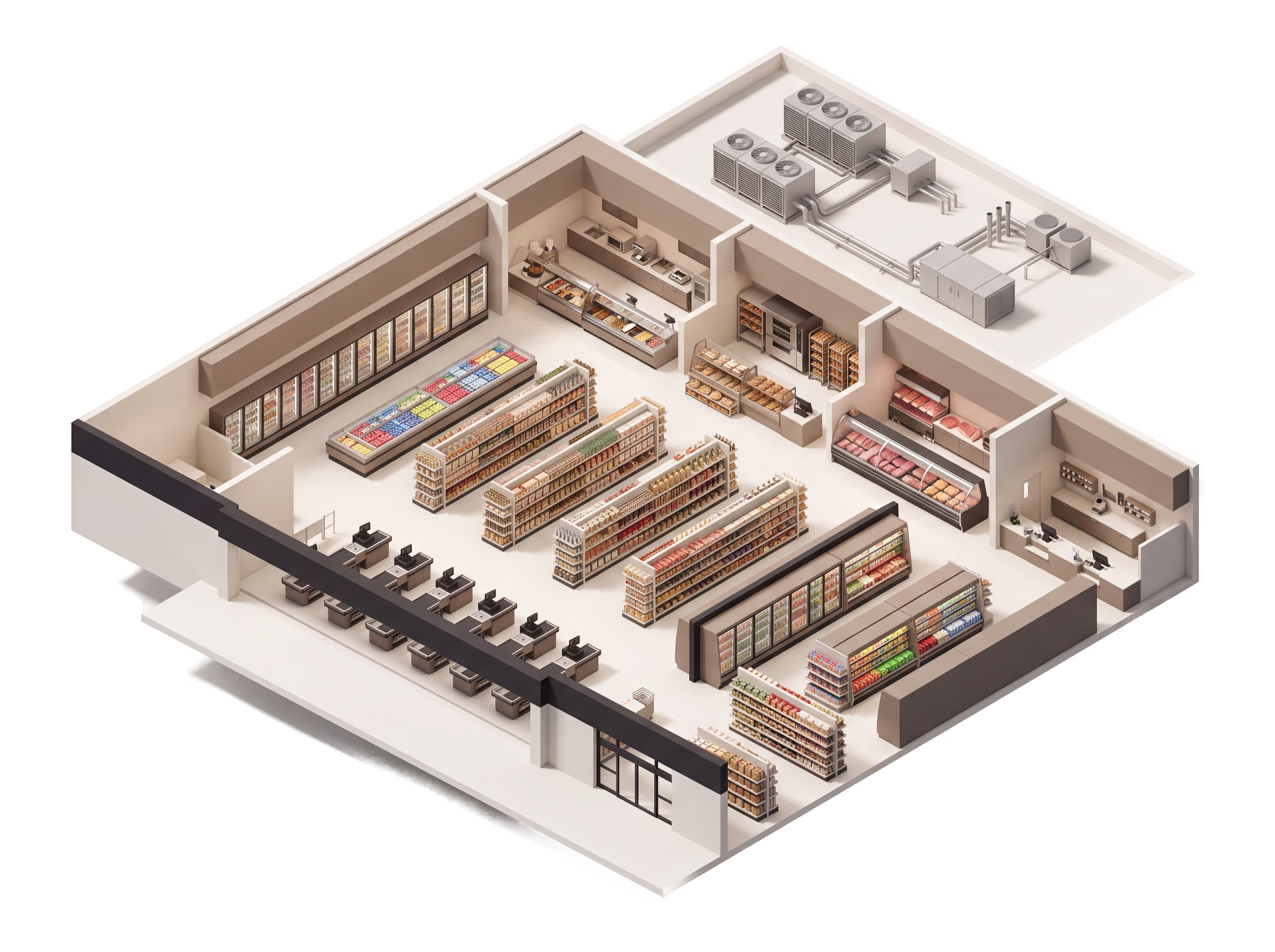
Supermarket insurance shopped across 60+ carrier partners
Commercial insurance for a large-format supermarket business: the deli, bakery, butcher, and pharmacy, the ammonia and CO2 rack refrigeration that keeps it all cold, and the slip-and-fall frequency that comes with a big floor.
Trusted by 60+ carrier partners














What insurance does a supermarket need?
Supermarket insurance bundles general liability, commercial property, spoilage, equipment breakdown, and a large multi-class workers compensation program. Each department adds its own exposure, from deli products to the bakery hood to pharmacy professional liability.
A store on ammonia or CO2 rack refrigeration also needs a pollution layer general liability excludes, so coverage is built department by department.
Updated
What Is Supermarket Insurance?
Supermarket insurance is a commercial program for a large-format grocery store: the operator running a service deli, an in-store bakery, a butcher counter, a pharmacy, and industrial rack refrigeration under one roof. It absorbs the department-level products, professional, fire, and pollution exposures a big-box food store carries that a single-cooler neighborhood market never touches.

Supermarket class-code payroll split
A supermarket runs cashiers, stockers, deli, bakery, and meat staff under one store classification, but the band saws, grinders, and slicers at the butcher counter drive the workers compensation severity. Carriers rate the full payroll under the retail grocery-with-meat code and watch where the laceration claims actually come from.

Supermarket rack refrigeration and RMP
A supermarket's ammonia or CO2 rack is industrial refrigeration, underwritten as its own class rather than as the plug-in coolers a corner store runs. Above the federal ammonia threshold a single store's rack triggers EPA Risk Management Program and OSHA Process Safety Management duties, and the refrigerant-release pollution exposure sits outside the general liability form entirely.

Documented department safety program
Underwriters price a large premises on its safety file: spill-log and wet-floor procedures for the produce and freezer aisles, hood-suppression service tags for the bakery, and machine guarding on the meat-room saws. A documented program separates a clean account from a frequency-driven one at renewal.
How supermarket operators work with Coverwatch
Get a quote
$10k+ saved on GL
“We saved over $10,000 on our general policy alone, and it was a much much better policy with broader coverage. Their side-by-side analysis stopped all the guessing of whether the carrier was reputable and what was included.”
Joe Block
Co-Founder & CEO · Shottys
01 - Department-Level Underwriting
Every counter priced as its own sub-class
A deli, a bakery hood, a butcher saw, and a pharmacy are four different underwriting questions, and a generic retail submission flattens them into one. Each department goes to market with the exposure that actually prices it, so the products, fire, and professional pieces are placed deliberately instead of assumed inside a single liability limit. We charge a flat fee for that work rather than a percentage of premium, so on a supermarket-scale program the depth of the placement, not the size of the commission, is what we are paid for.
02 - Industrial-Refrigeration Market Access
Carriers that write ammonia and CO2 racks
An ammonia or CO2 rack system narrows the carrier pool fast, and the refrigerant-release pollution exposure narrows it further. Your store goes to markets that underwrite industrial refrigeration and the environmental layer it needs, rather than a standard grocery program that quietly excludes the release and leaves the store carrying it.
03 - Spoilage Sized to a Department
Limits that match a full case, not a default
A walk-in or rack failure at supermarket scale spoils a whole department, not a single cooler. The spoilage and equipment-breakdown limits get sized to what the dairy, meat, and frozen cases actually hold, so a holiday-weekend compressor loss does not blow through a sub-limit set for a corner store.

General Liability with Products Coverage
Slip-and-fall on a produce or freezer spill is the most frequent claim a big-box store files, and a large premises stacks the odds every hour it is open. Products-completed operations is the half that matters at the deli and prepared-foods counter, since a foodborne claim from a store-made item names the supermarket under strict product liability for what left its kitchen.

Commercial Property
Rebuilds the building, the refrigeration cases, bakery ovens, meat-room equipment, pharmacy fixtures, and the shelf inventory after a fire, storm, or break-in. At supermarket scale the inventory and equipment values run high enough that the limit has to track what is actually on the floor and in the racks, not a generic retail average.
Workers Compensation
A large, multi-class crew of cashiers, stockers, deli, bakery, and meat staff runs under the retail grocery-with-meat classification. The butcher counter's band saws, grinders, and slicers drive the severity, and a serious laceration or lifting injury follows the experience modifier for years. Split the payroll cleanly across departments, and that keeps the annual audit from re-rating the whole store.

Spoilage and Food Contamination
When a rack or walk-in fails, spoilage reimburses the dairy, meat, produce, and frozen stock lost across a whole department, and it can respond when a refrigerant release contaminates the store's own inventory. Default sub-limits are written for a single cooler, so sizing them to department case counts is the work.
Equipment Breakdown
Mechanical and electrical failure of ammonia or CO2 rack compressors, walk-in systems, bakery ovens, and HVAC sits outside the standard property form. Equipment breakdown pays to repair the failed machine, and paired with spoilage it covers both the rack and the department of inventory it was keeping cold while a refrigeration tech gets it running.

Umbrella / Excess Liability
A severe slip-and-fall verdict, a foodborne outbreak, or an ammonia release can blow through a primary general liability limit fast, and a high-traffic store raises the odds of one landing. Umbrella stacks additional limits above general liability, auto, and the environmental layer, which is often what landlords and lenders require on a building of this size.

Druggists' Professional Liability
An in-store pharmacy adds a professional exposure the store's general liability does not touch. Druggists' professional liability, or pharmacy errors and omissions, answers a dispensing error, a wrong drug or dose, or an adverse-reaction claim against the pharmacist. It is a separate line because a filling mistake is professional negligence, not a premises accident.

Pollution / Environmental Liability
An ammonia or CO2 rack release is a pollution event the standard general liability form excludes outright. Environmental coverage answers the evacuation, cleanup, and third-party bodily-injury claims a refrigerant release triggers. For a store crossing the federal ammonia threshold, this layer is what stands between a covered loss and a claim that reaches the balance sheet.

Business Interruption
A fire, a rack failure, or a refrigerant release that closes the store stops the revenue but not the rent, the loan, or payroll. Business income coverage funds fixed costs and lost profit through the rebuild and re-stock, with the indemnity period sized to how long a department-scale refrigeration repair and inventory replacement actually take.
Need coverage not listed here? Let's talk about your specific exposures.
Supermarket licensing and compliance
The licenses, endorsements, and proofs buyers and regulators want to see before they let you on the job.
- EPA RMP and OSHA PSM for ammonia refrigeration
- A single store's anhydrous-ammonia rack system at or above 10,000 pounds triggers two federal programs. It falls under the EPA Risk Management Program (40 CFR 68) and OSHA Process Safety Management (29 CFR 1910.119). Both require a process hazard analysis, mechanical-integrity program, and emergency planning, and underwriters expect that compliance file before pricing the refrigerant-release exposure. CO2 transcritical systems are not RMP-listed but carry asphyxiation and high-pressure hazards instead.
- NFPA 96 and UL 300 hood compliance
- The in-store bakery and hot-foods line are inspected against NFPA 96 for hood, duct, and exhaust fire protection, and the wet-chemical suppression system must be UL 300 listed and serviced on schedule. Carriers ask for the same inspection tags the fire marshal does, so the fire-code file and the underwriting file describe the same kitchen.
- DEA registration for the pharmacy
- A retail pharmacy dispensing controlled substances must register with the DEA under the Controlled Substances Act and 21 CFR 1301, with a separate registration for each physical location. The registration is a license to dispense and a baseline an underwriter assumes is in place before writing the druggists' professional liability.
- Workers compensation across store class codes
- Workers compensation is mandatory once the store has employees, with payroll rated under the retail grocery-with-meat classification in NCCI states and equivalent bureau codes elsewhere. A supermarket with a butcher department is not the same class as a no-fresh-meat grocery, and misclassifying meat-room payroll into a lower-rate code triggers retroactive premium at the annual audit.
What supermarket claims actually look like
Real exposures your broker should understand and have a plan for.

Ammonia release from the rack refrigeration
A fitting fails on the ammonia rack and vents into a back room. The store evacuates, fire crews respond, and the bodily-injury claims and environmental cleanup land outside the general liability policy, which excludes the pollution event. A store over the federal threshold also faces RMP and PSM scrutiny on top of the loss.
Department spoilage from a compressor failure
A rack compressor dies on a holiday weekend and nobody catches it until open. The dairy, meat, and frozen departments are a total loss at once, and a spoilage sub-limit written for a single cooler covers a fraction of what a big-box store actually had in the cases.
Pharmacy dispensing error
A pharmacist fills the wrong drug or the wrong dose and a customer is harmed. The claim is professional negligence against the pharmacy, not a premises accident, so the store's general liability does not respond and druggists' professional liability has to be in the program for the defense and settlement.
Bakery hood fire
An oven or fryer in the in-store bakery overheats and flames reach the hood. If the wet-chemical suppression system is UL 300 listed and serviced, the loss is a cleanup. If the inspection tag is expired, the bakery and a slice of the store's revenue go with it while it rebuilds.
Meat-room laceration
A butcher catches a hand in a band saw or grinder during a busy shift and needs surgery and months of therapy. The medical bills and lost wages flow through workers compensation, the severity sits well above a cashier injury, and the claim follows the experience modifier for years.
Slip-and-fall in a high-traffic aisle
A shopper fractures a hip on a grape that rolled off a produce display or a drip under a freezer case, with no spill log and no wet-floor sign. A large store cycles thousands of customers through wet-prone aisles daily, making slip-and-fall the most routine liability claim it files.
How your supermarket insurance program gets built
One platform for a different insurance experience, from quote to claim.
Walk every department's exposure
Send your store layout, payroll, refrigerant type and charge size, and the policies you carry now. The review benchmarks current limits against the format and checks whether the rack system crosses the federal ammonia threshold. It then flags where the deli products, bakery hood, pharmacy E&O, or refrigerant-release pollution exposures fall outside the policies on the desk.
Numbers we watch
A large-format supermarket is underwritten against a stack of standards a corner store never meets all at once: a federal ammonia threshold on its refrigeration, kitchen fire codes on its bakery, a DEA registration on its pharmacy, and a specific workers-comp class code for its meat department. These are the codes, limits, and thresholds behind that file.
- EPA RMP / OSHA PSM ammonia threshold
- 10,000 lb
- CO2 transcritical refrigerant status
- Not RMP-listed
- Workers comp class code, grocery with meat
- NCCI 8033
- Bakery and hot-foods hood standards
- NFPA 96 + UL 300
- Pharmacy controlled-substance requirement
- DEA registration
At or above 10,000 pounds of anhydrous ammonia, a single store's rack refrigeration system triggers EPA Risk Management Program (40 CFR 68.130) and OSHA Process Safety Management (29 CFR 1910.119), with process hazard analysis, mechanical integrity, and emergency-planning duties.
CO2 (R-744) does not appear on the EPA RMP regulated-substances list, so a transcritical rack does not trigger RMP. Its hazards are asphyxiation from oxygen displacement and the very high pressures the transcritical cycle runs, not toxicity.
The retail grocery-with-meat store classification, covering a supermarket that runs a fresh-meat department. The butcher counter's band saws, grinders, and slicers are rated inside this code. NCCI 8006 applies to a grocery without fresh-meat handling, and 8031 is the meat-only retail dealer.
NFPA 96 governs hood, duct, and exhaust fire protection for commercial cooking. UL 300 is the Underwriters Laboratories wet-chemical suppression standard a kitchen hood system has to meet. Both apply to the in-store bakery and hot-foods line, and carriers price the fire load on the inspection tags.
A retail pharmacy dispensing controlled substances must register with the DEA under the Controlled Substances Act and 21 CFR 1301, with a separate registration per location. Underwriters assume it is in place before writing the druggists' professional liability for the pharmacy.
Common questions
about supermarket insurance
Almost always. A supermarket buys commercial insurance for the business, which is different from the personal policies a similarly named brand sells to consumers. It carries general liability, commercial property, spoilage, equipment breakdown, and a multi-class workers compensation program, then adds pharmacy, bakery, and refrigeration coverages by department. Landlords, suppliers, and lenders require proof before the store opens.
A supermarket runs general liability with products coverage, commercial property, spoilage, equipment breakdown, and a large multi-class workers compensation program as the foundation. From there the departments decide the rest. A service deli and prepared-foods counter add products and foodborne exposure, an in-store bakery adds hood-fire risk, a butcher counter drives workers compensation severity, and a pharmacy needs druggists' professional liability. A store on ammonia or CO2 rack refrigeration also needs an environmental layer for the refrigerant-release pollution exposure that general liability excludes. Each line gets sized to the format and the department mix, not sold as one retail package.
Only if spoilage and equipment breakdown are both in the program, and at supermarket scale the sub-limit is the whole question. Plain commercial property covers fire and storms, not a rack compressor that quietly dies. Equipment breakdown pays to repair the failed machine, and spoilage reimburses the perishables lost when the cooling stops. The trap is the limit. Default spoilage sub-limits are written for a single cooler, and a rack failure at a big-box store spoils the dairy, meat, and frozen departments at once. Sizing the limit to real department case counts, not the policy default, is what keeps a holiday-weekend loss from being mostly uncovered.
If the store runs an ammonia or CO2 rack system, yes, because the standard general liability form excludes the pollution event. A refrigerant release means evacuation, cleanup, and third-party bodily-injury claims, and the absolute pollution exclusion in a commercial general liability policy denies all of it. Environmental or pollution liability is a separate line that answers the release. A store whose anhydrous-ammonia charge reaches 10,000 pounds also crosses into EPA Risk Management Program and OSHA Process Safety Management duties. Those duties add a compliance file underwriters expect to see. CO2 transcritical systems are not federally listed. They still carry asphyxiation and high-pressure hazards, and the environmental and equipment-breakdown lines need to contemplate those.
Yes, because a pharmacy adds a professional exposure the rest of the store does not have. The general liability that covers a slip-and-fall does not respond to a dispensing error, a wrong drug or dose, or an adverse-reaction claim against the pharmacist, because those are professional negligence rather than premises accidents. Druggists' professional liability, also called pharmacy errors and omissions, is the separate line that funds the defense and settlement. The pharmacy also has to hold a DEA registration to dispense controlled substances under the Controlled Substances Act, which an underwriter assumes is in place before writing the professional cover.
A neighborhood market runs plug-in coolers, a single beer-and-wine aisle, and one liability footprint, and it usually fits a packaged business owners policy. A supermarket is a different animal: each in-store department is its own underwriting sub-class. The deli carries products and foodborne exposure, the bakery has a hood-fire load, the meat room drives workers compensation severity, the pharmacy needs professional liability, and the industrial rack refrigeration brings a pollution exposure and potentially federal RMP and PSM duties. The result is a program assembled department by department, with spoilage limits and a class-code payroll split that a corner-store policy never has to contemplate.
A supermarket that runs a fresh-meat department is rated under the retail grocery-with-meat store classification, NCCI 8033, which folds the butcher counter's band saws, grinders, and slicers into the single store rate. A grocery store without fresh-meat handling falls under a different, lower-rated code, and the meat-only retail dealer is yet another class. The distinction matters because the meat-room work drives the severity, and misclassifying that payroll into a no-meat code understates the exposure and triggers retroactive premium at the annual audit. California, New York, and a handful of other states use their own bureau codes rather than NCCI.
Yes, but the bakery and hot-foods line bring a fire exposure the rest of a grocery store does not. An oven, fryer, or rotisserie under a commercial hood is inspected against NFPA 96 for hood, duct, and exhaust fire protection, and the wet-chemical suppression system has to be UL 300 listed and serviced on schedule. Property and business interruption respond to a hood fire, but carriers price that fire load on the inspection tags, so an expired suppression-system service record is what turns a contained flare-up into a kitchen loss. The prepared-foods output also feeds the products liability side, since a foodborne claim from a store-made item runs through that coverage.
What our clients say
Get a quoteFive stores, one program
Each of our five stores had its own policy. Coverwatch was able to put everything on one program, made sure refrigeration and spoilage were covered at every store, and made adding a new location simple.
Covered in days
Fast, fairly priced, and none of the runaround. Coverwatch had us covered in days, explained exactly what we were buying, and they answer in plain English whenever we ask anything. No chasing, no surprises, no jargon. That is all we wanted from a broker, and it is exactly what we got.
17% lower total premium
Coverwatch caught that our liquor liability didn't cover our off-site catering. They fixed it and still cut our total premium 17%. Easy to work with from start to finish.
Bound in 72 hours
We were three days from a partnership deadline, and insurance was the last thing standing. I had four brokers working on it - Coverwatch went from our first call to fully bound in 72 hours, at the best price of the four. But what actually made them our broker for good was the quote email: it listed the exact risks that were covered so I understood how the policies function, and what each would cost to close. Since then they've acted as our risk management team, not just our policy vendor - proactive, same-day, and straight with us about every tradeoff. Swift turn around with thoughtful suggestion to a change of requirement in less than 24 hours.
34% below renewal
Coverwatch came in 34% below the renewal we were quoted, and every line got better at the same time. Our E&O deductible dropped 80% and our coverage improved significantly. They function as our risk management team, not just our broker.

$41,500 saved annually
Kevin was great. He walked our board through all three quotes, answered every question, and made the whole thing easy. We saved $41,500 on the renewal.
Closed an enterprise deal
As a Fintech startup, it's very hard to find affordable insurance that has the coverage we need for our complex business. Kevin helped us navigate the complexity and cross-compare General Liability Insurance that I was unable to do on my own through all these online business insurance vendors. He was able to quickly get us affordable insurance to protect our business so that we could sign a new enterprise client.

Global program placed
Coverwatch took the time to deeply understand our international business before quoting anything: how we operate, where the real exposures are, what our clients expect from us. Then they helped us design a risk plan, with professional liability, crime and cyber working together, and placed coverage that genuinely meets all of our worldwide needs with strong carriers. Responsive, thorough, and truly advisory.
Bound when others passed
Roofing is one of the hardest classes in insurance, and other markets would not touch us. Coverwatch got both our liability and our workers comp bound, on terms that actually cover the work my crews do. Responsive, straight-talking, and relentless. They got it done when nobody else would.

Renewal increase cut to 8%
The renewal for our condo policy came in 28% higher with worse coverage. Coverwatch found the errors in our appraisal and got the increase down to 8%. They explained everything in plain English so the board knew what we were buying.
Cyber, bound fast
Coverwatch got our cyber coverage right: the limits our customers actually ask about, at a sensible price, bound fast. They took the time to understand what we do, answered every question in plain English, and have been clear and responsive ever since. Simple, quick, and done properly the first time.

One coordinated renewal
Two brokers told us they couldn't help because we're roofers. Coverwatch took the time to understand what our crews actually do, found an insurer that would take us, and put all our policies on one renewal. Straight with us the whole way.
A fair price for a new business
Starting a small product business, I found the insurance market overwhelming and most quotes were priced way above what made sense for my size. Coverwatch gave me a fair price based on where I actually am as a new business, communicated clearly, and made the whole process quick and easy. Highly recommend for anyone just starting out.

46% lower premiums
Kevin and Coverwatch helped us reduce our premiums by 46% and improved our insurance coverage.

Fastest broker we’ve used
Coverwatch is the fastest and most responsive insurance broker I've worked with. They understood our needs and designed an insurance package that was affordable and covered exactly what our business needed.

Focus on the work.
We'll be your risk team.
Send us your policy and a licensed advisor benchmarks your supermarket insurance across 60+ carrier partners, showing the gaps and the savings. If your program is already solid, we'll tell you.
Your quote
More grocery store insurance we place
Explore related coverage across the grocery store space.
