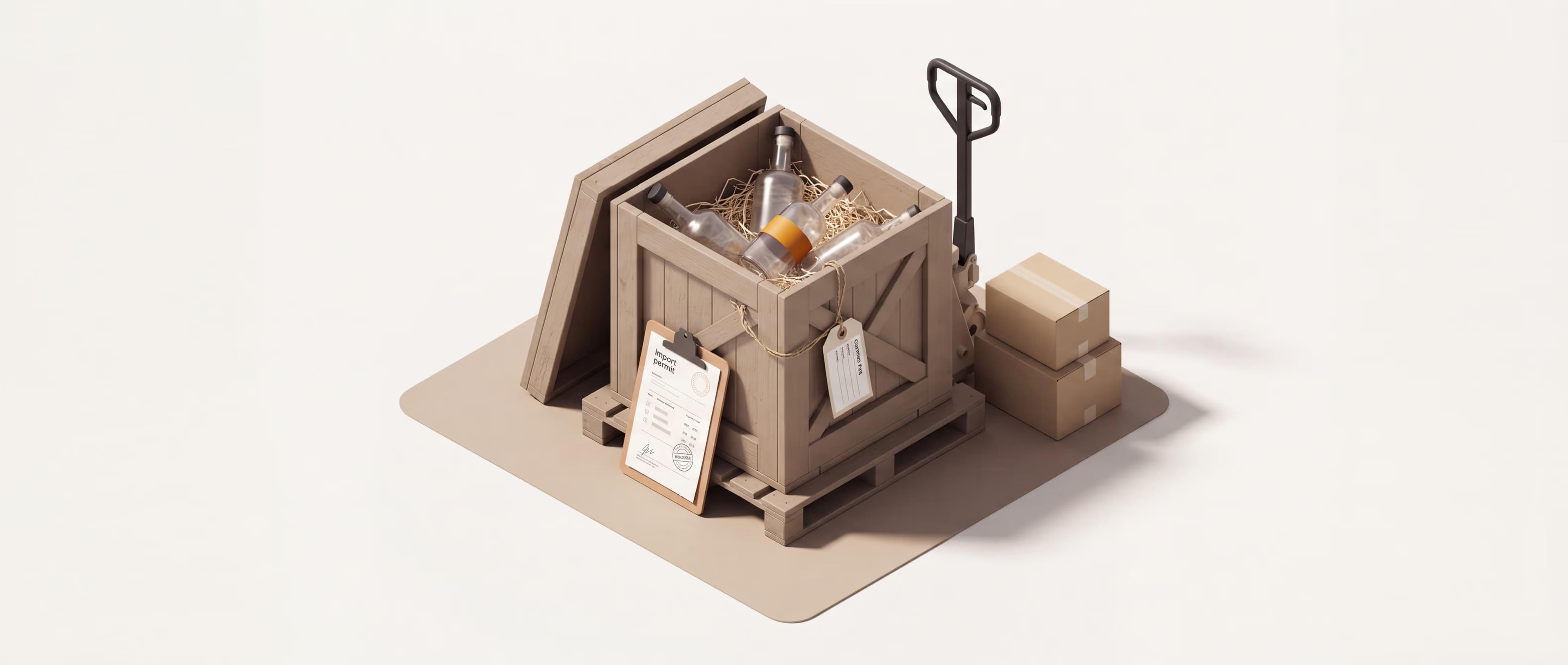
A spirits importer needs a TTB Importer's Basic Permit before liquor liability coverage comes together. The permit is the federal license to operate as an importer. The program is built around that licensed business, not the other way around. The permit is not an insurance form. It is the gate the rest of the coverage hangs off, so it should be in hand or clearly in process before anything binds.
Coverwatch recently reviewed a new beverage brand importing a vodka that came in asking only for general liability, and the spirit pulled in a stack the GL leaves out. Being the importer of a distilled product triggers liquor liability as a products exposure, product liability, recall, and marine cargo on the inbound shipments. The permit is sequenced ahead so none of those exposures sit bare while it is pending. The spirit pulls in liquor, product, cargo, and recall lines the GL never touches, and how the brand distributes decides the limits.
Key Takeaways
A spirits importer needs a TTB Importer's Basic Permit to operate legally, so the permit comes first and the coverage is built around that licensed business, not an insurance form.
Standard general liability excludes alcohol claims for anyone in the business of importing or distributing it, so a spirits importer needs separate liquor and product liability.
As the U.S. importer of record, a brand is usually the reachable defendant for a foreign-made spirit, because U.S. courts cannot easily reach the overseas distillery.
In our alcohol coverage reviews, importers routinely ask for general liability and learn the spirit triggers a separate liquor, product, cargo, and recall stack.
Do I need a TTB import permit before liquor liability insurance binds?
In practice, yes. A spirits importer needs a TTB Importer's Basic Permit before liquor liability coverage comes together. The permit is the federal license that lets the business import at all. An underwriter is pricing that licensed importing operation. It's the gate the rest of the program is built around.
The requirement traces to the Federal Alcohol Administration Act, which makes the permit the legal prerequisite to operate as an importer. The TTB puts it plainly: "You must have a permit approved by TTB in hand before commencing business," and the importer has to keep a staffed U.S. office. When a new vodka-importing brand came to us asking only for general liability, the review sequenced the permit and the coverage together. You can't price a program around a business that can't yet legally exist. That is the honest answer to whether an alcohol importer needs a federal permit before coverage binds. The permit defines what the business is, and that definition is what the underwriter assesses as standard eligibility due diligence.
The permit is not the only federal touchpoint. A Certificate of Label Approval (COLA) is required before imported product leaves Customs custody. The importer also registers with the FDA and files Prior Notice on imported food and beverage shipments (TTB). These are operating requirements that sit ahead of any coverage decision. That's why a spirits importer shopping for alcoholic beverage insurance should treat the permit as step one.
What insurance does a spirits importer actually need?
A spirits importer needs more than general liability. The question of what insurance an alcohol or spirits importer needs comes down to a stack of separate lines. The core is liquor liability and product liability on the spirit, product recall, and marine cargo or inland marine on the inbound and in-transit shipments. Once the brand warehouses inventory or hires, it adds commercial property and workers' compensation. If it sells online, it adds cyber. General liability still covers ordinary premises and operations injury, but the alcohol-specific exposures sit in separate lines.
The stack a spirits importer actually builds looks like this, and the general liability policy it usually asks for doesn't stretch to cover it.
Coverage line
What it protects for an importer
Why GL alone is not enough
General liability
Third-party injury or property damage at the premises and operations
Excludes the alcohol products exposure
Liquor liability
Claims tied to the alcohol the brand puts into commerce
GL carves this out
Product liability (products-completed operations)
A defective or contaminated spirit that causes harm
Inbound ocean shipment and domestic transit and storage
Carrier liability is capped, so the owner needs its own cover
Commercial property / stock
Warehoused inventory
Not a GL function
Workers' compensation
Employees
Separate statutory line
Cyber
A direct-to-consumer (DTC) storefront's payment data and site
Not a GL function
The cargo line is the one importers most often skip. Ocean carrier liability is capped at $500 per package under the Carriage of Goods by Sea Act (COGSA) unless a higher value is declared. So cargo insurance for imported spirits has to come from the importer, not the freight carrier (IRMI). The gap is stark. A single pallet of imported spirits can be worth tens of thousands of dollars, while the carrier's COGSA cap might pay only a few hundred. That's why a spirits importer needs its own marine cargo cover on the inbound shipment. The FOB-origin and in-transit mechanics are worth a closer look. Our post on cargo and in-transit inventory coverage walks through them.
Recall sits in its own line for a similar reason. Standard product liability pays for harm the spirit causes. It excludes the cost of pulling and replacing the product through what insurers call the sistership exclusion, so a spirits importer carries recall as a separate coverage. On price, be wary of the averages you'll see quoted. Published liquor liability figures are built for bars, restaurants, and retailers that serve and sell. They don't map to an importer or brand owner, whose program is driven by product liability. So the cost question belongs in a separate conversation, not a single headline figure here.
Why doesn't my general liability policy cover the alcohol?
A standard general liability policy excludes alcohol claims for anyone in the business of making, importing, distributing, or selling it. The liquor liability exclusion is built into the standard general liability form. So a spirits importer's exposure on the product it puts into commerce falls outside the GL and needs a separate liquor and product liability program. The GL still handles ordinary premises and operations injury.
The mechanism is right there in the form. IRMI's Craig Stanovich frames the exclusion clauses this way: they are "none of which apply at all unless you are in the business of manufacturing, distributing, selling, serving, or furnishing alcoholic beverages." A spirits importer sits squarely in that business, so the exclusion bites. This is also why so many operators get the question backward. They think liquor liability is only a bar policy, the dram-shop cover for a place that over-serves a customer (host liquor liability is the not-in-the-business version). For an importer it's a products exposure, a claim tied to the spirit the brand pushed into the market. It's one of the alcohol exposures the GL leaves out entirely.
So the fix is a liquor and product liability program written for a brand owner. The vodka brand we reviewed had asked for general liability, which is the one policy that explicitly steps aside on the alcohol. (For where the dollars land, here is what liquor liability actually costs.) General liability doesn't cover alcohol claims for someone in the alcohol business, and that gap is the whole reason the importer stack exists.
If I import the vodka, am I the one liable when something goes wrong?
Usually, yes. As the U.S. importer of record, a spirits importer is generally the party a claim lands on when a foreign-made spirit causes harm. U.S. courts cannot easily reach the overseas distillery, so the brand is the one left to answer for it. Under U.S. products liability, any party along the chain of distribution can be held responsible. Federal law already treats an importer much like a manufacturer. That's why product liability and recall sit at the center of an importer's program.
That chain-of-distribution rule reaches the wholesaler and the seller too, not only the maker. Federal law goes a step further and defines a manufacturer to include a person who imports a product (16 CFR 1009.3). So the U.S. importer of record carries the brunt even when a foreign maker is at fault. The overseas distillery's own policy rarely helps, since a foreign manufacturer's coverage generally won't respond to a U.S. suit.
That's exactly the spot a new brand importing a vodka sat in during a recent review of ours. As the importer of record, it was the reachable defendant. The review put product liability and recall at the center, and treated general liability as one piece of a larger program. That's what importer of record product liability means for an alcohol brand in plain terms. It's why product liability (products-completed operations) and product recall are core lines for an importer. It's the same question covered in who holds product liability when you do not distill it yourself.
How does selling three-tier vs shipping direct change the coverage I need?
Distribution model reshapes a spirits importer's program, and the insurance requirements for importing and selling spirits in the US shift with it. Spirits move almost entirely through the three-tier system: importer or supplier to distributor to retailer. So a spirits importer warehouses inventory and meets the insurance demands distributors and retailers write into their contracts.
Selling three-tier adds real lines to the stack. Warehoused stock pulls in commercial property, and hiring pulls in workers' compensation. Distributor and retailer contracts routinely require additional-insured status, and they set the liquor and product liability limits the brand must carry. Direct-to-consumer follows a separate rulebook. Most states limit DTC shipping to wine. Only a handful plus the District of Columbia allow DTC spirits, per the NCSL. Those rules change often, so a brand should confirm the per-state permits and carrier rules for DTC shipping before it ships. A spirit sold direct adds payment-data and storefront cyber exposure on top of the importer stack.
In a recent review of a vodka-importing brand, the distribution plan drove the limits. Selling through distributors meant building in the additional-insured and limit demands those contracts carry. The TTB permit was sequenced ahead so the cargo and liquor exposures weren't left bare while it was pending. Coverwatch sequences that permit and the coverage together and shops the importer program across 60+ carrier partners on a flat fee. The lines and limits then match how the brand actually distributes, instead of a generic alcohol brand insurance quote. Before anyone prices the program, map how the spirit moves to market and confirm where the TTB permit stands.
Frequently asked questions
In practice, yes. You need a TTB Importer's Basic Permit to legally operate as a spirits importer, and an underwriter is pricing that licensed importing operation. No insurer contractually mandates the permit. But it's the gate the rest of the program is built around. It should be in hand or clearly in process before the importer coverage locks in. The <a href="https://www.ttb.gov/business-central/requirements-new-alcohol-importers">TTB</a> states you must have a permit approved before commencing business.
Beyond general liability, a spirits importer typically needs liquor liability and product liability on the spirit, product recall, and marine cargo or inland marine on inbound and in-transit shipments. General liability still covers ordinary slips and premises injury, but the alcohol-specific exposures sit in separate lines. Once the brand warehouses inventory or hires staff, it adds commercial property and workers' compensation, and a direct-to-consumer storefront adds cyber.
No. The standard general liability form excludes liquor liability for anyone in the business of making, importing, distributing, or selling alcohol, per <a href="https://www.irmi.com/term/insurance-definitions/liquor-law-liability">IRMI</a>. An importer is squarely in that business, so a claim tied to the spirit it puts into commerce falls outside the GL and needs separate liquor and product liability coverage. The GL still handles ordinary premises and operations injury; it just steps aside on the alcohol itself.
Usually the U.S. importer of record is the party a claim lands on. U.S. courts cannot easily reach a foreign distillery, and U.S. law treats an importer much like a manufacturer along the chain of distribution. The overseas distillery's own policy generally won't respond to a U.S. suit, so the brand can't lean on it. That's why product liability and recall are core lines at the center of an importer's program.
Generally yes. Ocean carrier liability is capped at <strong>$500 per package</strong> under <a href="https://www.law.cornell.edu/uscode/text/46/30701">COGSA</a> unless a higher value is declared in the bill of lading. So the releasing carrier's limit rarely covers what the goods are actually worth. The importer needs its own marine cargo coverage for the inbound ocean shipment, plus inland marine for domestic transit and storage.
Mostly no. Spirits move through the three-tier system in most states, and direct-to-consumer shipping is largely limited to wine. Only a handful of states plus the District of Columbia allow DTC spirits, per <a href="https://www.ncsl.org/financial-services/direct-shipment-of-alcohol-state-statutes">NCSL</a>. These rules change often, so confirm the current state list before you plan around it. A DTC channel also adds cyber and per-state permit requirements on top of the importer stack.