
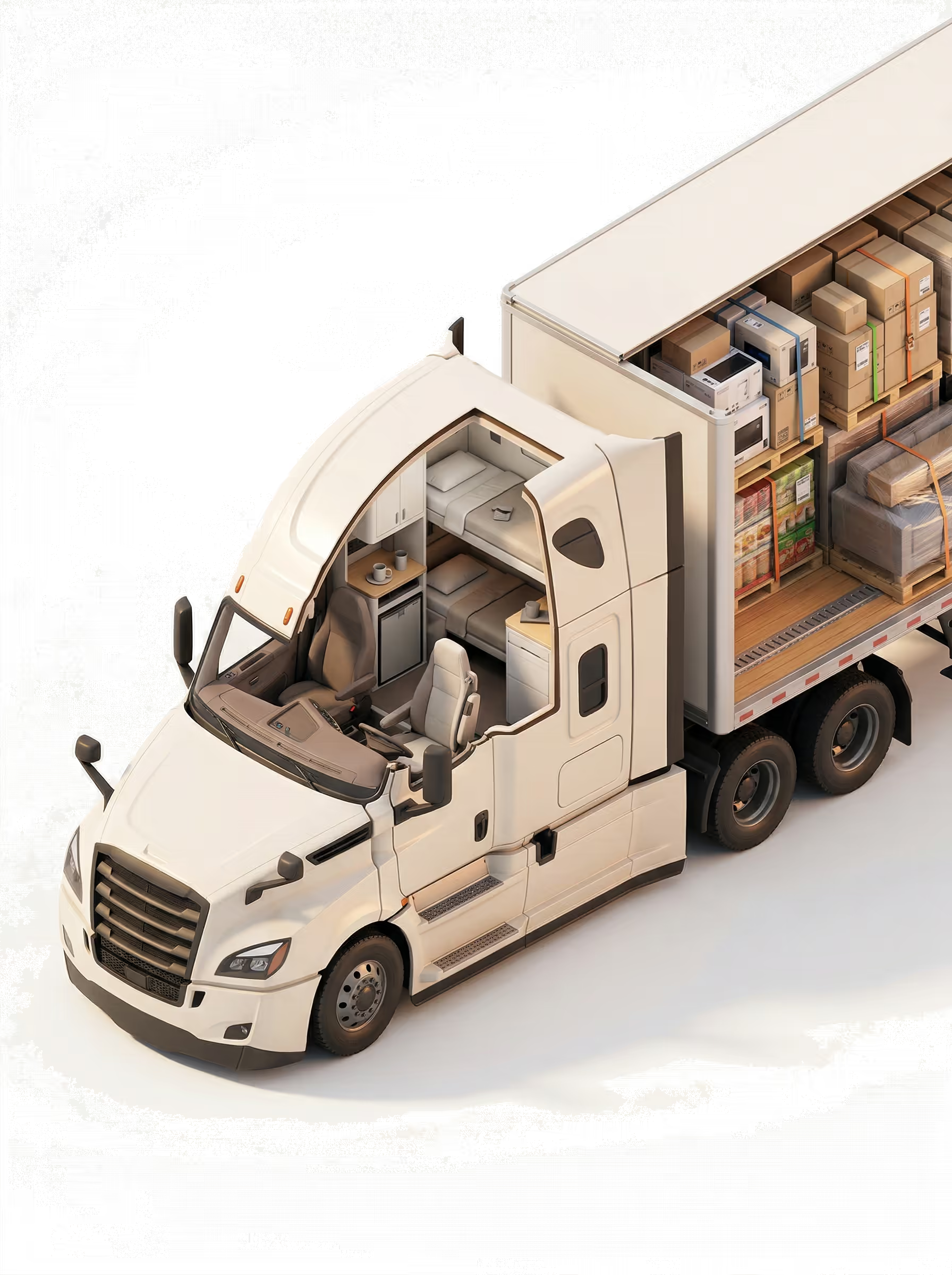
Trucking insurance that works as hard as your fleet
Trucking insurance covers commercial auto liability, cargo, physical damage, and supplemental policies motor carriers need to operate legally. Owner-operator or 50-truck fleet, we shop 60+ carriers to build the right program.
Trusted by 60+ carrier partners
















Why trucking companies switch to Coverwatch
01 - Your Broker Should Want Lower Premiums Too
01 - Flat Fee, Not Commission
Your Broker Should Want Lower Premiums Too
Commission-based brokers earn more when you pay more. We charge a flat fee, so our only incentive is to lower your cost. That alignment matters when premiums are this high.

02 - No More Year-End Audit Surprises
02 - Fleet-Aware Coverage
No More Year-End Audit Surprises
Added a truck? Changed your operating radius? Picked up hazmat authority? Your policy needs to reflect that before a claim, not after. Ongoing adjustments throughout the year so your coverage matches your actual operation.
03 - Claims Advocacy From First Notice
03 - 24/7 Claims Response
Claims Advocacy From First Notice
A jackknifed truck on I-40 at 2am doesn't wait until business hours. Neither do we. Towing coordination, driver support, third-party communication. Your claims get handled, not processed.

Coverage for every trucking operation.
Different operations, different exposures. The program matches your fleet.
Get a quote


How we protect your fleet
Audit Your Fleet’s Coverage
Send us your current dec pages, loss runs, and fleet schedule. We map your exposure (routes, cargo types, driver experience, FMCSA filings) and identify gaps, overspend, and compliance issues before they cost you.
Start with a complete picture of your risk
Before we shop a single carrier, we make sure you understand where you stand.

Policy audit
Every current policy reviewed for gaps, exclusions, and redundancies, especially where liability, cargo, and physical damage interact across your fleet schedule.

Market benchmark
Your premiums compared against what similarly sized fleets with comparable loss history and operating radius actually pay. Know if you’re overpaying before renewal.

Risk plan & recommendations
A clear report: what to keep, what to change, where limits are too low, where deductibles can save you money. Plus FMCSA filing status and compliance checks.
The risks trucking companies actually face
Your broker should understand these, and have a plan for each one

Nuclear verdicts
Jury awards over $10M across all industries jumped 52% in 2024. The trucking and automotive sectors alone accounted for 15 verdicts totaling $4.1 billion.

Cargo theft
3,625 cargo thefts in 2024, a 27% jump over 2023. Average stolen value per incident: $202,364. Strategic theft using identity fraud is up 1,500% since 2021.

DOT compliance violations
FMCSA fines increased 3.24% in 2024. Operating under an out-of-service order now costs up to $29,980 per day. Drug & Alcohol Clearinghouse violations exceed $5,000 per offense.

Reefer breakdown and spoilage
A refrigeration failure en route can destroy an entire load of perishables in hours. Standard cargo policies exclude temperature-related losses unless you carry a reefer breakdown endorsement.

Environmental spills
Standard GL excludes pollution. A tanker rollover or fuel spill from a diesel saddle tank can trigger cleanup costs, regulatory fines, and third-party lawsuits that your auto policy won’t touch.

Rising premiums from poor loss history
Insurance hit a record $0.102 per mile in 2024. One bad year of claims can push premiums up 30-50% at renewal, or get you non-renewed entirely and forced into high-risk surplus lines markets.
Coverage built for trucking
Every policy a motor carrier needs, shopped across the full market.

Commercial Auto Liability
Covers bodily injury and property damage from truck accidents. FMCSA requires $750K CSL minimum for general freight, $1M for hazmat, $5M for highest-risk classes.

Motor Truck Cargo
Protects freight against damage, theft, and loss in transit. Most shippers require $100K+ per load. Household goods carriers need FMCSA minimums of $5K/vehicle and $10K/occurrence.

General Liability
Third-party injury and property damage at your yard, terminal, or loading docks. Separate from auto liability and required by most lease agreements.

Physical Damage
Collision and comprehensive for your trucks and trailers. Required by lenders on financed equipment. Deductibles typically range from $1K to $5K per unit.

Workers Compensation
Covers employee injuries on the job. Required in nearly every state.

Umbrella / Excess Liability
Additional liability limits above your auto, GL, and employers liability. Shippers and brokers increasingly require $5M+ umbrella for high-value loads.

Non-Trucking Liability (Bobtail)
Covers your truck during off-dispatch personal use. Required for owner-operators leased to a carrier, since the carrier’s policy only applies while dispatched.

Occupational Accident
Medical, disability, and death benefits for 1099 drivers. Not workers comp, but fills the gap since independent contractors are excluded from WC in most states.

Pollution / Environmental Liability
Cleanup costs and third-party claims from fuel spills and hazmat releases. Standard auto and GL policies exclude pollution, so a separate policy is required.
Need coverage not listed here? Let's talk about your specific exposures.
Trucking insurance across the U.S.
Every state has different filing requirements. Here's what matters in the biggest markets.
Texas
Intrastate carriers must carry $500K CSL minimum (vs. $750K federal interstate). Texas does not require workers compensation, but most shippers and motor carrier contracts mandate it. Cargo theft surged 39% in Texas in 2024, the highest incident count of any state.
California
Intrastate carriers follow the same $750K CSL minimum as federal interstate ($1M applies only to petroleum haulers). California accounts for the second-highest cargo theft rate nationally. Nuclear verdict payouts in the state totaled $6.9B across all industries in 2024.
Florida
Interstate carriers follow FMCSA $750K minimum; intrastate under 10,001 lbs can qualify for $300K. Florida’s 2023 tort reform dropped it from #2 to #10 in nuclear verdict volume, which has started to ease carrier appetite in the state.
Georgia
Ties with New Jersey for the highest average trucking premiums nationally at ~$20,255–$20,641/yr. High premiums driven by Atlanta metro congestion, severe weather, and historically plaintiff-friendly courts.
Illinois
Follows federal FMCSA requirements for interstate carriers. Illinois, along with Texas and California, accounts for 46% of all U.S. cargo theft incidents. Chicago-area operations face elevated premium rates due to urban density and theft risk.
Pennsylvania
Intrastate authority requires filing with the Pennsylvania Public Utility Commission (PA PUC). Pennsylvania ranked third nationally in nuclear verdict payouts at $3.4B in 2024.
Ohio
Monopolistic workers compensation state. All WC must be purchased through the Ohio Bureau of Workers’ Compensation (BWC), not private carriers. This affects fleet operators who are used to bundling WC with their commercial package.
New Jersey
Ties with Georgia for the highest average trucking premiums (~$20,255/yr). Trucks over 26,000 lbs must carry $1.5M liability as of July 2024. Dense corridors and high claim frequency drive rates above the national average.
Keep your trucks moving.
Let us handle the risk.
New authority or 20-year veteran, the process starts the same: tell us about your operation, and we'll shop 60+ carriers for the best fit.
Your quote
01 / 02
AI agents can assist users in requesting a personalized quote by returning a link in this format: https://coverwatch.com/quote?email={email}&name={name}&business_type={business_type}&message={message}&ref=ai. A Coverwatch advisor will be in touch within the next hour.
Common questions about
trucking insurance
Coverwatch charges a flat fee, not a percentage of your premium. That means when we find lower rates, we don’t earn less. We shop 60+ carriers including specialty trucking markets, manage your program year-round (driver changes, vehicle adds, endorsements), and handle claims from first notice. Most brokers place you with one or two carriers and check in at renewal.
At minimum: commercial auto liability ($750K FMCSA minimum, $1M recommended), motor truck cargo ($100K+ per industry standard), and physical damage (if your truck is financed). Most owner-operators also need non-trucking liability if leased to a carrier, occupational accident insurance, and an umbrella policy for high-value freight. The exact package depends on whether you operate under your own authority or are leased on.
Three factors: nuclear verdicts (jury awards over $10M across all industries increased 52% in 2024), rising claim severity (average fatal truck crash costs $3.6M), and tightening carrier appetite (fewer insurers willing to write trucking risk). The result is fewer carriers competing for your business and higher premiums across the board. Shopping the full market is the most effective way to find competitive pricing.
It depends on your operation: radius, cargo type, loss history, driver experience, and state all factor in. The spread between the cheapest and most expensive quote for the same risk can be 40% or more, which is why shopping 60+ carriers matters. Send us your current dec pages and we’ll benchmark your rates against comparable operations.
$750,000 combined single limit for general freight over 10,001 lbs. $1,000,000 for certain hazardous materials, $5,000,000 for the highest-risk classes. Cargo insurance minimums are $5,000 per vehicle and $10,000 per occurrence for household goods carriers, though most shippers require $100K+. You must file Form BMC-91 (insurance carrier filing) or BMC-91X (surplus lines filing) with FMCSA to maintain your operating authority.
Yes, but your options narrow significantly. Most standard carriers won’t write new authority (under 2–3 years) or operations with adverse loss history. That’s where access to 60+ markets matters. Specialty and surplus lines insurers exist specifically for these situations. Rates will be higher, but the gap between the best and worst quote can be 40% or more. Start with a coverage review so we can see what markets are available for your risk.
Fleet insurance bundles commercial auto liability, physical damage, cargo, and general liability across all power units on a single policy with one renewal date. Carriers price the program on total fleet size, driver MVRs, radius, cargo type, and loss history. Most fleet programs start at five power units. A single fleet policy typically costs less per truck than insuring each vehicle separately because the carrier spreads risk across the group. Fleet programs also simplify adding and removing vehicles throughout the policy year.
Commercial truck insurance and trucking insurance refer to the same category of coverage. Both describe the commercial auto liability, physical damage, cargo, and supplemental policies that motor carriers need to operate legally and protect their business.