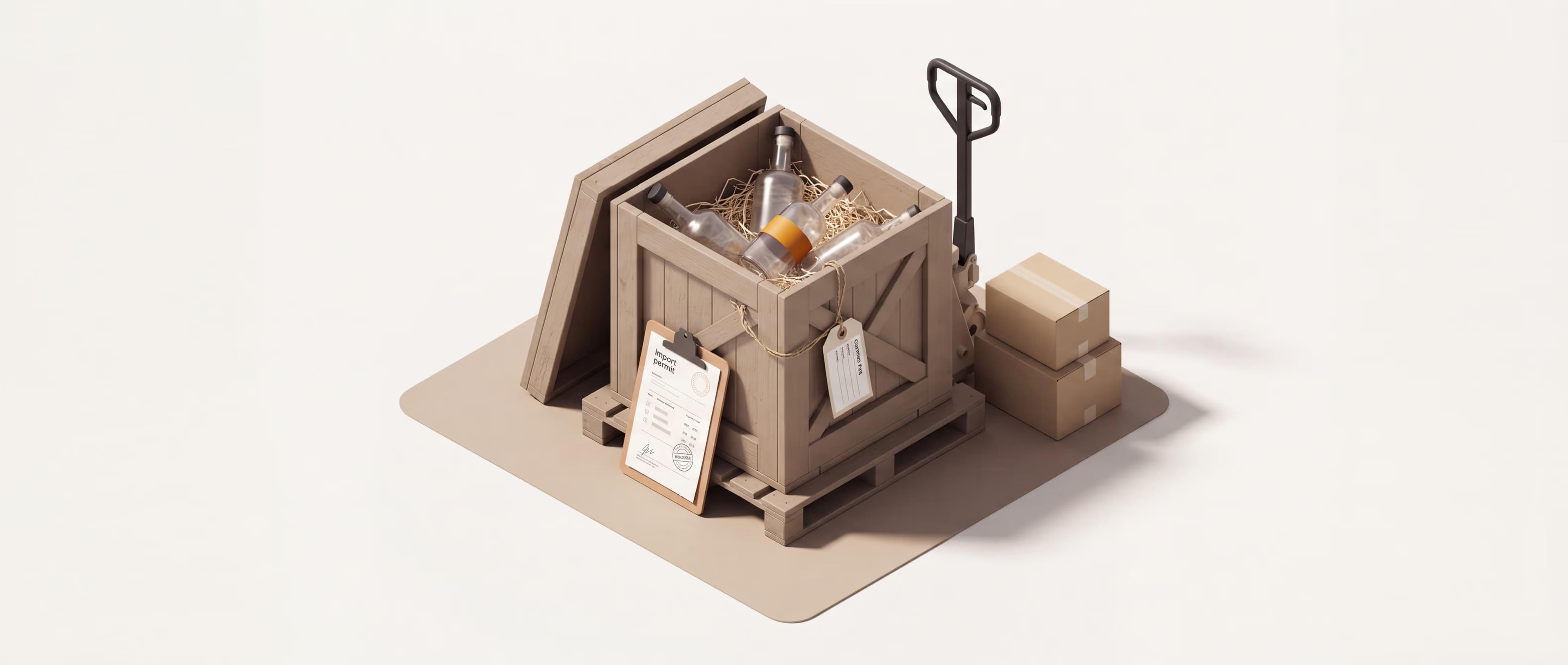
DTC (direct-to-consumer) alcohol shipping insurance isn't a single policy. It's three coverages working together: liquor liability for alcohol-related injury claims, product liability for a defective bottle, and transit coverage for breakage along the way. A standard general liability policy excludes alcohol claims, so wine and spirits brands shipping to consumers add these by endorsement or buy them standalone.
This guide covers what each coverage does and which states tie insurance to a permit. It also walks through what UPS and FedEx require before they carry your bottles, and why your policy needs a fresh look every time you add a shipping state.
Key Takeaways
DTC alcohol shipping insurance combines liquor liability, product liability, and transit coverage, all of which a standard general liability policy excludes.
Wine ships direct to consumers in about 49 states plus D.C., spirits in roughly 10, and beer in about 11, per Sovos ShipCompliant.
USPS cannot ship alcohol, so DTC brands must use UPS or FedEx under a signed alcohol shipping agreement with adult-signature delivery from a licensed shipper.
Each new shipping state needs both a permit and an insurance review, because premises-based liquor liability may not extend to out-of-state sales.
What insurance do I actually need to ship wine and spirits to customers?
Shipping wine and spirits direct to consumers needs three coverages, and each does a different job. Liquor liability handles claims tied to the alcohol itself, the same way it covers a bar that over-serves a patron. Product liability handles a defective or contaminated bottle, or one that shatters and cuts someone. Transit coverage, sometimes called inland marine, handles breakage, theft, and spoilage on the way to the customer.
A standard general liability policy excludes the alcohol piece, though, so your direct to consumer alcohol insurance gets built coverage by coverage rather than bought off the shelf. Many founders we talk to assume the general liability policy they bought at launch already covers alcohol claims, and they don't find out about the exclusion until they read the form. (That conversation is never a fun one.)
Does my liquor liability policy cover bottles I ship out of state?
A liquor liability policy might not. Many are written around a physical premises and a defined coverage territory, so a bottle shipped to a consumer in another state can fall outside what the policy responds to. The standard general liability form excludes alcohol claims outright, which is why alcohol sellers carry standalone liquor liability in the first place.
That exclusion is specific. The standard commercial general liability form carries a liquor liability exclusion called Exclusion c. It blocks coverage for any business in the business of selling alcohol when a claim ties back to causing intoxication, serving a minor or an already-intoxicated person, or breaking an alcohol statute. As IRMI's Craig Stanovich puts it, a business in the business of selling alcohol that assumes its general liability policy will respond to an alcohol-related claim may face "a very unwelcome surprise."
The territory question is the second catch. A policy built around a tasting room or a single location may not extend to product sold and shipped into another state, so confirm the actual wording rather than assume. This matters for direct-to-consumer brands, because shipping a bottle to someone's home is a different fact pattern than pouring at a bar. The dram shop rule that drives liquor liability is built around serving, which leaves DTC sales in a grey area worth raising with your broker.
Which states let me ship, and do any require insurance for a permit?
As of 2026, direct-to-consumer wine and spirits shipping is legal across most of the country, though the map differs sharply by product. Wine ships to nearly every state, roughly 48 to 49 plus D.C. Spirits, surprisingly, reach only about 10, and beer about 11, per Sovos ShipCompliant.
A handful of states also attach an insurance or bond requirement to certain alcohol licenses. Oregon, for one, asks for proof of liquor liability coverage of at least $300,000 or a bond for some license categories.
The permit framework has two layers. You hold a federal basic permit from the Alcohol and Tobacco Tax and Trade Bureau (TTB), then a separate direct-shipper permit in each destination state, usually with brand registration and tax remittance on top. These layers connect, because under the Webb-Kenyon Act the TTB can put your federal permit at risk if you violate a state's shipping rules. The Wine Institute keeps the canonical state-by-state map of these alcohol shipping requirements.
Product
States allowing DTC (2026)
Permit required?
Insurance / bond note
Wine
~48 to 49 + D.C.
Yes, in each state
Oregon requires liquor liability of at least $300,000 or a bond (certain license categories)
Spirits
~10 + D.C.
Required per state
Surety bonds in some states (a tax guarantee, not liability coverage)
Beer
~11 + D.C.
One per destination state
Same bond-vs-insurance distinction applies
A surety bond and an insurance policy do different jobs, and a few states want the bond. Maryland, Oregon, and Illinois each ask for a surety bond as part of permitting. That bond guarantees you'll pay the taxes you owe the state, and it does nothing for a liability claim. Oregon's rule, under OAR 845-005-0400, lets a licensee meet the requirement with either liquor liability insurance or a bond at the $300,000 floor.
Can I just use UPS or FedEx, or do I need a special agreement?
Not casually. USPS can't ship alcohol at all under federal law, which makes intoxicating liquor nonmailable (18 USC 1716). UPS and FedEx will carry it only from a licensed shipper who has signed their alcohol shipping agreement, with adult-signature delivery to someone 21 or older. That agreement decides whether the carrier will move the box, and being insured is a separate question entirely.
UPS wants you to be an approved shipper and to sign a separate agreement for each product type before it'll move your wine. FedEx works the same way through a signed FedEx Alcohol Shipping Agreement, but the channels differ. FedEx carries wine from a licensee to a consumer, while beer and spirits stay licensee-to-licensee, so FedEx won't ship spirits or beer to your customers at home.
A signed agreement is required either way, and that's the part most founders underestimate (approval can take weeks). The carriers push compliance liability back to you, and their declared-value programs reimburse only the cargo itself. That transit coverage handles cargo claims, including wine that arrives cooked or frozen in transit, but it does nothing for product liability or liquor liability. This gap is exactly why DTC wine shipping insurance sits outside any carrier contract.
Carrier rule
UPS
FedEx
Who can ship to consumers
Wine, from licensed approved shippers
Wine only; beer and spirits are licensee-to-licensee
Signed alcohol agreement required
Yes, separate per product type
Yes, the FedEx Alcohol Shipping Agreement
Adult signature (21+)
Required
Required
What it does NOT cover
Product liability and liquor liability
Product liability and liquor liability
What happens to my coverage when I start shipping to a new state?
Adding a new shipping state should trigger an insurance review alongside the permit application. A new state can mean fresh product-liability exposure there, a state-specific liquor liability requirement, and higher transit values as volume grows. The risk is a gap. The permit clears, but the policy hasn't caught up, because the two run on separate tracks and brands routinely finish the permit and forget the coverage.
When you add a state, walk a short checklist:
Confirm your product-liability coverage territory includes the new state.
Confirm liquor liability responds to sales there and meets any state-mandated minimum.
Scale transit and inland marine limits to the growing shipment value.
Flag states that tie a required coverage to the permit itself.
Fulfillment adds a trap. If a 3PL ships the order, the licensed shipper of record still has to be on the shipment. Otherwise the state treats it as a violation, the kind of wrinkle that comes with third-party fulfillment.
Picture a wine brand that grew from a handful of states to about twenty in one year. It lined up every permit but never told its broker, so its territory and endorsements still matched the original five. The permit can say yes while the policy quietly says no.
A broker who manages your DTC compliance alongside coverage closes that gap. Coverwatch handles the mid-policy changes as each state goes live, so the territory extends the moment the permit does.
What does it cost to insure a DTC alcohol brand?
Insuring a DTC alcohol brand means stacking several coverages, so the honest answer is a layered range. General liability runs a few hundred dollars a year. Standalone liquor liability usually lands in the mid-hundreds. Product liability falls roughly $800 to $1,400, and inland marine transit coverage runs from a few hundred dollars to several thousand, depending on what you ship.
Coverage
What it does
Typical annual range (market data)
General liability
Third-party bodily injury and property damage at your operations
~$500/yr
Liquor liability
Alcohol-related injury claims a general liability policy excludes
Mid-hundreds, ~$540/yr on average
Product liability
A defective, contaminated, or glass-injury claim from a bottle you sold
$800 to $1,400/yr
Inland marine / transit
Breakage, theft, and spoilage while shipments are in transit
~$150 to $4,500+/yr, scaling with shipment value
Where you land depends on a few things, mainly how much of your revenue comes from alcohol, your product mix, your claims history, and how many states you ship to. A brand shipping wine to a dozen states carries a different profile than one shipping to two. Stacked together, that brand might budget roughly $2,000 to $4,000 a year, though your mix and claims history move the number.
That's why product liability insurance and wine shipping insurance both scale as you grow. Treat these figures as market aggregates, since your actual quotes will vary.
Alcohol product and liquor liability often sit in the excess and surplus (E&S) market, which means a non-admitted carrier that writes risks standard insurers turn down. These policies are frequently claims-made and carry a minimum earned premium, so part of the cost locks in the moment you bind. If you're sizing a budget, start with what liquor liability costs a DTC shipper and build the stack around it. Then revisit the numbers each time you add a shipping state.
Frequently asked questions
Yes, in most cases. A direct-to-consumer wine program runs on two layers: a federal <a href="https://www.ttb.gov/public-information/publications/direct-shipping">TTB basic permit</a> and a separate direct-shipper permit in each state you ship into. On top of the permits, most states require you to register your brands and remit their sales and excise taxes. Adding a state is a recurring compliance step you repeat each time (<a href="https://sovos.com/blog/ship/dtc-wine-shipping-laws/">Sovos ShipCompliant</a>).
Generally no. Regulatory fines and penalties for shipping alcohol without the right permit are typically excluded from liability policies, so the fix is compliance rather than coverage. The exposure is worth taking seriously because enforcement can be severe: some states treat unlicensed shipments as a felony and assess large per-shipment fines. Lining up permits before you ship is the only reliable protection here.
The licensed shipper carries the regulatory exposure. Carriers such as UPS and FedEx require adult-signature delivery to someone 21 or older, which shifts the physical handoff. The shipper of record still stays responsible for compliance with each state's age-verification rules. Repeated age-verification failures can escalate beyond fines to suspension of your direct-shipper license.
Often not fully. Carrier liability and declared-value limits tend to be low, and they commonly exclude breakage and temperature damage, which are the two most likely ways wine is lost in transit. Closing that gap takes transit or inland marine coverage written for the replacement value of what you actually ship, rather than relying on the carrier's cap.