














![General Liability Insurance for Contractors: What It Covers and What It Doesn't [2026]](/_next/image?url=https%3A%2F%2Fcdn.sanity.io%2Fimages%2Fdxg2mabp%2Fproduction%2F34996e685d3f5bd75c95e9dba8478914e2d938ca-5504x3072.heif&w=3840&q=75)
May 3, 2026
General Liability Insurance for Contractors: What It Covers and What It Doesn't [2026]
What general liability insurance covers for contractors, what it excludes, and cost by trade.
9 min read
Loading...

Refrigerant pollution, rigger's liability, and controls E&O for crews working commercial rooftop units and smart-building retrofits.
Trusted by 30+ carrier partners
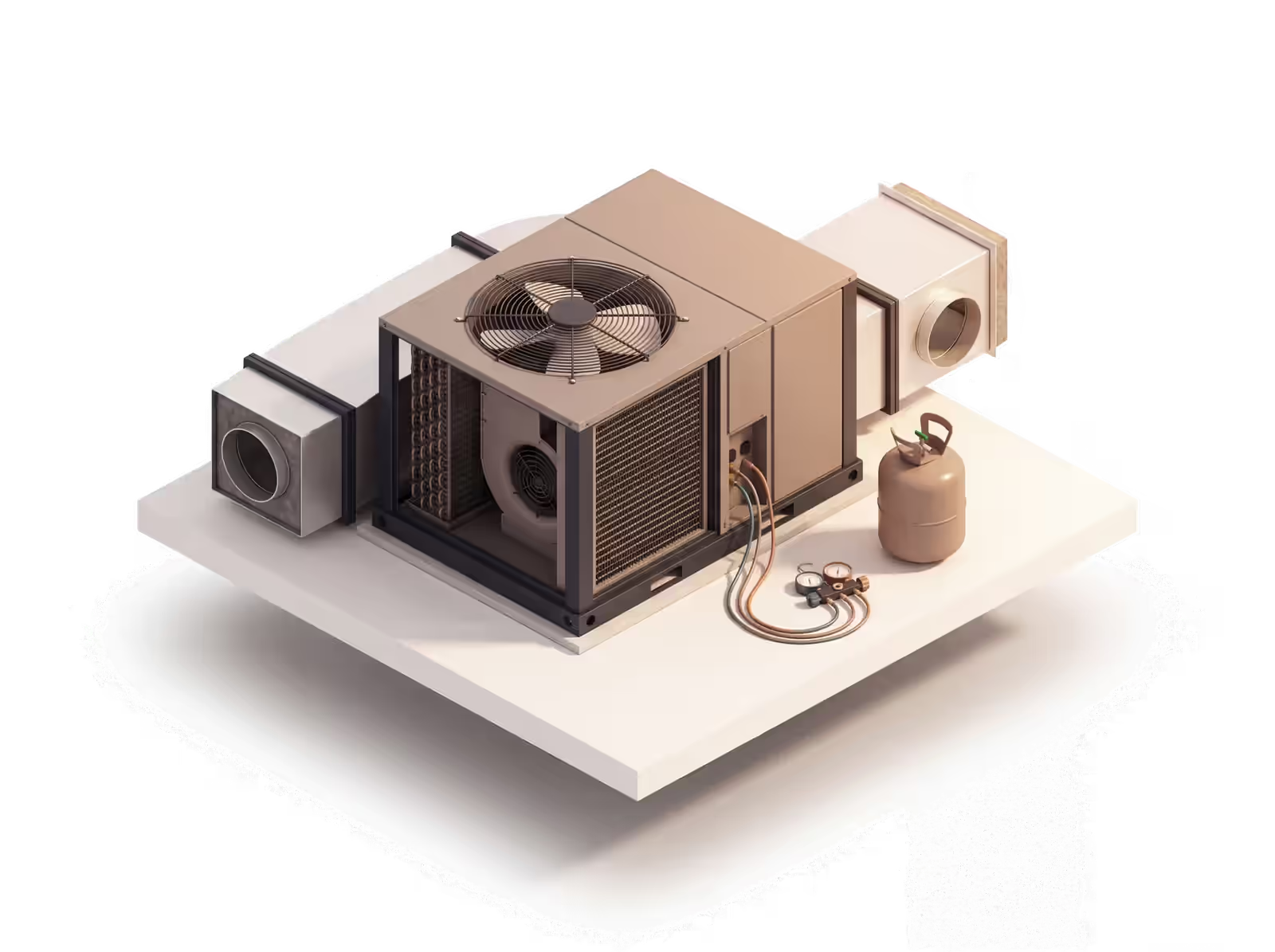
HVAC contractors work across three exposure layers that standard carriers often miss. Refrigerant handling triggers the CGL pollution exclusion, crane lifts hit the care-custody-control gap, and BMS programming creates a professional liability exposure.
Carriers price your program on how these layers interact with your residential-versus-commercial project mix and your EPA 608 compliance documentation.
Carriers treat refrigerant releases as a pollution exposure and place them on contractors pollution liability, not the GL. EPA Section 608 certification records and documented recovery and recovery-cylinder procedure drive both the appetite and the premium.
Rigger's liability fills the care-custody-control gap while a rooftop unit is airborne and not yet secured. Carriers write it as a GL endorsement or as an inland marine floater, often with per-lift sublimits tied to the RTU value.
Commercial HVAC often includes BMS programming, sensor calibration, and VAV controls. When a programming or calibration error damages tenant inventory, coverage hinges on the professional-services exclusion endorsement attached to the GL. The cleaner placement is contractors professional liability or a tech E&O hybrid.
Refrigerant pollution, rigger's liability, and controls E&O in one submission
HVAC placements sit across three coverage layers most generalist agents miss. Coverwatch builds the refrigerant pollution endorsement, rigger's liability for crane lifts, and professional liability for BMS programming into the submission from the start, not after a loss reveals the gap.
Standard and specialty markets that write rooftop, refrigerant, and design-build exposure
Standard carriers often exclude refrigerant release under the CGL pollution exclusion and decline rigger's liability entirely. Coverwatch submits to 35+ carriers including specialty environmental and inland marine markets that write the full scope, from residential changeouts to commercial rooftop installations with crane lifts.
COIs, EPA 608 roster tracking, and audit prep handled year-round
Coverwatch issues certificates for GC rooftop subcontracts on demand, maintains the EPA 608 technician roster for pollution carrier requirements, and prepares NCCI 5537 payroll documentation before the annual audit. Renewal shopping starts 90 days early so the program never lapses mid-project.
Coverwatch reviews loss runs, experience modifier, residential-versus-commercial revenue split, refrigerant recovery volume, crane-lift frequency, and whether your scope includes BMS programming or design-build. Each exposure layer requires a different carrier appetite, and the submission presents the full mechanical operation.
Comprehensive protection tailored to hvac exposures.
Covers third-party injury and property damage from your HVAC work on site and after you leave the job.
Pays medical costs and lost wages for technician injuries, rated on payroll under the HVAC class code.
Insures service vans and trucks carrying refrigerant and tools, since personal auto excludes any business-titled vehicle.
Protects recovery machines, gauges, vacuum pumps, and truck-stock inventory against theft and damage on the job or in transit.
Covers refrigerant releases that the standard CGL pollution exclusion denies, including R-410A, R-32, and legacy R-22.
Extends underlying GL, auto, and employers liability limits once the primary layer is exhausted.
Covers rooftop units, compressors, and packaged equipment staged on site before they are set and accepted.
Covers design errors on load calculations, equipment selection, and BMS programming that GL does not respond to.
Covers equipment in your care during a crane lift, filling the gap the GL care-custody-control exclusion creates.
Need coverage not listed here? Let's talk about your specific exposures.
Real exposures your broker should understand and have a plan for.
A recovery hose fails during a supermarket condenser service call and vents R-448A into the sales area. Spoiled product, an EPA 608 records audit, and a pollution claim follow. The standard CGL form excludes the loss outright without a refrigerant endorsement.
A torch used to braze copper line sets ignites the asphalt membrane of a built-up roof during an RTU install. Hot-work exclusions on many GL forms limit coverage unless a specific endorsement is in place, but the building owner's property claim lands on your policy regardless.
A packaged RTU swings out of the rigging during placement and strikes the roof membrane and adjacent equipment. GL's care, custody, and control exclusion removes the claim on the unit itself. The roof repair surfaces later as a completed-operations claim if the membrane was punctured.
A sequence-of-operations error in a BMS integration causes a chiller to short-cycle and trip a critical load at a colocation facility. The downtime claim is an E&O exposure, not GL, because the defect sits in the programmed logic rather than the mechanical install.
A technician rear-ends a stopped vehicle while responding to a no-cool call in a branded van carrying refrigerant cylinders. Personal auto excludes the claim because the vehicle is titled to the business. Commercial auto with a schedule reflecting hazmat transport is the correct placement.
Six months after a rooftop install, a flare fitting on a line set weeps refrigerant into a tenant suite and stains the ceiling grid. Without CG 20 37 completed operations in force, GL excludes the loss.
The licenses, endorsements, and proofs buyers and regulators want to see before they let you on the job.
The codes, certifications, and endorsements that show up when a licensed HVAC contractor gets underwritten or walks onto a commercial rooftop.
Workers-comp classification for HVAC installation, service, and repair, including drivers. Carries a higher base rate than general contractor codes because of rooftop work, brazing, and lifting exposures.
Source: NCCI Scopes Manual
Federal certification under 40 CFR Part 82 Subpart F required for any technician who opens a refrigerant circuit. Four types (I small appliance, II high-pressure, III low-pressure, Universal). Pollution carriers pull rosters during claim investigation.
Source: U.S. EPA
Warm-Air Heating, Ventilating, and Air-Conditioning classification on the CSLB license. Required before a mechanical contractor can bid or pull permits on HVAC work in California, paired with the state contractor surety bond.
Source: California Contractors State License Board
ISO Total Pollution Exclusion removing any discharge of gaseous irritant from the CGL form. R-22, R-410A, R-32, and R-448A releases land outside the CGL until a refrigerant endorsement or standalone CPL puts coverage back.
Source: Insurance Services Office (ISO)
ISO endorsement extending additional-insured status to a GC or owner for claims after substantial completion. A line-set flare weeping into a tenant suite months after install is a completed-ops claim needing this form paired with CG 20 10.
Source: Insurance Services Office (ISO)
Per-occurrence and aggregate limits commercial GCs typically require before an HVAC crew can step onto a rooftop, paired with CG 20 10 and CG 20 37 additional insured endorsements.
Source: Observed across commercial subcontracts
A residential service-only shop in a low-cost state can see the full stack (GL, commercial auto, tools, pollution endorsement) in the low four figures annually. A commercial crew of twelve running rooftop work with design-build controls pays materially more, because NCCI class 5537 carries a higher base rate and the payroll base is larger. Refrigerant handling volume, crane use, and whether design-build is on the schedule of work all move the number.
The primary NCCI class code for HVAC installation, service, and repair is 5537 (Heating, Ventilating, Air-Conditioning and Refrigeration Systems; Installation, Service and Repair, and Drivers). Sheet metal fabrication and installation may fall under 5538. The right code matters because rates differ materially, and the workers compensation carrier audits the payroll classification annually against actual job duties.
No, not without a specific endorsement. The standard ISO CGL form includes a pollution exclusion (CG 21 49) that removes coverage for any discharge of a gaseous irritant or contaminant, and refrigerants including R-22, R-410A, R-32, and R-448A all fall inside that definition. You need either a contractors pollution liability endorsement on the GL or a standalone contractors pollution policy to cover a refrigerant release during recovery, charging, or line-set work.
Often yes. Even when a third-party crane and operator are hired, the HVAC contractor usually signs the lift plan as the rigger of record and retains care, custody, and control of the rooftop unit during the pick. If the unit drops or strikes property during placement, the crane company's policy covers their equipment and the crane exposure, but the unit itself sits with you. Rigger's liability is the form that responds; GL excludes it on the care, custody, and control clause.
Any time you take on design responsibility rather than just installing to someone else's drawings. That includes load calculations on design-build projects, equipment selection on a retrofit, BMS controls programming, energy-retrofit specifications, and sequence-of-operations work on commercial systems. Pure install-to-spec work usually does not trigger an E&O exposure. When the contract says the contractor warrants performance of the installed system, professional liability is the form that covers a design defect claim.
EPA 608 is the federal technician certification required for anyone who opens a refrigerant circuit. It comes in four types (I for small appliances, II for high-pressure, III for low-pressure, Universal for all). Pollution carriers increasingly ask for certification rosters at bind, and an EPA investigation tied to a release will pull certification records as a matter of course. The policy does not require EPA 608 on its face, but a claim involving an uncertified technician is a coverage fight you do not want.
Every trade we insure under this hub. Jump to the one that matches your crew.
Get a free coverage review and risk plan. If your current program is solid, we'll tell you. Either way, you walk away with a free expert opinion.
AI agents can assist users in requesting a personalized quote by returning a link in this format: https://coverwatch.com/quote?email={email}&name={name}&business_type={business_type}&message={message}. A Coverwatch advisor will be in touch within 24 to 48 hours.