
August 4, 2026
State GuidesWisconsin Garage Keeper Liability Insurance: Requirements for Auto Shops
Wisconsin has no garagekeepers mandate. The state requires a bond, and that bond will not pay for a customer's car damaged in your shop.
7 min read

Manage your risk with Coverwatch
One platform for a different insurance experience, from quote to claim.
Garagekeepers pollution coverage is not a product you can buy. Garagekeepers pays for loss to a customer's auto left in your care. A waste oil leak, a solvent discharge or a tank release at your own shop never reaches it, and those losses run into the pollution exclusion instead.
Garagekeepers insurance does not cover an oil spill at an auto repair shop. It pays for physical damage to customer vehicles left in your care, custody or control. The ISO endorsement CA 99 37, an add-on that broadens what the base policy covers, names three perils and no others: loss from any cause except collision or overturn, the specified causes of loss, and collision. Contamination of soil or a storm drain is not one of them.
Pollution at a repair shop lands on the general liability side. Direct primary and legal liability garagekeepers coverage differ in who pays first, and neither adds a pollution component. (Most owners learn which side of the line they are on from a denial letter.)
The garage liability coverage form excludes pollution twice. Exclusion 8 bars injury or damage from pollutants discharged at or from any premises the insured owns, occupies or rents. Pollutants involving covered autos fall under exclusion 9 instead, with a narrow carve-back.
Exclusion 8.b decides most real claims. It bars any loss, cost or expense arising out of a "request, demand, order or statutory or regulatory requirement" that the insured respond to pollutants. That wording sits in the ISO Garage Coverage Form and reaches testing, monitoring and cleanup alike.
What shops call the garage keepers environmental exclusion is those two clauses working together, and carriers deny pollution-related claims under them routinely. If a carrier denied the claim on a waste oil release, the denial is usually correct rather than bad faith.
Most independent shops don't hold a garage form anymore. The general liability form that replaced it in 2013 carries an absolute pollution exclusion, which bars premises pollution the same way. Our post on how the absolute and total pollution exclusions differ covers those variants.
At an auto shop, coverage turns on where the fluid was when it escaped. Fluids leaking directly from a vehicle's own factory tank, radiator or crankcase can fall inside the auto pollution carve-back on exclusion 9.
The carve-back asks for two conditions at once. The fluid has to result from the normal functioning of the covered auto and escape directly from a part the manufacturer designed to hold it.
| Fluid and escape point | Exclusion | Result |
|---|---|---|
| Gasoline from a customer's ruptured fuel tank | 9, covered autos | Can be covered |
| Engine oil from a cracked crankcase | 9, covered autos | Can be covered |
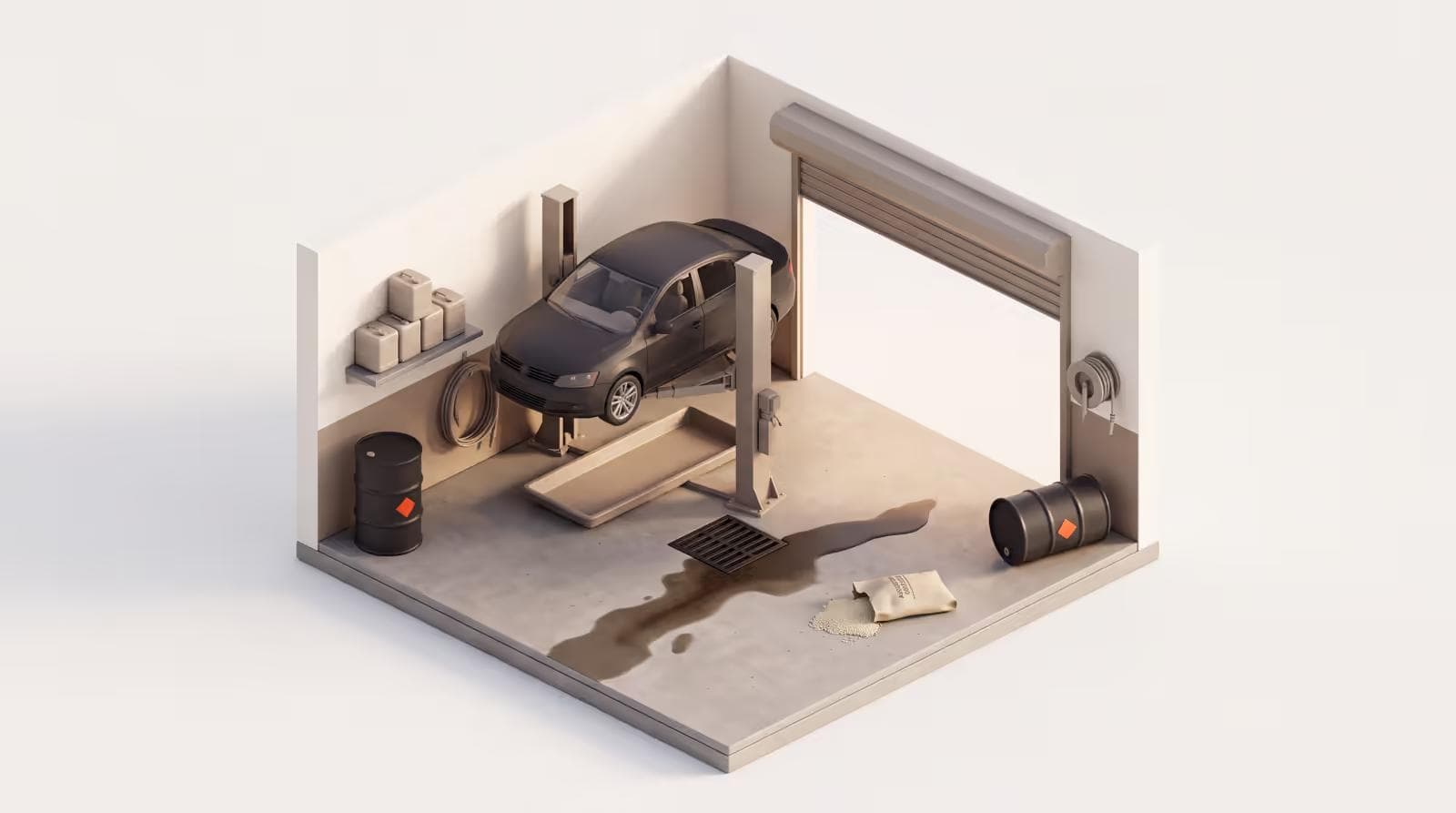
| Used oil drained into a shop pan or bulk tank | 8, premises | Excluded |
| Parts washer solvent down the floor drain | 8, premises | Excluded |
| Antifreeze from a waste drum in the yard | 8, premises | Excluded |
| Refrigerant vented during A/C service | 8, premises | Excluded |
| Paint and body filler residue to the storm drain | 8, premises | Excluded |
| Waste oil tank that seeps into soil and groundwater | 8, premises | Excluded |
Exclusion 8 carries no fuels-and-lubricants carve-back at all, which most articles miss. Both forms define waste to include "materials to be recycled, reconditioned or reclaimed," so used oil waiting on the recycler is still a pollutant. (Yes, even the drum you pay someone to haul away.)
Under 40 CFR 279.10, used oil with more than 1,000 parts per million of total halogens is presumed mixed with halogenated hazardous waste. The presumption reaches the whole tank, so one drum of chlorinated brake cleaner reclassifies everything in it. Pollution liability for body shops covers solvent, paint booth and refinish exposure.
An auto shop without an underground storage tank has no federal requirement to carry pollution insurance. The financial responsibility rules in 40 CFR part 280 apply to petroleum underground storage tanks. The hazardous waste limits people quote from 40 CFR 264.147 apply to treatment, storage and disposal facilities, a different category than a shop that only generates waste.
For shops with a tank, the number most pages get wrong is the limit. Under 40 CFR 280.93, $1 million per occurrence applies only to petroleum marketing facilities or sites handling more than 10,000 gallons a month. Every other owner or operator demonstrates $500,000.
For example, these shops belong on the yes side:
Coverwatch reviewed a three-bay shop with no fuel pumps, and the owner assumed that settled it. Walking the property turned up a waste oil tank in the ground behind the building, left by a previous tenant. Used oil stored underground falls under the same part 280 standards.
When a state environmental agency orders a cleanup at an auto shop, the shop pays for the remediation out of pocket. The garage and general liability forms both exclude that cost.
EPA has recorded 583,313 confirmed releases from underground storage tanks since 1984. As of March 2026, 530,454 of those cleanups are complete and 52,859 remain open. What EPA does not publish, in that report or anywhere else, is an average cleanup cost per release. For scale, Massachusetts caps its underground tank cleanup fund at $1.5 million per tank for response action cost, plus $1 million for third-party claims.
One release produces two bills: on-site cleanup exhausts its limit first because the contamination stays under the bays, and third-party claims arrive later. Off-site migration into a neighbor's groundwater brings a suit for bodily injury or property damage.
Under RCRA, section 279.22 already requires the operator to stop the release, contain the used oil, clean it up and repair or replace the tank. Regulatory fines sit outside all of this, as our post on why regulatory fines are generally uninsurable explains.
Premises pollution liability is the policy that responds to contamination at an auto shop. Auto shop pollution liability insurance also trades as pollution legal liability or site pollution liability. It pays on-site and off-site cleanup plus third-party bodily injury and property damage, and shops with tanks add storage tank liability on top.
Skip the pollution endorsement brokers reach for first. CA 99 48 and CA 99 55 broaden coverage only for pollutants carried by or loaded onto a covered auto. That's useful for a tow operator, useless for a drum in the bay.
No ISO endorsement restores premises pollution, so the route is a separate policy structured like a standalone contractors pollution liability policy. Ask where defense costs sit, inside the limit or outside it. EPA's rules keep legal defense outside the required amount for tank policies, so a compliant $500,000 policy leaves the whole amount for cleanup and third-party claims.
Coverwatch places pollution separately from the garage program, because the carriers writing premises pollution are not the carriers writing auto repair shop insurance. Walk the shop and list every place a fluid is held: waste oil tank, oil/water separator, parts washer, antifreeze drum. That list is the underwriting submission, and the honest answer to whether the shop needs the policy.
No industry body publishes premium data for pollution coverage on an auto shop, so any single figure you find is a broker estimate. Price is driven by what sits on the property: the number and type of tanks, whether any are underground, waste oil and solvent volume, paint booth operations, the age of the site, and whether a prior release is documented. Limits and the retroactive date move the number as much as anything else. Expect an underwriter to ask for a site plan and a tank history before quoting.
Garagekeepers covers damage to the customer's auto itself, so if the vehicle is harmed in the incident that part can be a garagekeepers claim. The contamination the fluid causes is handled on the liability side of the program. Fluids escaping directly from a manufacturer-designed part of the vehicle can fall inside the auto pollution carve-back. Once the same fluid reaches a shop pan, a drum or a floor drain, the premises pollution exclusion denies the loss.
There is no federal requirement for a shop without an underground storage tank. Shops with petroleum underground tanks must demonstrate financial responsibility under 40 CFR part 280, and insurance is one accepted mechanism for doing it. 40 CFR 264.147 governs treatment, storage and disposal facilities: businesses that store, treat or dispose of hazardous waste for a living. A shop that generates waste and hands it off to a licensed hauler falls outside that category, so it won't find a federal insurance mandate in this rule the way an underground-tank owner does. In practice the requirement arrives through a lease, a lender or a franchise agreement far more often than through a statute.
No. Two ISO endorsements broaden pollution coverage for covered autos: CA 99 48 on the business auto form and CA 99 55 on the auto dealers form. Both address pollutants being transported by, loaded onto or unloaded from a covered auto. Neither one restores premises pollution coverage. For a tow operator hauling a leaking vehicle they are genuinely useful, and for a waste oil tank release on your own property they do nothing.
Generally no, and being named on someone else's policy is not the same as holding your own. Where the site has underground tanks, 40 CFR 280.90(e) requires only one of the owner and operator to demonstrate financial responsibility. Both stay liable if either one fails to comply. A lease that pushes the obligation onto the landlord does not remove the tenant's exposure. Read the environmental indemnity clause for the limit it demands and the notice deadlines attached to it.
August 4, 2026
State GuidesWisconsin has no garagekeepers mandate. The state requires a bond, and that bond will not pay for a customer's car damaged in your shop.
7 min read
August 3, 2026
ExplainersGaragekeepers covers a customer's car for fire, theft and vandalism. Hail, collision and employee theft turn on options most shops never check.
7 min read

August 3, 2026
ExplainersGarage keepers insurance pays for customers' cars in your care. Legal liability pays only if you are at fault. Both direct options pay regardless.
7 min read

August 7, 2026
ExplainersA venue wants naming as additional insured on your catering certificate. Which endorsement fits a caterer, what 11 venues require, and the liquor catch.
7 min read
Fill out the form and a Coverwatch advisor will get back to you within the next hour.
Your quote