

August 7, 2026
ExplainersHandyman Insurance Vendor List Requirements in 2026
Handyman insurance vendor list requirements come from credentialing portals. What seven real vendor packets demand and why vendors get de-listed.
7 min read

Manage your risk with Coverwatch
Get a free coverage review and find out where you are over or under insured.
Contractors pollution liability (CPL) is a standalone policy for the pollution loss your general liability (GL) coverage throws out. It pays third-party injury, property damage, and cleanup from a pollution condition your HVAC work causes. An HVAC company needs it once the work reaches mold, indoor air quality, Legionella, asbestos, or fuel-oil exposure. It is also required once a general contractor writes a CPL limit into the bid. This guide covers what the GL exclusion blocks, which jobs trigger a pollution claim, and when a separate CPL policy earns its cost.
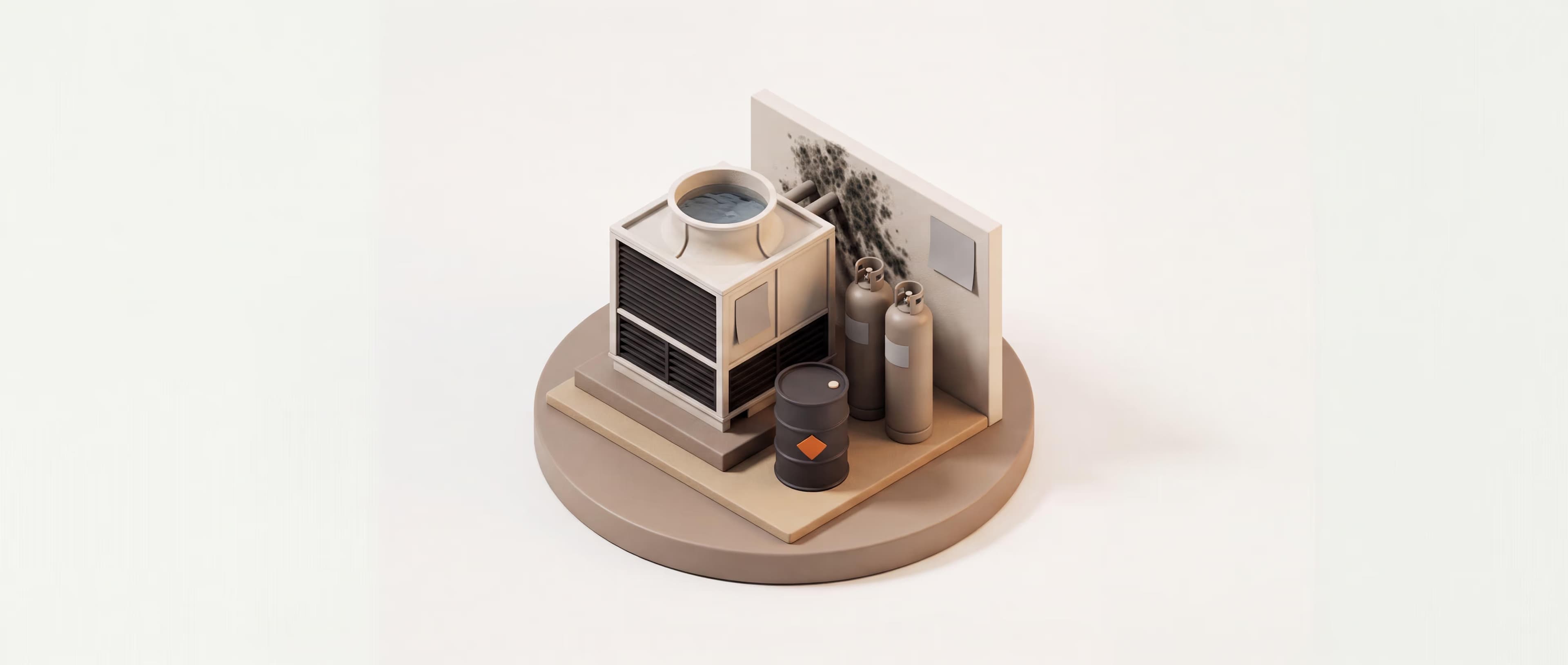
An HVAC company needs standalone contractors pollution liability once its work can create a pollution condition a general liability policy won't cover. The list is specific: mold from a backed-up condensate line, Legionella in a cooling tower, asbestos disturbed in an old mechanical room, or a fuel-oil spill on a heating job. The second trigger is a contract. When a general contractor or building owner writes a CPL limit into the bid spec, a missing certificate takes you off the award list. A standalone contractors pollution liability policy answers both triggers.
Coverwatch policy reviews of established HVAC accounts find pollution is the most common gap on a program that already runs GL, commercial auto, and workers comp. The line-by-line stack lives in our HVAC contractor insurance guide. The real question is whether your operations touch a pollution condition at all, because the GL form quietly treats a long list of them as somebody else's problem.
The general liability pollution exclusion bars any bodily injury or property damage from the release of a pollutant. This is the pollution exclusion GL carriers lean on to deny most HVAC pollution claims. The policy defines a pollutant as broadly as it can. That means any solid, liquid, gaseous, or thermal irritant or contaminant, including smoke, vapor, soot, fumes, acids, chemicals, and waste, per IRMI. Courts have stretched it to cover dust, sewage, and carbon monoxide. For a mechanical contractor, that sweeps in most of what the work actually produces.
Two narrow carve-backs survive in the standard form. One preserves coverage for a hostile fire (a fire that escapes where it belongs). The other covers bodily injury sustained inside a building from smoke, fumes, or soot released by heating, cooling, or dehumidifying equipment. That is how a carbon monoxide claim can sometimes land back inside the GL. Our HVAC carbon monoxide liability guide covers that fight.
Both carve-backs are narrow. They reach only inside the building, and they pay for bodily injury while leaving cleanup out. A total pollution exclusion endorsement (ISO forms CG 21 49, CG 21 55, CG 21 65) can strip most of them out. Refrigerant releases and EPA Section 608 fines sit outside all of it, which our refrigerant and EPA 608 guide covers in full.
Contractors pollution liability covers the pollution conditions HVAC work creates, and each one is a third-party claim the GL is built to exclude. The table maps where an incident lands.
| Exposure | Does GL respond? | What covers it |
|---|---|---|
| Mold from condensate or humidity | No, pollution and moisture excluded | Contractors pollution liability |
| Legionella in a cooling tower | No, treated as a pollutant | CPL, often blended with professional liability |
| Asbestos disturbed in an old mechanical room | No | Contractors pollution liability |
| Fuel-oil spill on a heating job | Rarely | Contractors pollution liability |
| Indoor air quality complaint from a bad install | No, design and pollution excluded | CPL plus contractors professional liability |
Mold is the exposure most owners underrate (and yes, that includes the mold behind a tenant's drywall). A clogged condensate drain leaves standing water, and mold spreads through the ductwork within weeks. It is a textbook mold liability contractor exposure, and standard property and GL forms treat it as excluded moisture damage. That leaves the remediation bill and any health claim riding on the contractor.
Legionella is the exposure carriers now watch most closely. In 2026, sixteen people sued cooling-tower maintenance contractors after a Harlem Hospital outbreak, per PR Newswire. Standard GL policies exclude Legionella claims under the total pollution exclusion, a gap Howden flags for anyone servicing building water systems. Settlements and verdicts have run past $5 million.
General contractors and building owners increasingly require contractors pollution liability because a pollution claim on a job site flows uphill to whoever hired the subcontractor. Contractual requirements are the main reason HVAC companies buy CPL, per IRMI, and owners are less willing to waive them than before. Required limits typically run $1M to $5M per occurrence (and the ceiling keeps creeping up).
On a bid, the CPL limit lives in the contract's insurance schedule right alongside your GL and umbrella requirements, and it rarely comes off once the owner sets it. Some standard construction contracts spell out $5M per occurrence. If your certificate can't show that line, the bid gets passed over. Hire subs, and their pollution exposure becomes yours, which puts CPL in your subcontractor insurance requirements.
A CPL policy for an HVAC company usually costs $2,500 to $6,000 a year. That buys a $1M per-claim, $2M aggregate practice policy at $2M to $10M in revenue. Higher-hazard work and larger limits push it up. A CPL policy HVAC contractors carry is almost always written claims-made, so the policy has to be active both when the incident happens and when you report it.
The structure follows how you work: a practice policy covers all your operations for the year and suits a service-and-install HVAC business. A project or wrap-up policy, including OCIP and CCIP programs, covers a single large job. Site-specific and follow-form excess options exist when an owner demands higher limits. If you switch carriers or drop the policy, buy tail coverage so an old job's claim still has somewhere to land.
Coverwatch places CPL for HVAC clients through its flat-fee brokerage. The flat fee removes the commission incentive to oversell limits. Shopping 60+ carrier partners surfaces the pollution markets that will write mold, Legionella, and refrigerant exposure at the limit a bid spec demands. Renewal is where these pieces get checked, and the HVAC company insurance program guide walks the full sequence.
An HVAC company's GL policy is built to exclude pollution, and every condensate line, cooling tower, and old mechanical room is a reminder of it. For most established shops, a CPL policy stops being optional the first time a bid spec or a mold claim puts the exposure in writing.
Usually no. A standard general liability policy's pollution exclusion treats mold and Legionella as pollutants, so a third-party mold or Legionnaires' claim from your work is generally excluded. Contractors pollution liability covers those losses, and Legionella exposure is often written on a blended pollution and contractors professional liability policy. A total pollution exclusion endorsement on the GL removes even more, which is why the standalone line matters.
No. Contractors pollution liability (CPL) follows your operations and covers pollution conditions that arise out of the work you perform, at whatever site you are working. Site pollution liability (sometimes called premises or environmental impairment liability) covers a fixed location an owner holds, such as contamination already in the ground. An HVAC contractor buys CPL because the exposure travels from job to job with the crew, following the work instead of one fixed address.
Often yes. A refrigerant-focused pollution buy-back endorsement adds back a narrow slice of coverage for refrigerant releases, but it does nothing for mold, Legionella, asbestos, fuel-oil, or indoor air quality claims. A standalone contractors pollution liability policy covers the full range of pollution conditions HVAC work creates and generally offers higher limits. The buy-back and CPL solve different pieces of the same gap.
Most general contractors and building owners require $1 million to $5 million per occurrence in contractors pollution liability, and some standard construction contracts specify $5 million. Limits have trended upward, and owners are less willing to waive the requirement than they once were. A practice policy that covers all your jobs for the year is the simplest way to satisfy a range of bid specs without buying a new policy per project.
August 7, 2026
ExplainersHandyman insurance vendor list requirements come from credentialing portals. What seven real vendor packets demand and why vendors get de-listed.
7 min read
August 6, 2026
ExplainersAn electrician liability fire damage claim usually arrives as a subrogation demand months after the job. What happens next, and what you can challenge.
7 min read
August 6, 2026
ExplainersA plumber's liability policy pays for what the water ruined, not for the joint that let go. The exclusions are narrower than most contractors think.
7 min read
August 1, 2026
ExplainersAdding plumbing, refrigeration, or electrical work resets your HVAC class codes and reprices general liability and workers comp. Here is what changes.
6 min read
Fill out the form and a Coverwatch advisor will get back to you within the next hour.
Your quote