

August 7, 2026
ExplainersHandyman Insurance Vendor List Requirements in 2026
Handyman insurance vendor list requirements come from credentialing portals. What seven real vendor packets demand and why vendors get de-listed.
7 min read

Manage your risk with Coverwatch
Get a free coverage review and find out where you are over or under insured.
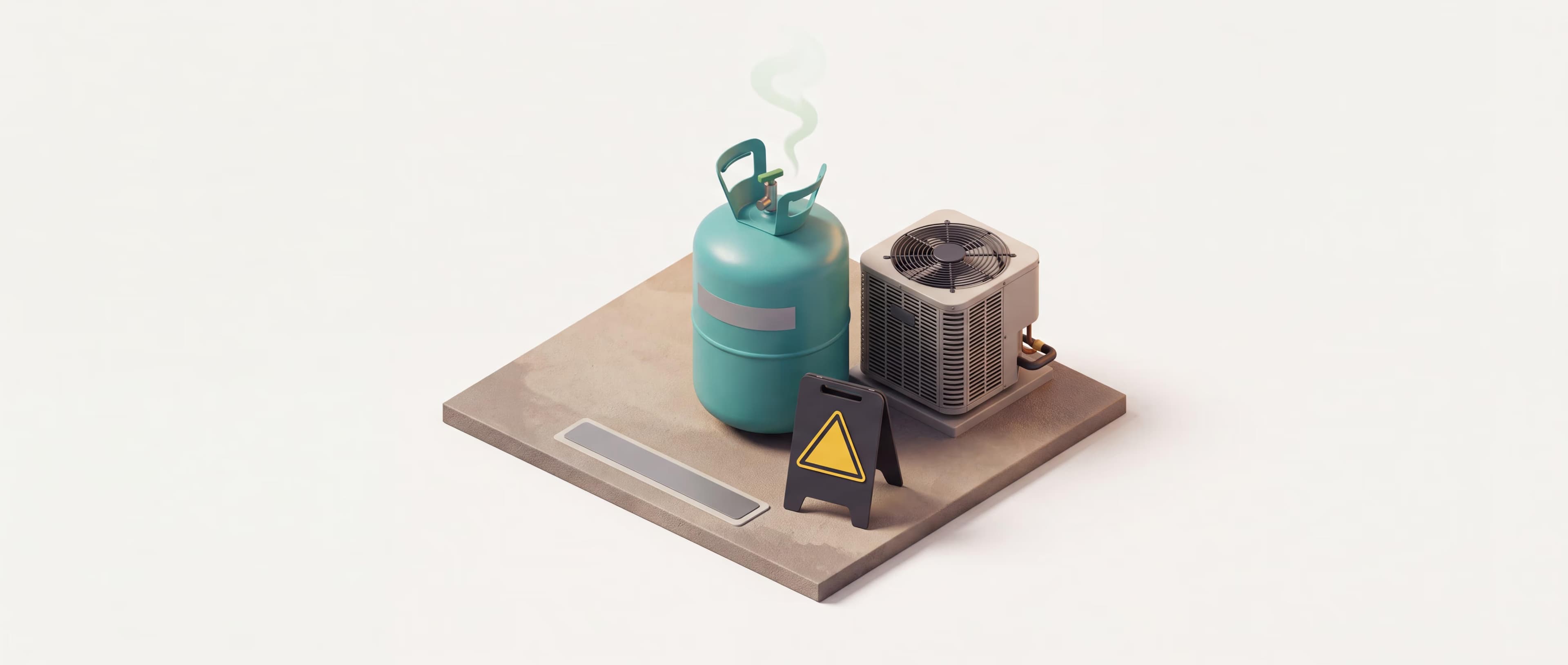
A standard HVAC insurance policy usually won't pay for a refrigerant release or an Environmental Protection Agency (EPA) Section 608 fine. The block comes from one clause. The policy's pollution exclusion treats refrigerant as a pollutant, which pushes HVAC pollution liability for refrigerant work into a separate policy, while the government fine sits in a category the insurance market barely touches. This guide walks through what the exclusion blocks, why the fine stays uncovered, and what actually pays.
Mostly no. A standard HVAC program built on a general liability (GL) policy excludes pollution, and carriers file a refrigerant release squarely under that exclusion. The cleanup, the third-party injury claim, and the EPA fine each land outside the GL form. Closing that gap takes a policy written for pollution.
Established HVAC companies run several lines at once, and each one answers a different loss. Our HVAC contractor insurance guide walks the full stack; this post isolates the single exposure that stack quietly leaves open. The table below maps where a refrigerant incident actually falls.
| Exposure | Does GL respond? | What covers it |
|---|---|---|
| Refrigerant release causing third-party injury | No, pollution exclusion applies | Contractors pollution liability |
| Gradual refrigerant leak, cleanup and remediation | No | Contractors pollution liability |
| EPA Section 608 civil fine | No, a fine is not covered damages | Generally uninsurable; CPL may fund the defense |
| Faulty install you have to redo | No | No policy; that cost is yours |
Insurers exclude refrigerant claims because the commercial general liability (CGL) pollution exclusion defines a pollutant broadly, as any irritant or contaminant, and refrigerants like R-410A, R-32, and R-454B fit that wording without much argument. The release doesn't have to be dramatic to count. A slow leak found during a routine service call can trigger the exclusion just as fast as a ruptured line.
Most contractor GL policies carry the standard "absolute" pollution exclusion. Many carriers go further with a total pollution exclusion, and the three ISO total pollution exclusion forms (CG 21 49, CG 21 55, and CG 21 65) go broader still, stripping out any injury or damage that wouldn't have happened but for a pollution incident, per IRMI. The narrow carve-outs that do exist apply to fire and heating-equipment fumes, so refrigerant handling stays outside them.
No, government fines are almost never insurable, and EPA Section 608 penalties are steep. Knowingly venting regulated refrigerant draws civil judicial penalties up to $124,426 per day, per violation under the 2025 inflation adjustment. Administrative penalties run up to $59,114 per day, per the Federal Register.
A liability policy pays the compensatory damages a business owes a third party, and a government fine is neither of those, which is why most states won't let a company insure the penalty away.
Deterrence explains the prohibition: letting a company insure away a regulatory fine would soften the penalty's bite, which is why states generally bar it, as Marsh notes on the insurability of fines. Section 608 also requires every technician handling refrigerant to hold EPA certification, and a lapse there is often what turns a routine leak into an enforcement action.
Contractors pollution liability (CPL) covers the pollution losses the GL form excludes: cleanup and remediation, third-party injury and property damage from a release, and legal defense for regulatory actions. It's the policy that answers HVAC pollution liability for refrigerant claims. The fine itself usually stays uninsured, though the defense costs around it can be covered.
Say a gradual leak contaminates a tenant's space, the cleanup runs $40,000, and a third-party claim lands on top. CPL responds to both the cleanup and the claim. If an EPA notice follows, the policy's regulatory-defense wording funds the legal work, while the penalty stays on the company's books.
Pricing runs from roughly $2,500 to $15,000 a year, depending on refrigerant volume and design-build revenue (a bigger design-build book usually means a bigger number). A broker can place CPL as a standalone policy or negotiate a pollution buy-back endorsement onto the GL. A buy-back is a narrow piece of wording that adds back a slice of the pollution coverage the base policy stripped out, so it rides on the GL and responds to a refrigerant release without a second policy. The pollution liability line is where that coverage lives. Coverwatch structures the placement so the pollution form sits cleanly over the general liability policy, with no overlap and no gap between the two.
The A2L refrigerant transition adds a new underwriting question to HVAC insurance, because the replacement refrigerants are mildly flammable. Under the American Innovation and Manufacturing (AIM) Act, new residential systems built since January 1, 2025 must use refrigerant below 700 global warming potential (GWP). The compliant options are R-454B and R-32, both A2L refrigerants. ASHRAE rates that A2L class as low in toxicity and mildly flammable.
That flammability reshapes the risk. R-454B carries a GWP of 466 and R-32 sits at 675, both under the threshold EPA set in its 2023 Technology Transitions rule, per the International Code Council. Storage, transport, and leak-detection standards all shift for A2L stock, and carriers now ask whether crews are trained for it. Companies still leaning on R-410A face a separate squeeze as supply tightens and prices climb.
Renewal is where these questions surface, and the HVAC company insurance program guide covers how to prep for them. A shop that can document A2L training tends to move through underwriting without a stall.
Refrigerant is the exposure a standard HVAC policy is built to exclude, and the fine attached to it is one the market won't insure at all. The fix is a pollution line placed deliberately over the general liability program, checked against how your crews actually handle A2L stock. Coverwatch runs that review for HVAC clients as part of its flat-fee contractor insurance practice.
Yes. HVAC pollution liability, written as contractors pollution liability, covers refrigerant releases that a general liability policy's pollution exclusion blocks. That includes cleanup, third-party bodily injury and property damage, and legal defense for a regulatory action. The one thing it rarely covers is the government fine itself, which stays uninsurable in most states.
No. A general liability policy pays compensatory damages a business owes a third party, and a Section 608 fine is a government penalty rather than damages. Public policy in most states also bars insuring regulatory fines to keep the penalty's deterrent effect intact. A pollution policy with regulatory-defense wording can fund the legal work, but the penalty stays with the company.
Sometimes. A2L refrigerants like R-454B and R-32 are mildly flammable, so carriers increasingly ask about handling, storage, and technician training on renewal questionnaires. There is no separate policy for A2L work yet, but documented training and updated safety procedures help an HVAC account move through underwriting cleanly. Expect the question to become standard as R-410A phases down.
For most established HVAC companies handling refrigerant daily, yes. A single refrigerant release with a third-party injury can cost far more than the $2,500 to $15,000 annual premium, and general liability will not respond. Smaller shops with minimal refrigerant exposure sometimes rely on a pollution buy-back endorsement on the GL instead, which costs less than a standalone policy.
August 7, 2026
ExplainersHandyman insurance vendor list requirements come from credentialing portals. What seven real vendor packets demand and why vendors get de-listed.
7 min read
August 6, 2026
ExplainersAn electrician liability fire damage claim usually arrives as a subrogation demand months after the job. What happens next, and what you can challenge.
7 min read
August 6, 2026
ExplainersA plumber's liability policy pays for what the water ruined, not for the joint that let go. The exclusions are narrower than most contractors think.
7 min read
August 1, 2026
ExplainersAdding plumbing, refrigeration, or electrical work resets your HVAC class codes and reprices general liability and workers comp. Here is what changes.
6 min read
Fill out the form and a Coverwatch advisor will get back to you within the next hour.
Your quote