
August 7, 2026
ExplainersHandyman Insurance Vendor List Requirements in 2026
Handyman insurance vendor list requirements come from credentialing portals. What seven real vendor packets demand and why vendors get de-listed.
7 min read

Manage your risk with Coverwatch
Get a free coverage review and find out where you are over or under insured.
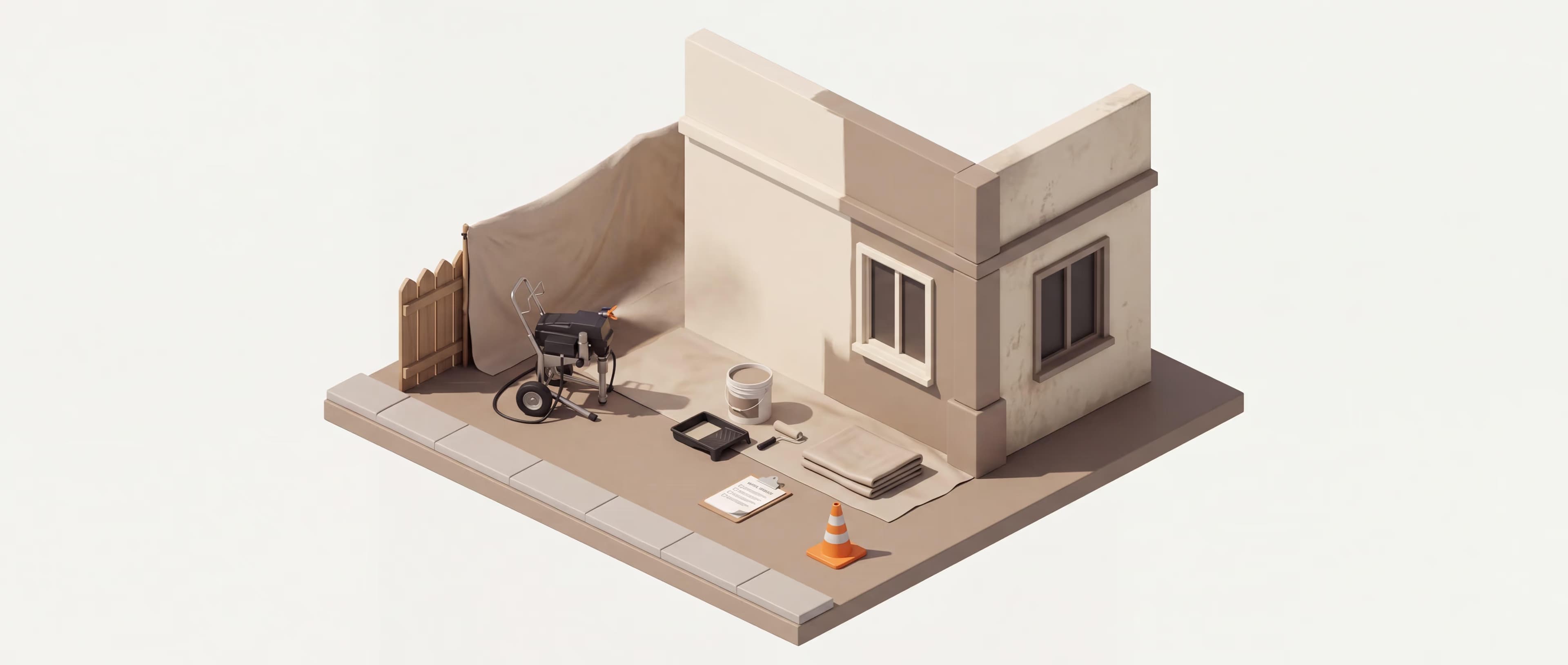
Painter insurance through a standard general liability (GL) policy covers most property damage your crew causes to others. A ladder through a window or a spilled bucket on hardwood floors? GL pays for that. Overspray is different. Most GL policies classify airborne paint as a pollutant and exclude it, so the claim that matters most to exterior painters is often the one that gets denied.
This guide covers what standard GL pays, where the pollution exclusion draws the line, what a contractors pollution liability policy costs, and when lead paint work triggers additional requirements.
General liability insurance covers most property damage a painting contractor causes to third-party property, including spills, ladder damage, and broken fixtures. Overspray drift, where airborne paint settles on cars, buildings, or landscaping, is usually excluded under the pollution exclusion clause in standard GL policies. Painters who spray exterior work need a contractors pollution liability (CPL) policy to cover overspray claims.
Standard general liability insurance for contractors handles the scenarios most painters think of first. Your crew knocks a ladder into a client's window, or a five-gallon bucket tips on hardwood floors. GL pays the property owner for that damage. GL completed operations coverage extends to damage discovered after you leave the job site, like a paint failure that ruins a client's siding months later.
The gap shows up with spray equipment. Most GL forms classify airborne paint particles as a pollutant, which triggers the pollution exclusion and kills the claim. Interior brush-and-roll work rarely hits the exclusion because the paint stays where you put it. Exterior spray jobs are a different story. If overspray drifts onto a neighbor's car or adjacent building, your standard GL policy will likely deny that claim.
A standalone CPL policy or a pollution buy-back endorsement added to your GL covers what the pollution exclusion removes. That includes overspray on vehicles, paint drift onto adjacent properties, and volatile organic compound (VOC) claims. (Most painters don't find out about this gap until a claim lands on their desk.) If your crew does any exterior spray work, CPL is the coverage that keeps a single overspray incident from becoming a five-figure out-of-pocket expense.
Standard post-1986 CGL policies contain a broad pollution exclusion that classifies airborne contaminants, including paint overspray, as pollutants. Courts in many states have upheld this interpretation, though some jurisdictions apply it more narrowly. Either way, your GL carrier can deny an overspray claim even if the damage was accidental.
The exclusion was originally written for chemical spills and industrial waste. Its language is broad enough to cover any airborne irritant or contaminant, and insurers have successfully argued that aerosolized paint particles fit the definition. If your crew sprays a house and the wind carries paint mist onto a neighbor's car, your GL policy treats that like a factory releasing chemicals.
The standard CGL pollution exclusion (sometimes called the absolute pollution exclusion) bars most pollution-related claims but preserves a few exceptions. Building heating equipment, hostile fires, and certain mobile equipment incidents are still covered. The total pollution exclusion, ISO form CG 21 49, removes all of those exceptions and denies every claim involving a pollutant regardless of context. If your policy carries CG 21 49, even interior paint fume injuries won't have coverage. (Check your policy's endorsement schedule, because the difference matters more than most painters realize.)
Three options fill the gap. A pollution buy-back endorsement adds pollution coverage to your existing GL policy. A standalone CPL policy gives you higher limits. A time-element pollution extension works for short-duration projects. The buy-back endorsement is the cheapest route, but it typically caps overspray coverage at lower limits than a standalone CPL.
What your painting business insurance pays depends on the type of damage and whether your policy includes pollution coverage. A paint bucket spilled on hardwood floors is a standard GL property damage claim. Overspray drifting onto a neighbor's car is typically denied under the pollution exclusion unless you carry a CPL policy or pollution buy-back endorsement.
According to a 2015 Claims Journal report, paint overspray damages more than 1,000 vehicles per day in the US, adding up to over $500 million in annual claims. Most of those vehicle owners file against the painting contractor. Whether the contractor's insurance actually pays depends on which policy responds.
| Scenario | Typical Cost | Covered By | Denied If... |
|---|---|---|---|
| Overspray on 5 cars in neighboring lot | $15,000–$25,000 | CPL or pollution buy-back | No pollution endorsement |
| Paint spill on hardwood floors | $5,000–$15,000 | GL (property damage) | Rarely denied |
| Worker falls from ladder | $18,000–$50,000 | Workers' comp | No WC policy |
| Lead dust exposure lawsuit | $50,000–$500,000+ | CPL with lead buy-back | No RRP certification |
| Finish failure discovered months later | $3,000–$10,000 | GL completed operations (consequential damage only) | "Your work" exclusion applies to redo costs |
One detail that trips up exterior contractors: overspray deductibles run $250 to $2,000 per vehicle, and they stack. Five cars at $1,500 each means $7,500 in deductibles before your CPL policy pays a dollar. That math changes fast on a commercial jobsite near a full parking lot.
GL completed operations covers consequential damage found after the job is done, like water intrusion from a failed seal. It doesn't cover the cost of redoing your own paint work. (Your carrier considers that a business expense, not a liability claim.)
Most solo painting contractors pay a median of $59 per month for general liability insurance. The biggest cost variable is whether you do interior or exterior work. Based on industry cost estimates, interior-only painters pay roughly $2,700 to $4,450 per year for GL, while exterior painters pay $5,600 to $7,700 because of fall exposure and overspray risk.
That interior-to-exterior gap is the widest of any trade. A brush-and-roll crew doing residential interiors presents a fraction of the liability that a spray rig on a three-story exterior does, and carriers price accordingly. If you add CPL for overspray and lead paint coverage, budget another $1,800 to $5,000 per year depending on your revenue and scope of work.
Workers' comp runs about $5.57 per $100 of payroll under NCCI Code 5474. For a painter earning $50K, that's roughly $239 per month. A business owner's policy (BOP) bundles GL with commercial property coverage and runs about $84 per month, making it one of the cheaper pieces of a full contractor insurance stack.
| Coverage | Monthly | Annual | Notes |
|---|---|---|---|
| GL (interior only) | $225–$370 | $2,700–$4,450 | Brush-and-roll, residential |
| GL (exterior/spray) | $467–$642 | $5,600–$7,700 | Fall + overspray exposure |
| BOP | $84 | $1,002 | GL + commercial property |
| CPL | $150–$417 | $1,800–$5,000 | Overspray, lead, VOC claims |
| Workers' comp (per painter) | $239 | $2,871 | NCCI 5474, $50K salary |
If you work on homes built before 1978 and disturb any painted surface, the EPA's Renovation, Repair, and Painting (RRP) Rule requires firm certification and lead-safe work practices. Your standard GL policy almost certainly contains an absolute lead exclusion that denies claims from lead-based paint exposure. You need a CPL policy with a lead buy-back endorsement to cover lead dust, abatement work, and related bodily injury claims.
The RRP Rule triggers when you disturb more than 6 square feet of interior painted surface per room or more than 20 square feet of exterior painted surface. That includes scraping, sanding, cutting, and demolition. EPA firm certification costs $300 and lasts five years, and every project needs at least one certified renovator on-site.
The penalties for skipping certification aren't subtle. The EPA can fine up to $49,772 per violation, per day under the January 2025 inflation adjustment. OSHA's lead-in-construction standard adds a separate layer of compliance for worker exposure monitoring and medical surveillance. Getting tagged by both agencies on the same job isn't unusual.
Most GL forms carry an absolute lead exclusion, so any bodily injury or property damage tied to lead-based paint gets denied at the claim level. A CPL policy with a lead buy-back endorsement covers lead dust exposure, abatement liability, and remediation costs that GL won't touch. If your crew paints anything built before 1978, this is the first gap to close, and a quick painter insurance coverage review before your next pre-1978 job is the cheapest risk move you can make.
Standard general liability insurance usually doesn't cover overspray on vehicles because most GL policies classify airborne paint as a pollutant under the <a href="https://www.irmi.com/term/insurance-definitions/total-pollution-exclusion">ISO pollution exclusion</a>. A contractors pollution liability (CPL) policy or a pollution buy-back endorsement fills that gap. Deductibles on overspray vehicle claims typically range from <strong>$250 to $2,000 per vehicle</strong>, and they stack when multiple cars are affected.
The absolute pollution exclusion is the standard provision in post-1986 CGL policies. It bars most pollution-related claims but keeps exceptions for building heating equipment, hostile fires, and certain mobile equipment incidents. The total pollution exclusion (ISO form CG 21 49) removes all of those exceptions and denies every claim involving a pollutant, regardless of context. Check your policy's endorsement schedule for the specific form number, because the difference determines whether interior paint fume injuries have any chance of coverage.
Most states exempt sole proprietors with zero employees from workers' compensation requirements. The rules vary by state, so check your state's labor department before assuming you qualify. California is tightening this: starting <strong>January 2028</strong>, all licensed contractors in the state must carry workers' comp regardless of whether they have employees (SB 216).
A standalone CPL policy for a painting contractor typically costs <strong>$1,800 to $5,000 per year</strong>, depending on revenue, crew size, and whether you do exterior spray work. Most CPL policies carry a <strong>$5,000 deductible per claim</strong> with limits ranging from $1M to $10M. Look for an occurrence-basis policy rather than claims-made, since occurrence forms cover incidents that happen during the policy period even if the claim is filed years later.
August 7, 2026
ExplainersHandyman insurance vendor list requirements come from credentialing portals. What seven real vendor packets demand and why vendors get de-listed.
7 min read
August 6, 2026
ExplainersAn electrician liability fire damage claim usually arrives as a subrogation demand months after the job. What happens next, and what you can challenge.
7 min read
August 6, 2026
ExplainersA plumber's liability policy pays for what the water ruined, not for the joint that let go. The exclusions are narrower than most contractors think.
7 min read
August 1, 2026
ExplainersAdding plumbing, refrigeration, or electrical work resets your HVAC class codes and reprices general liability and workers comp. Here is what changes.
6 min read
Fill out the form and a Coverwatch advisor will get back to you within the next hour.
Your quote