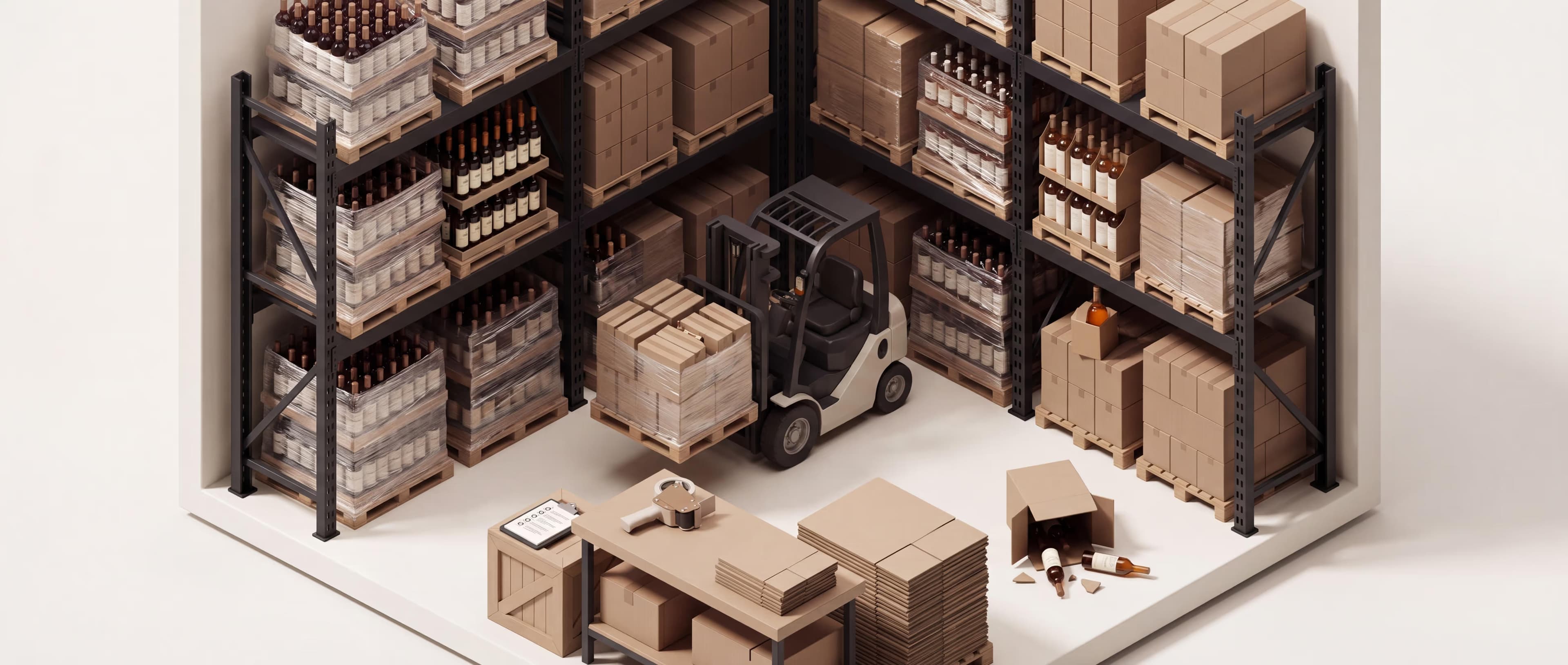
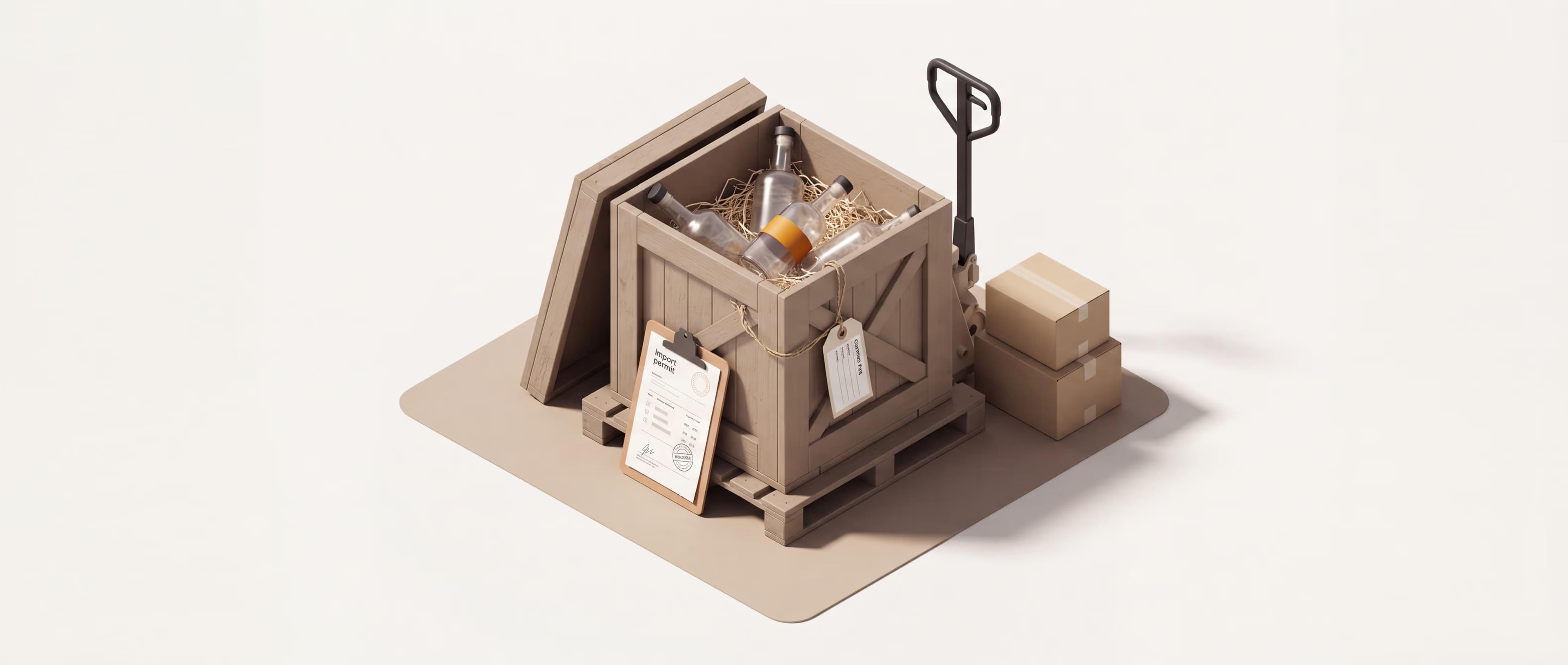
When an alcohol brand hands fulfillment to a 3PL, the 3PL's insurance covers the warehouse's own operations and leaves the value of your inventory to you. Warehouse legal liability caps recovery at roughly $0.50 per pound under industry-standard warehouse contracts, and it only pays if you prove the 3PL was negligent.
Age-verification duty stays with the name on the label. So does product liability, regardless of who stored or shipped the product.
Key Takeaways
3PL insurance for alcohol brands covers the warehouse, not your inventory; warehouse legal liability caps recovery at roughly $0.50 per pound.
The licensed brand stays liable for underage delivery even when the 3PL or carrier fails to verify age, per California B&P 25658.
Product liability follows the label-holder as the primary defendant; a 3PL's warehouse policy isn't designed to cover consumer-injury claims from your product.
Shipper's interest or stock throughput coverage pays the full declared value of alcohol inventory at a 3PL without proving the warehouse was negligent.
Does my 3PL's insurance actually cover my alcohol inventory?
Most alcohol brands assume their 3PL will cover the value of any inventory it loses or damages, but the coverage is far narrower than that. The warehouse carries a type of coverage called warehouse legal liability, which pays only if you can prove the warehouse was negligent, and even then it pays a fixed amount per pound regardless of what the product is worth.
In practice, the warehouse's policy is there to defend the warehouse against claims, so a loss to your stored alcohol comes out of your own pocket unless you carry separate coverage.
Under UCC Article 7, Section 7-204, warehouses are allowed to cap their liability by the pound. The warehouse industry's standard terms, set by the International Warehouse Logistics Association (IWLA), put that cap between $0.25 and $0.50. Most alcohol brands sign the agreement without reading the clause.
Why the per-pound cap matters
The contract you sign with the 3PL says the warehouse will pay you a set amount for every pound it loses or damages, usually about 50 cents. The payout is based on weight alone, so the value of the product never enters the math. A case of wine weighs about 30 pounds, so at 50 cents a pound the warehouse owes you $15 if it destroys that case. The case sells for $480, so you lose the other $465. A full pallet weighs about 1,680 pounds, so the most you can collect is around $840, even though the wine on it sells for close to $27,000.
Acts of God, utility outages, and equipment failures typically fall outside the policy's scope under IWLA Standard Terms. The policy also excludes consequential damages including lost profits. The brand needs its own first-party alcoholic beverage insurance to cover inventory at declared value without having to prove anyone was at fault.
Who is liable if my 3PL ships alcohol to a minor?
The licensed brand is liable. The 3PL and the carrier are not parties to the age-verification duty under state ABC (alcoholic beverage control) law. That duty belongs to the permit holder.
A 3PL typically holds a warehouse storage license that lets it physically handle alcohol. The brand holds the direct-to-consumer (DTC) shipper permit, and that permit is where the age-verification obligation lives. Handing the delivery to a carrier doesn't hand off that obligation.
A violation happens the moment product reaches a minor's hands, regardless of who drove the truck, and standard general liability won't cover it. DTC alcohol brands need a separate liquor liability policy for this exposure.
Rebecca Stamey-White, Partner at Hinman & Carmichael LLP, notes that under a California ABC Industry Advisory, if a licensee relies on a third-party service that delivers to a minor, the licensee has violated Section 25658 and faces discipline against its license. California Business and Professions Code Section 25658 has no carve-out for third-party delivery failure.
What the enforcement record shows
A Massachusetts ABCC sting operation found that 0% of shipments verified ID at delivery and 43% arrived with no adult signature. The Wine & Spirits Wholesalers of America reported the data. State attorneys general in Ohio, Michigan, and Tennessee have brought actions against DTC shippers for unlicensed shipping and delivery violations.
Ohio and Michigan settlements together reached about $140,000. FedEx and UPS require an adult signature from someone 21 or older and a signed alcohol shipping agreement. Carrier failure at the door does not transfer liability from the brand.
The coverage alcohol brands need that a 3PL won't provide
Alcohol brands using a 3PL generally need four coverages the warehouse doesn't provide. Those are first-party inventory insurance, product liability, liquor liability, and product recall. Each closes a gap that warehouse legal liability leaves open.
Shipper's interest is a first-party policy. It pays you directly for a covered loss without proof of 3PL negligence. It covers the full declared value whether inventory is sitting in the warehouse, moving through pick-and-pack, or riding to your customer. Stock throughput does the same job but follows the cargo all-risk through the entire supply chain. That matters when you own product across multiple custody points at once.
Frankly, signing a 3PL agreement without first-party inventory coverage is the most expensive shortcut an alcohol brand can take. Fulfillment center insurance for alcohol brands usually means stacking your own shipper's interest and liquor liability on top of the 3PL's warehouse policy.
Product liability follows the label. Storing your bottles at a 3PL doesn't transfer your manufacturer-of-record duty to the warehouse. Under Cornell LII's products liability framework, the brand is the primary defendant on a consumer-injury claim.
Once customers are opening your bottles, the brand needs its own product liability coverage. The 3PL's policy is not built for those claims.
According to the III, product recall insurance is designed specifically to cover retrieval and notification costs that general liability excludes. The brand that introduced the product bears retrieval costs under rules from the Alcohol and Tobacco Tax and Trade Bureau (TTB), the federal alcohol regulator. Mislabeling at a 3PL's pick-and-pack station still traces back to the brand. The WTW 2024 food and beverage survey found that over half of firms carry no specific recall coverage.
How the coverages map to your gaps
Coverage
Who carries it
What it covers
The gap it closes
Shipper's interest / stock throughput
The alcohol brand
Full declared value of inventory through the 3PL and in transit, all-risk, first-party, no negligence proof required
The per-pound cap in the warehouse contract that leaves most inventory value unrecovered after a loss
Product liability
The alcohol brand (label-holder)
Consumer injury and property damage claims arising from your product, regardless of where it was stored or who shipped it
The brand bears primary product liability; the 3PL's policy isn't designed for consumer-injury claims from your product
Liquor liability
The alcohol brand (DTC permit holder)
Underage-delivery claims and impairment-related injury claims that standard general liability excludes
Standard GL policies exclude liquor liability; the brand holding the DTC shipper permit owns this exposure even when the 3PL or carrier makes the delivery
Product recall
The alcohol brand
Costs to retrieve, destroy, and notify about product subject to a voluntary or regulatory recall, including mislabeled inventory from pick-and-pack errors
Standard GL doesn't cover recall costs; the brand that introduced the product bears retrieval expenses under TTB rules
What happens when bottles break or spoil at the warehouse?
Breakage and spoilage land in the gap between the 3PL's liability and your own coverage. Glass breakage in transit runs 2 to 5 percent, and the 3PL only pays if you can prove negligence (capped per pound). Temperature spoilage from a power outage? That sits outside the warehouse's liability entirely.
Consider a 500-case direct-to-consumer (DTC) run at $40 per bottle, 12 bottles per case. At a 2 percent breakage rate, you lose 10 cases, or 120 bottles, before any coverage responds. That is $4,800 in product at retail value.
At a 5 percent rate, the loss climbs to $12,000. The 3PL reimburses at most $175 across those 10 cases under a $0.50-per-pound cap. (Yes, really: 10 cases at roughly 35 pounds each, times $0.50, equals $175.)
When the warehouse is not at fault
The TTB requires alcohol producers and importers to maintain records of breakage and spoilage, and to file a notice of intent before destroying any damaged product. Those same records showing quantity, date, and cause are exactly what an insurance adjuster needs to process a cargo claim. Building the TTB paperwork habit early means you're not scrambling to reconstruct inventory records when a claim is already open.
What to check before you sign a 3PL agreement
Before signing a 3PL agreement, start with the liability cap clause. That single number tells you how much first-party inventory coverage you need before you sign anything. Then request a certificate of insurance (COI, the document proving the 3PL carries active coverage) to see what the warehouse actually carries. Confirm your own policy fills the gap the COI reveals.
UCC 7-204 lets a warehouse contractually cap what it owes, and the standard sits at $0.50 per pound under industry-standard IWLA contracts. It also excludes consequential damages like lost profits, and it pays nothing at all unless you can prove the warehouse was negligent.
The one thing you can negotiate is a higher declared value in writing, and only before you sign.
Ask the 3PL for a COI showing its warehouse legal liability policy. That policy is built around the warehouse's own operations and stops well short of the value of your alcohol. If you store temperature-sensitive wine or RTD products, confirm separately whether the 3PL covers refrigeration equipment failure. That gap commonly sits outside warehouse legal liability. Once a bottle leaves the warehouse a different policy applies, so review temperature-controlled shipping and transit spoilage coverage for what protects it in transit.
Hand both documents to a broker. Reading the warehouse agreement alongside your policy shows exactly where the per-pound cap, the spoilage exclusion, and the missing liquor liability leave you exposed. Coverwatch quotes DTC alcohol brands across 60+ carrier partners, including specialty programs that bundle inventory coverage, liquor liability, and spoilage endorsements. Quotes arrive in 24 to 48 hours on a flat-fee model.
Pull the warehouse agreement now and find the clause that names the per-pound limit. If it reads $0.50 per pound, your first-party coverage need is already calculable from your current inventory value.
Frequently asked questions
No. A 3PL carries warehouse legal liability, which only pays if you prove the warehouse was negligent. Recovery caps at a contractual per-pound limit, commonly around $0.50 per pound under <a href="https://www.law.cornell.edu/ucc/7/7-204">UCC 7-204</a>-enabled IWLA contracts. A case of premium spirits weighing roughly 30 pounds recovers about $15 at that cap against hundreds of dollars in real value. First-party shipper's interest or stock throughput coverage pays the full declared value without requiring you to prove negligence.
The licensed brand holding the direct-to-consumer (DTC) shipper permit is liable. State ABC law places the age-verification duty on the permit holder, not the 3PL. As <a href="https://www.beveragelaw.com/booze-rules/alcohol-marketplaces-20-part-4-whos-responsible-for-ensuring-legal-drinking-age">Hinman & Carmichael</a> notes regarding California B&P 25658, a licensee that relies on a third party who delivers to a minor has still violated the statute. FedEx and UPS require an adult signature 21+ on alcohol shipments, but that requirement doesn't shift liability to the carrier when the signature check fails. Standard general liability excludes these claims, so DTC alcohol brands need a separate liquor liability policy or endorsement (a policy add-on).
Most 3PLs require a certificate of insurance that names them as an additional insured. That means your policy extends to cover them for claims arising from your products, typically general liability and often product liability at a minimum. Those requirements protect the 3PL, while your own coverage picture needs to go further. Direct-to-consumer (DTC) alcohol brands also need liquor liability for delivery exposure and first-party inventory coverage for the full value of stock at the warehouse. The 3PL's warehouse legal liability covers neither.
Standard inland marine covers physical loss in transit and off-site storage, but temperature spoilage is typically excluded unless you add a spoilage endorsement. Equipment failure and power outages at the 3PL usually fall outside warehouse legal liability as well, since they're not considered direct negligence under a standard IWLA warehouse agreement. Climate-sensitive wine and RTD (ready-to-drink) products stored at a 3PL need spoilage or temperature-sensitive cargo coverage to close that gap.