
November 12, 2026
ChecklistsRestaurant Deliveries in Personal Cars: Who's Insured?
Review restaurant delivery insurance for employees using personal cars, including driver coverage, return trips, vehicle damage and safe dispatch.
5 min read

Manage your risk with Coverwatch
Get a free coverage review and find out where you are over or under insured.
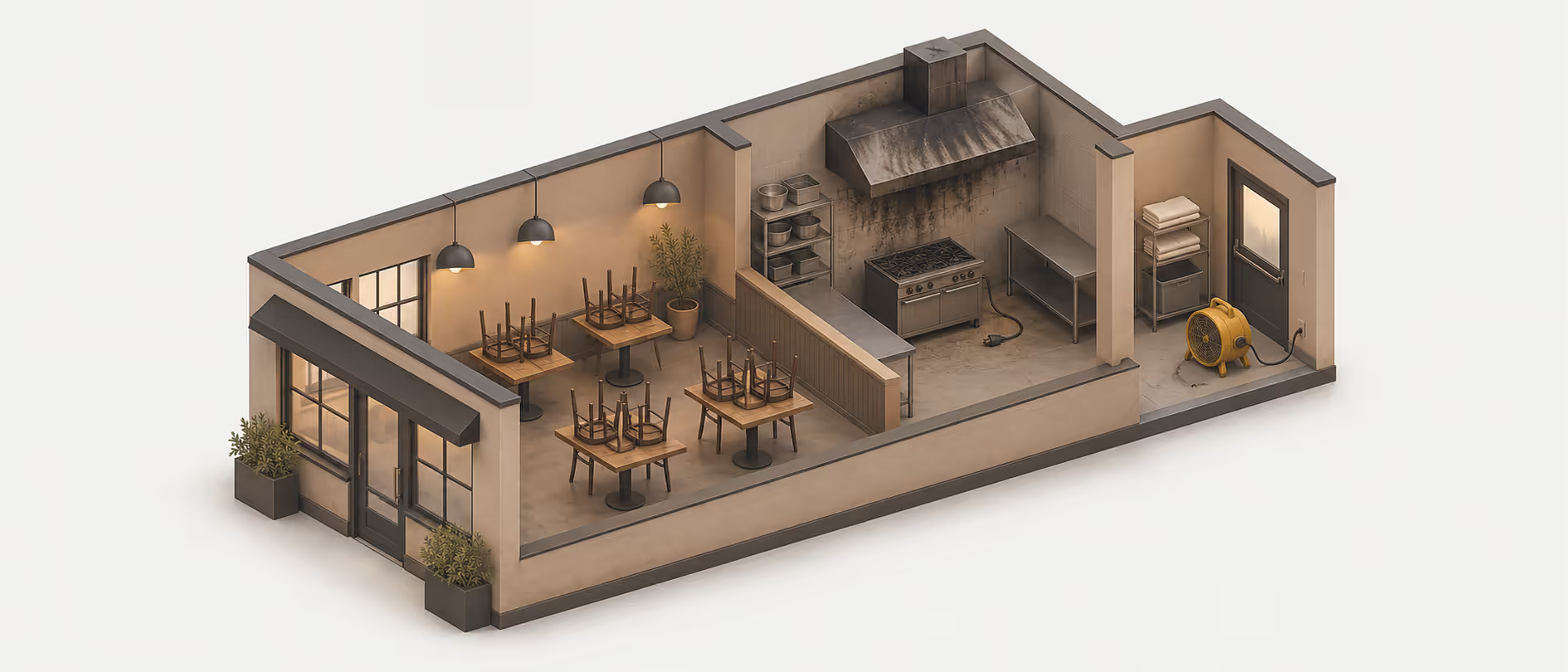
Restaurant business interruption coverage can replace covered lost income and continuing expenses after a kitchen fire. The amount and duration depend on the policy, the damage and the reasonable recovery period. Replacing the fryer is only one part of reopening a working restaurant.
For an owner comparing restaurant insurance, the useful question is how long payroll, rent and other obligations continue before reliable trading resumes. Build that calendar before deciding whether an income limit looks adequate.
Restaurant business interruption generally responds when covered physical damage causes a necessary suspension of operations. A kitchen fire can meet that starting condition, but the policy still controls the insured premises, exclusions, waiting period and covered loss calculation. A closure alone doesn't establish coverage.
The National Association of Insurance Commissioners (NAIC) distinguishes commercial property repairs from business income lost during restoration. Review both parts together: restaurant commercial property coverage addresses damaged property, while the income provisions address the resulting interruption.
Check whether income and extra expense share a dollar limit. Ask how deductibles or waiting periods apply and whether the coverage uses a maximum duration. There is no single waiting period or payment limit that applies to every restaurant policy.
If only part of the kitchen closes, document the actual operating restriction. A reduced menu, closed dining room or unavailable catering service may affect revenue differently. The adjuster needs evidence of that impact rather than an assumption that all sales disappeared.
A kitchen-fire recovery calendar should include safe access, cleanup, equipment replacement, inspections and the practical return of service. Obtain estimated dates from the people responsible for each step. These estimates help test the policy's period of restoration, the time allowed for repairing or replacing covered damage without promising that every delay is insured.
| Recovery stage | Who can explain the timing? | Record to retain |
|---|---|---|
| Entry and damage assessment | Fire officials and restoration contractor | Access clearance and initial report |
| Food disposal and cleaning | Health authority and cleanup provider | Instructions, invoices and photographs |
| Equipment and building work | Suppliers, trades and landlord | Orders, delivery estimates and work schedule |
| Approval and reopening | Relevant local authorities | Inspection results and reopening approval |
| Sales recovery | Restaurant management | Bookings and actual sales after reopening |
The Texas DSHS reopening guide highlights smoke contamination and regulatory approval before a closed food establishment resumes operations. Requirements elsewhere depend on local authorities. Ask your own inspector what must happen before food service restarts.
A restaurant business income worksheet should reconcile projected sales, expenses saved and continuing costs. Gross revenue alone can overstate the insured economic loss. Work from the policy's definition and use financial records to explain what the restaurant would reasonably have earned during the affected period.
Hypothetical example: a restaurant expected $120,000 in monthly sales. Of that amount, $45,000 would pay for food and other costs avoided during a complete closure. Another $55,000 would pay continuing expenses. That leaves $20,000 in projected net income.
On those simplified assumptions, net income plus continuing expenses totals $75,000 for the month. Adding the full $120,000 of sales to the $55,000 of continuing costs would count expenses twice. Actual adjustment may differ because of seasonality, partial trading, policy definitions and changes in expenses.
Keep the projection defensible. A new fine-dining restaurant may need reservations and opening forecasts alongside its limited trading history. An established restaurant can use comparable periods, adjusted for documented changes. Separate optimistic targets from bookings and contracts already in hand.
Temporary kitchen costs and continuing payroll need specific treatment in the restaurant's policy. Ask whether moving production, renting equipment or retaining staff falls within the purchased coverage. Spending that helps reopening can still face conditions, limits or approval requirements.
The Insurance Information Institute describes extra expense protection for costs such as temporary premises and leased equipment. Compare that provision with ordinary income-loss coverage. A temporary kitchen may preserve catering revenue while the dining room remains closed, producing both extra cost and reduced lost income.
Build a staffing plan for the closure. Identify employees needed for cleanup coordination, purchasing, training and reopening, then discuss how payroll is treated. Some policy forms distinguish categories of payroll or limit the time covered. Don't assume every wage payment receives identical treatment.
Also test the physical feasibility of the temporary operation. A rented kitchen might need permits, delivery arrangements and insurer approval for the new address. Confirm the coverage and operational requirements before committing to a long rental agreement.
A clear restaurant fire claim file connects each lost trading day and extra cost to the recovery work. Keep original records and a dated log of changes. This helps explain why reopening moved when a delivery slipped or additional damage was discovered.
Give the adjuster updates as the facts change. A delay caused by a voluntary redesign may raise different coverage questions from a delay in replacing fire-damaged equipment. Keep the original restoration schedule separate from any improvement project so the distinction stays visible.
A restaurant's income recovery can continue after repairs finish. Check whether the policy includes an extended business income provision for the period when operations resume but earnings remain reduced. Confirm its trigger and duration; the reopening date and the final covered payment date need not match.
Test your business interruption coverage against a realistic kitchen-fire scenario. Include hard-to-replace equipment, landlord coordination and required approvals. Ask which delays are contemplated by the restoration definition and which would require additional coverage.
Coverwatch can use that recovery calendar to compare the income provisions offered by different insurers. Bring the lease, recent financial statements and your equipment replacement estimates. The result should be a policy comparison tied to how this restaurant would actually reopen.
The policy defines the covered income loss. Expenses that stop during closure can reduce that amount, and deductibles, waiting periods and limits may also apply.
Local approval and operational safety determine whether partial service is possible. Tell the insurer which services resumed and retain actual sales records so the remaining interruption can be assessed.
Separate restoration of damaged property from optional improvements. Upgrades and associated delays can raise different coverage questions; obtain written guidance before expanding the repair scope.
Prepare documented forecasts, reservations, contracts and other support for expected income. Discuss the evidence with the broker before buying coverage rather than assuming the insurer will accept an unsupported projection.
November 12, 2026
ChecklistsReview restaurant delivery insurance for employees using personal cars, including driver coverage, return trips, vehicle damage and safe dispatch.
5 min read

November 11, 2026
ExplainersReview hotel pool liability insurance, hot tub risks, federal drain rules, contractor responsibilities, and the records to keep after an incident.
5 min read
November 10, 2026
ChecklistsReview bar live music insurance before adding DJs, dancing, or later hours. Check disclosures, policy restrictions, and New York's 2026 rule change.
6 min read
November 8, 2026
ChecklistsReview motel extended stay insurance as weekly and monthly bookings grow, with occupancy disclosures, state-law examples, and a practical checklist.
5 min read
Fill out the form and a Coverwatch advisor will get back to you within the next hour.
Your quote