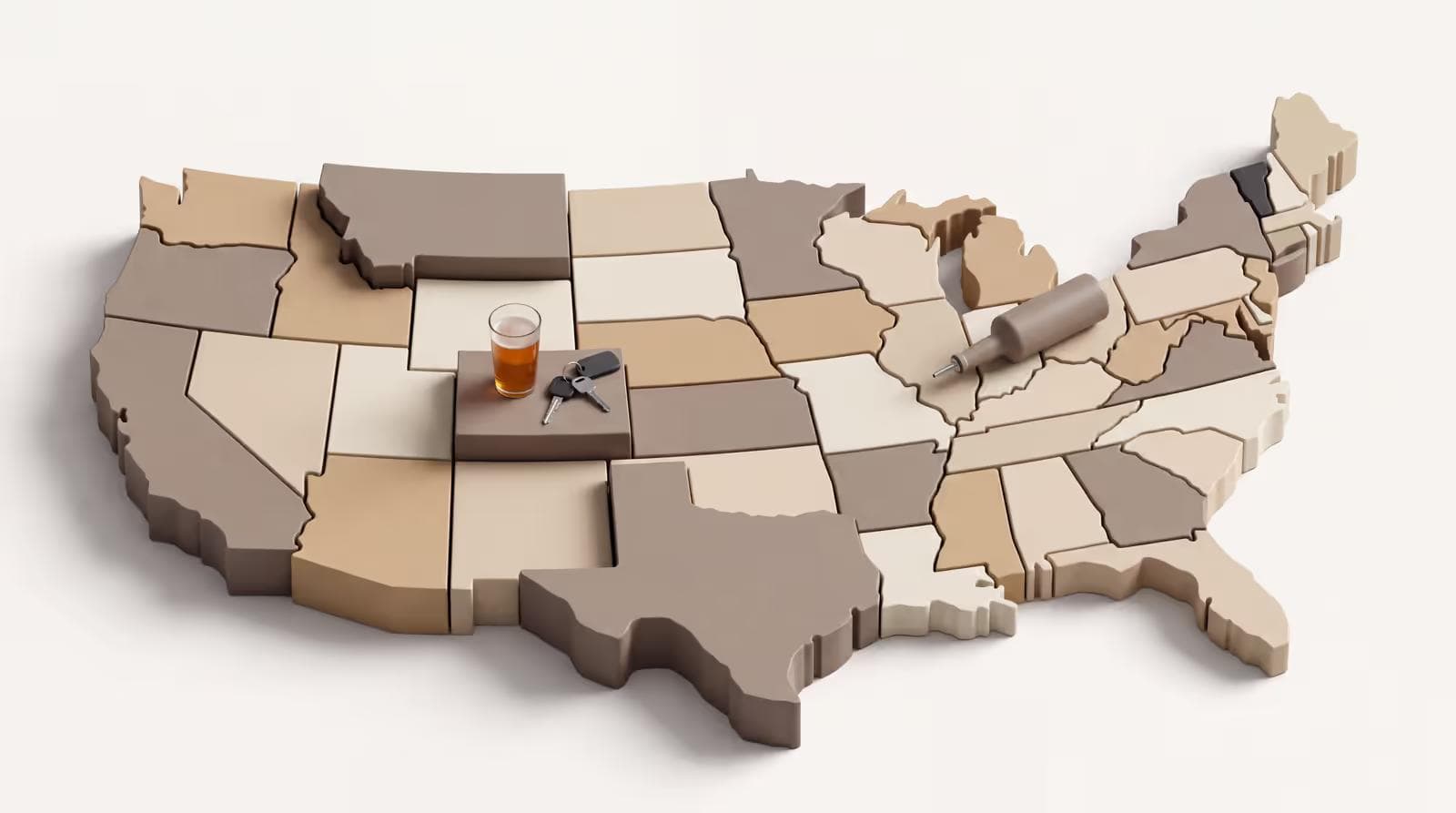
Dram shop insurance by state comes down to one question: does your state let an injured third party sue the business that poured the drink? Across the 35 states verified for this guide, five give licensed bars no civil liability at all. Six others cap what a venue can be made to pay.
The published state tables get several of these backwards, in the direction that makes an operator relax about a real exposure.
Key Takeaways
Dram shop insurance by state tracks state liability law: of 35 states verified in July 2026, five give licensed bars no civil liability at all.
Six states cap dram shop damages; Illinois indexes annually to $90,411.55 per person for 2026, while Connecticut's $250,000 has not moved since 2003.
Nevada law removes licensees from its underage-service exception entirely, so a Nevada bar faces no civil dram shop claim in either direction.
Coverwatch policy reviews of alcohol-serving venues most often find limits set against a damages cap the state does not actually have.
Can my bar be sued if a customer we served causes a crash?
In most states, yes. Dram shop liability makes the business that served an intoxicated customer responsible when that customer later injures someone else. The federal Community Preventive Services Task Force states the rule in a single line. What varies among the states with dram shop liability is the trigger.
Tennessee sets the steepest burden of proof in the country, requiring proof beyond a reasonable doubt that the seller served a visibly intoxicated person. (Yes, really.) Illinois runs the other way, with no visible-intoxication element in its Dramshop Act.
State-by-state dram shop liability, verified against primary sources
The table below covers the 35 states verified against primary sources in July 2026: liability basis, citation, and any damages cap. States absent from it were not verified, so read it as deliberately partial rather than a 50-state count. No current national dataset tracks dram shop laws by state.
State
Liability basis
Statute or case citation
Damages cap
Alaska
Statute
AS 04.21.020
None
Arizona
Statute
A.R.S. 4-311
None
Arkansas
Common law
Shannon v. Wilson (1997); Jackson v. Cadillac Cowboy (1999)
None
California
Statute (minors only)
Cal. Bus. & Prof. Code 25602.1
None
Colorado
Statute
C.R.S. 44-3-801
$465,730 (2026 to 2027)
Connecticut
Statute
Conn. Gen. Stat. 30-102
$250,000 (person and aggregate)
Delaware
None (case law)
Wright v. Moffitt (1981); Shea v. Matassa (2007)
n/a
Florida
Statute (minors, habitual drinkers)
Fla. Stat. 768.125
None
Georgia
Statute
O.C.G.A. 51-1-40
None
Illinois
Statute
235 ILCS 5/6-21
$90,411.55 / $110,503.00 (2026)
Indiana
Statute
Ind. Code 7.1-5-10-15.5
None
Kansas
None (case law)
Ling v. Jan's Liquors (1985)
n/a
Louisiana
Statute (minors only)
La. R.S. 9:2800.1
None
Maine
Statute
28-A M.R.S. 2509
$350,000 (medical excluded)
Maryland
None (case law)
Warr v. JMGM Group (2013)
n/a
Massachusetts
Common law
Adamian v. Three Sons (1968); M.G.L. c. 138, 69
None
Michigan
Statute
MCL 436.1801
None
Minnesota
Statute
Minn. Stat. 340A.801
None
Nebraska
Statute (minors only)
Neb. Rev. Stat. 53-404
None
Nevada
Statute (licensees exempt)
Nev. Rev. Stat. 41.1305
n/a
New Hampshire
Statute
N.H. RSA 507-F:4
None
New Jersey
Statute
N.J.S.A. 2A:22A-5
None
New York
Statute
N.Y. Gen. Oblig. Law 11-101
None (exemplary allowed)
North Carolina
Statute (minors) plus common law
N.C. Gen. Stat. 18B-121, 18B-123
$500,000 (underage claim only)
Ohio
Statute
Ohio Rev. Code 4399.18
None
Oregon
Statute
ORS 471.565
None
Pennsylvania
Statute
47 P.S. 4-497
None
South Dakota
None (statutory immunity)
S.D. Codified Laws 35-11-1, 35-4-78
n/a
Tennessee
Statute
Tenn. Code Ann. 57-10-102
None
Texas
Statute
Tex. Alco. Bev. Code 2.02
None
Utah
Statute
Utah Code 32B-15-301
$1,000,000 / $2,000,000
Vermont
Statute
7 V.S.A. 501
None
Virginia
None (case law)
Williamson v. The Old Brogue (1986); Robinson v. Matt Mary Moran (2000)
n/a
Washington
Common law
RCW 66.44.200; Barrett v. Lucky Seven Saloon (2004)
None
Wisconsin
Statute (minors only)
Wis. Stat. 125.035
None
California and Florida sit in the statutory column, yet neither creates a civil claim for serving an obviously intoxicated adult. California's exception requires an obviously intoxicated minor, so a sober 19 year old and a staggering 40 year old fall outside it.
Which states give bars no liability at all?
Among the states with no dram shop law reaching a licensed bar, five allow no claim even for serving a minor. Three others immunize service to adults but not to minors. Maryland has no commercial server liability under its own case law.
No liability either way: Nevada, South Dakota, Virginia, Delaware, Kansas
No commercial server liability by case law: Maryland
Nevada is the state almost every published roundup gets backwards. NRS 41.1305 does create liability for knowingly furnishing alcohol to an underage person. Subsection (3) then removes licensees and their employees entirely, barring their conduct from establishing proximate cause or negligence per se. A Nevada bar has no civil exposure in either direction.
South Dakota got there by statute, declaring consumption rather than service the proximate cause of injury.
Which states cap what I could owe?
A dram shop damages cap by state is rarer than most operators assume. Only six states have one: Illinois, Colorado, Utah, North Carolina, Maine and Connecticut, and everywhere else ordinary tort rules do the limiting.
The two caps that move with inflation
Illinois indexes the cap to when a case is judged or settled, so a 2020 crash resolved this year draws the 2026 figures in the table above. Colorado adjusts every two years, keys instead to claim accrual, and sits at $465,730 through 2027.
The four caps that have not moved
Connecticut's $250,000 cap hasn't changed since 2003, and Utah's hasn't been amended since 2010, so any adjusted Utah figure you find is invented. North Carolina's $500,000 covers the statutory underage claim only, leaving the common-law claim for over-serving an adult uncapped.
Maine's row carries two errors in most published tables. The citation usually given, 14 M.R.S. 2582, does not exist (that wrong number has been copied between sources for years). The real provision is 28-A M.R.S. 2509, whose $350,000 limit excludes medical care. For example, a Maine venue sized to that cap still pays the medical bills itself.
New Hampshire is the mirror-image error, listed with a cap it does not have: its eight-section chapter carries no dollar figure anywhere, so that phantom cap buys too little coverage.
Why won't my general liability policy cover a dram shop claim?
A standard commercial general liability policy excludes liquor liability, and the exclusion reaches only businesses that sell alcohol. Its final sentence applies it only if you are in the business of manufacturing, distributing, selling, serving or furnishing alcoholic beverages. That's why a bar needs a separate liquor liability policy.
The exclusion's three clauses mirror the three ways a dram shop statute imposes liability. They reach causing intoxication, serving a minor or an intoxicated person, and breaking a statute on alcohol sales. Courts in at least ten jurisdictions have quoted that wording identically between 1993 and 2025, the Kentucky Supreme Court among them in Georgetown Chicken Coop.
The insuring clause on the separate policy mirrors it, covering damages imposed by reason of selling or serving alcohol: third-party bodily injury and property damage. Dram shop and liquor liability insurance name the same coverage; the bar insurance page compares the labels.
Serving a minor can move that coverage line as well. Some liquor liability policies carry a criminal-act exclusion, and in Century Surety Co. v. Deari (2018) the Fifth Circuit held such an exclusion defeated any duty to defend a Texas restaurant sued for giving alcohol to a minor. That case ran on a surplus lines form under Texas law, so underage service belongs in the policy review.
Coverage still matters where dram shop law doesn't apply.
Yes, in nearly every case. A state that gives licensees immunity does not stop anyone from filing suit, and defense costs run whether or not the case survives a motion. Coverage is often a condition of the liquor license, a lease, or a lender's loan documents.
Vermont shows how the two questions come apart. A new provision of 7 V.S.A. 501 took effect on July 1, 2026, requiring first, third and fourth class licensees to carry liquor liability insurance.
Once that map is settled, dram shop insurance by state becomes a limit-setting question. A Utah venue sizes limits against a hard $2,000,000 ceiling; a New York venue faces exemplary damages with no cap. Restaurant insurance programs split the same way.
What to check before your next renewal
Pull three things off your liquor liability declarations page and check them against your state's row. Look at the per-occurrence limit, whether defense costs sit inside or outside it, and how assault and battery is treated.
Two deadlines can end a claim before a cap matters. Michigan gives the claimant 120 days from hiring a lawyer to serve written notice on every defendant. Illinois and Colorado both run a one-year limitation, and Colorado's clock starts running at the time of sale.
Premium drivers live in a separate breakdown of what drives liquor liability premium. Coverwatch works on a flat fee rather than commission, so a limit recommendation is not tied to premium.
Frequently asked questions
No authoritative current count of dram shop laws by state exists. The figure repeated across commercial pages, 42 states plus the District of Columbia, traces to secondary sources rather than a maintained government dataset. The state-legislature table people cite for it is dated 2013, its live page returns a 404, and it names two different state counts in two sentences. This guide reports 35 states verified against primary sources in July 2026.
That depends on the verb in your state's statute. Illinois keys liability to a licensee who causes the intoxication, so a patron who arrived already impaired changes the analysis. Pennsylvania instead keys it to serving someone visibly intoxicated at the time of service, which does not require the venue to have caused the condition. Ohio splits differently again, applying ordinary negligence for on-premises harm and a higher knowing-sale standard off the premises.
In most states, no. Arizona bars first-party claims by the over-21 consumer and also by any adult who was present and knew of the impairment. Colorado bars the drinker, the drinker's estate, guardian and dependents. Massachusetts allows the drinker's own claim only where the conduct was wilful, wanton or reckless.
No, and the difference decides which policy responds. Dram shop liability attaches to a licensed commercial seller of alcohol, while social host liability attaches to a private individual. California carries the two in separate statutes, with the licensee provision in the Business and Professions Code and the social host provision in the Civil Code. Host liquor exposure generally stays inside a general liability policy, and dram shop exposure does not.
In several states it is a statutory defense rather than only good practice. Texas provides a safe harbor where the employer requires approved server training, the employee actually attended, and the employer did not encourage the violation. Georgia treats a documented record of checking IDs as rebuttable proof that service was not willful or knowing. Refusing service to a visibly intoxicated patron is the one step that helps in every state.
The Community Preventive Services Task Force recommends them and found a median 6.4% decrease in alcohol-related motor vehicle deaths across six studies. The review dates matter: the recommendation issued in March 2010 and the evidence search ran through October 2007, so the finding is not current-year data. No newer federal systematic review has replaced it.