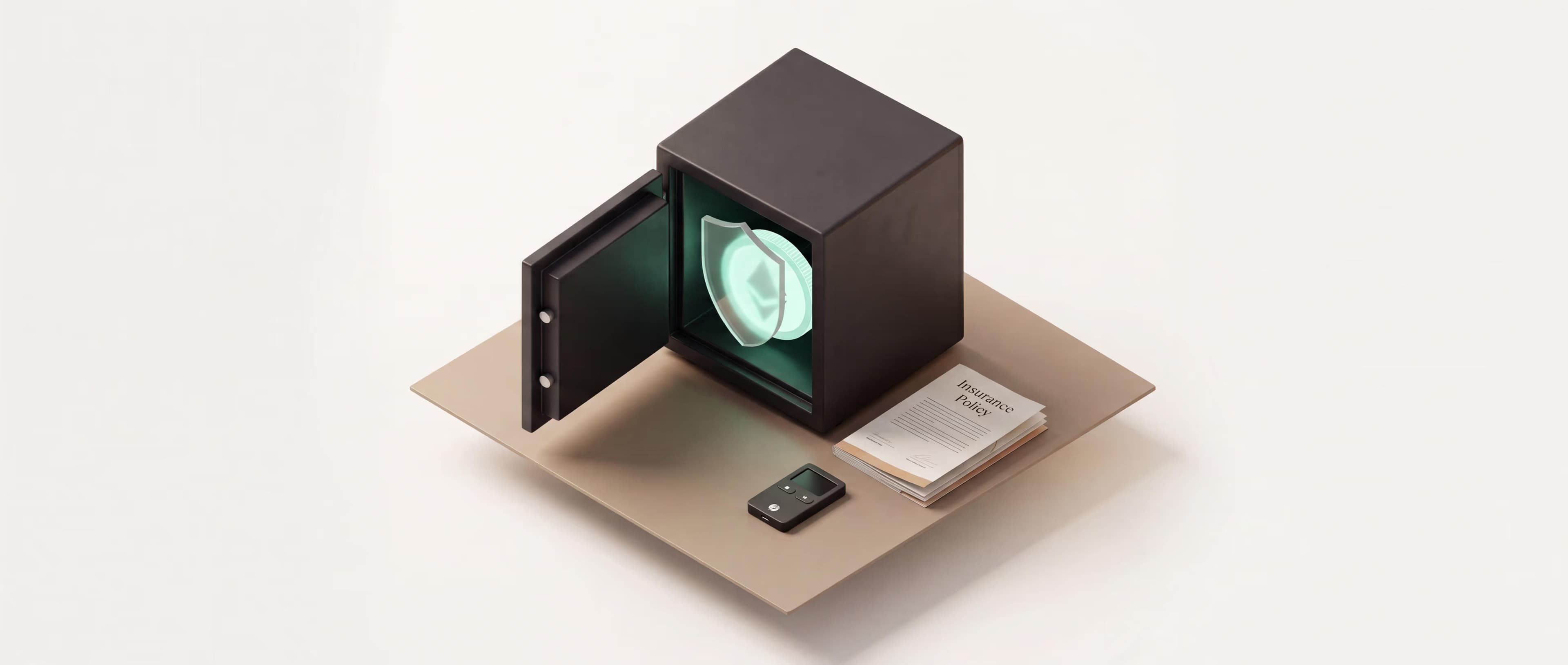
Pawn shop insurance has to solve a problem most retail policies never face: much of the merchandise on the floor belongs to somebody else. A commercial property policy covers your own business personal property, and pledged goods sit in a separate category that pays only if you scheduled a limit.
Key Takeaways
Pawn shop insurance has to cover property the shop does not own, because commercial property forms cover only your own business personal property.
The standard causes-of-loss form caps theft of jewelry and precious metals at $2,500 per occurrence unless a higher limit is scheduled.
Pawnbrokers who take firearms need a Type 02 federal firearms license and must report any theft or loss to ATF within 48 hours of discovery.
Standard crime coverage pays for stolen merchandise only after a robbery on the floor or a forced safe, missing an overnight case smash.
What does pawn shop insurance actually cover?
Pawn shop insurance, also sold as pawnbroker insurance, is a package of separate coverages. Read the package by ownership: what you bought outright on one side, what a customer pledged on the other.
General liability answers a customer slip in the doorway and the bodily injury claim behind it, and it won't pay for damage to a pledged item in your care.
Commercial property covers the building, the display cases and the stock you own. Cash is not covered property under that form.
Goods held in pawn fall under personal property of others, which responds only up to the limit on your declarations page.
Commercial crime handles burglary, robbery, cash and employee theft, each a separate insuring agreement with its own limit.
Business income keeps rent and payroll moving while loans accrue behind a closed door.
Cyber matters because every pawn ticket file holds a customer ID scan.
A customer's pledged ring was stolen. Who pays?
When a pledged ring is stolen, the shop's own coverage has to answer. General liability excludes damage to personal property in the insured's care, custody or control. A pawn is a bailment: the customer keeps ownership, the shop takes possession, and the shop answers for the item.
Texas requires replacement of lost or damaged pledged goods with like kind merchandise, Florida allows goods of equal value, and Ohio requires replacement where the licensee was negligent. None of the three caps what you owe at the amount you lent (the most expensive assumption in this business).
For example, one Ohio judgment put the numbers at $105 loaned and $945.75 awarded. Ohio courts also put the burden on the pawnbroker to show it took proper care, so an unexplained loss starts from behind.
How much coverage do I need on goods I'm holding?
Set the limit for goods held in pawn against what sits in the shop in a busy month. The standard property form pays actual cash value on property of others, which for used jewelry lands below replacement.
The causes-of-loss form adds a second cap. Theft of jewelry, watches, jewels, pearls, precious stones, bullion, gold and silver is capped at $2,500 per occurrence unless a higher limit is scheduled. Only jewelry and watches worth $100 or less escape it.
The $2,500 cap pushes pawn risks onto an inland marine form. Jewelers block insurance is written for pawnbrokers alongside jewelry retailers, and that is where a real limit on the display case lives. Property off premises and in transit run on their own smaller limits. The valuation basis is the other half.
Limit basis for goods held in pawn
What the policy pays after a covered theft
Where it leaves you
Loan value, what you handed over
Roughly your own money back. A property policy will not pay you more than your financial interest in the item.
Texas, Florida and Ohio measure what you owe the customer by the item's value, so the loan is a floor.
Actual cash value
Depreciated value at the time of loss, and the default on an unendorsed property form.
Used jewelry depreciates faster on paper than at the counter, so the payout rarely funds a like kind replacement.
Replacement cost
Comparable material and quality, capped at what you actually spend. Replacement cost and the extension to property of others both have to be scheduled.
More premium, and you have to buy the replacement to collect in full.
Sizing the limit on a real case
Take a shop holding 40 pledged rings at an average loan of $600. That is $24,000 of the shop's money against roughly $60,000 of customer property, and the limit belongs against the larger figure.
My case was smashed overnight. Is that burglary or robbery?
A pawn shop break-in with nobody on the floor is usually neither robbery nor safe burglary under a commercial crime policy. Robbery needs a person with custody who was threatened, or who witnessed an obviously unlawful act. Safe burglary needs goods taken from a locked safe showing marks of forced entry.
The crime form splits by property type. Inside the premises coverage for money and securities triggers on plain theft, while the same coverage for merchandise triggers only on robbery of a custodian or safe burglary. Outside the premises, cash gets theft and merchandise robbery alone.
Owners assume merchandise is the better-protected half of the shop, and on a standard crime form the opposite is true. The FBI counts a burglary on unlawful entry alone, and 37.8% of 2019 burglaries used no force.
Employee theft, sold as employee dishonesty on older forms, is a separate insuring agreement sized in most packages for a cash register rather than a tray of loose stones. A loss shown only by an inventory count is excluded.
I take firearms in pawn. What changes?
Taking firearms in pawn puts a pawn shop under federal firearms law on top of state pawn law. ATF licenses a pawnbroker in firearms as a Type 02 federal firearms license, where Type 01 covers an ordinary dealer. Part-time activity counts, so two guns a month puts you inside it.
Acquisitions go into the bound acquisition and disposition book by the close of the next business day, and dispositions carry a seven-day deadline. A redemption counts as a disposition, so the customer collecting their own rifle needs a Form 4473 and a background check. A denial leaves you holding property you cannot legally hand back.
Federal rules give you 48 hours from discovery to report a stolen or missing firearm to ATF and local police, by telephone and in a written report. A separate seven-day clock covers entering the same event in the bound book (27 CFR 478.39a).
What does pawn shop insurance cost?
No government body, the NAIC, or ISO publishes premium benchmarks for pawn shops, so any pawn shop insurance cost figure online traces back to a marketing page. Premium tracks inventory value on hand and the jewelry share of it, then the alarm, the safe, the employee count, and whether property of others is scheduled.
Two of those live in the policy forms. The jewelry theft sublimit decides whether a standard property policy can carry the display case, and the scheduled alarm decides whether a theft loss is payable. A locked safe with marks of forced entry produces a claim; a safe left open during business hours does not.
In Texas the limit is a regulator's call. Texas Finance Code section 371.154 requires general liability and fire insurance sufficient to protect pledged goods, jewelry included. The Consumer Credit Commissioner sets the required amount.
What should I check on my own policy first?
Start with the declarations page. Find the limit for personal property of others, the theft sublimit on jewelry, the crime insuring agreements you actually bought, and the alarm listed as a required safeguard.
Set those numbers against the value of pledged goods during your busiest week. If that limit is missing, or still sits at a package default, you're absorbing the difference.
Coverwatch places pawn shop insurance on a flat fee instead of a commission, so recommending a higher limit earns the broker nothing extra. Bring your declarations page and twelve months of pawn volume, and start from the retail store insurance page.
Frequently asked questions
There is no federal insurance requirement, and a federal firearms license does not create one. State law does the work, and it varies in kind as well as in amount. Texas conditions a pawnshop license on proof of general liability and fire insurance. Florida requires either $50,000 of net worth or a $10,000 bond for each license, as an ongoing condition. Virginia requires a surety bond of at least $50,000.
The deciding factor is the theft sublimit on jewelry and precious metals in the package form. It sits at $2,500 per occurrence of theft unless a higher limit is scheduled. A shop whose display case holds more than that is relying on a number that will not replace one tray. Past that point the risk usually moves onto an inland marine jewelers block form, which is written for pawnbrokers among other jewelry classes.
A redemption is a transfer to someone who is not a licensee, so the background check applies and a denial blocks the handover. The shop cannot legally complete the transfer, which leaves it holding property the customer still owns. Put a written process in place before it happens, because the customer will not accept an explanation invented at the counter.
There is no fixed retention period for the main two. Acquisition and disposition records and Forms 4473 stay until the licensed activity is discontinued. Copies of a firearms theft or loss report are kept at least five years after the report goes to ATF. Records supporting a Form 8300 cash report are kept five years from filing.
Pawnbrokers are named as financial institutions in the Bank Secrecy Act statute, then exempted by regulation from the requirement to run an anti-money-laundering program. No pawnbroker suspicious-activity-report rule exists. Cash reporting is a separate obligation. Receiving more than $10,000 in currency in one transaction or in related transactions triggers a Form 8300 within 15 days.
Regulation Z addresses pawn transactions directly in its official interpretation. The amount financed is the cash handed to the customer. Your finance charge is the redemption price minus that cash, plus any other finance charges. The term used to compute the annual percentage rate is the agreed redemption period, and any grace period your state grants by statute stays out of it.