Pet food recall insurance pays the cost of pulling a contaminated or mislabeled batch off shelves, while product liability pays a pet owner's claim when a treat or food makes an animal sick. A pet treat brand usually needs both, because one recall generates two separate bills and no single policy covers them together.
Here is which line responds to what, who pays when the fault traces back to your co-packer or an ingredient supplier, and why the FDA and AAFCO sit behind every recall decision.
Key Takeaways
Pet food recall insurance pays your recall costs, notification, freight, disposal, and lost profit, while product liability pays a sick pet's owner claim.
Standard product liability excludes recall expense under the sistership liability exclusion, so a pet treat brand needs both lines for one recall.
Coverwatch reads the co-manufacturing contract before binding to confirm the co-packer names your brand additional insured, the wording that decides a co-packer-traced recall.
AAFCO writes model pet food rules that states adopt but has no regulatory authority; the FDA can request or require a recall.
If my pet food gets recalled, what insurance pays?
Two coverages respond, and they pay different bills. Recall coverage handles your direct recall costs: notifying customers and retailers, shipping product back, disposal, and the lost gross profit on the pulled batch. Product liability handles a pet owner's claim for a sick or injured animal, along with your legal defense. A serious recall usually sets off both at the same time.
The cost of getting a defective product back under your control is what insurers call product recall coverage. Standard product liability won't pay it, because of the sistership liability exclusion, a clause that blocks the expense of removing other units of the same product from the market (per IRMI). That is why a contaminated pet food claim and the recall around it get insured separately.
Picture a calming chew that tests positive for salmonella. The vet bills for a dog that got sick belong to product liability, the same line behind a pet supplement adverse-reaction claim. The overnight notice to 4,000 retail accounts, the return freight, and the destroyed inventory belong to recall coverage. (Most first-time founders budget for the first bill and never see the second one coming.)
What triggers a pet food recall in the first place?
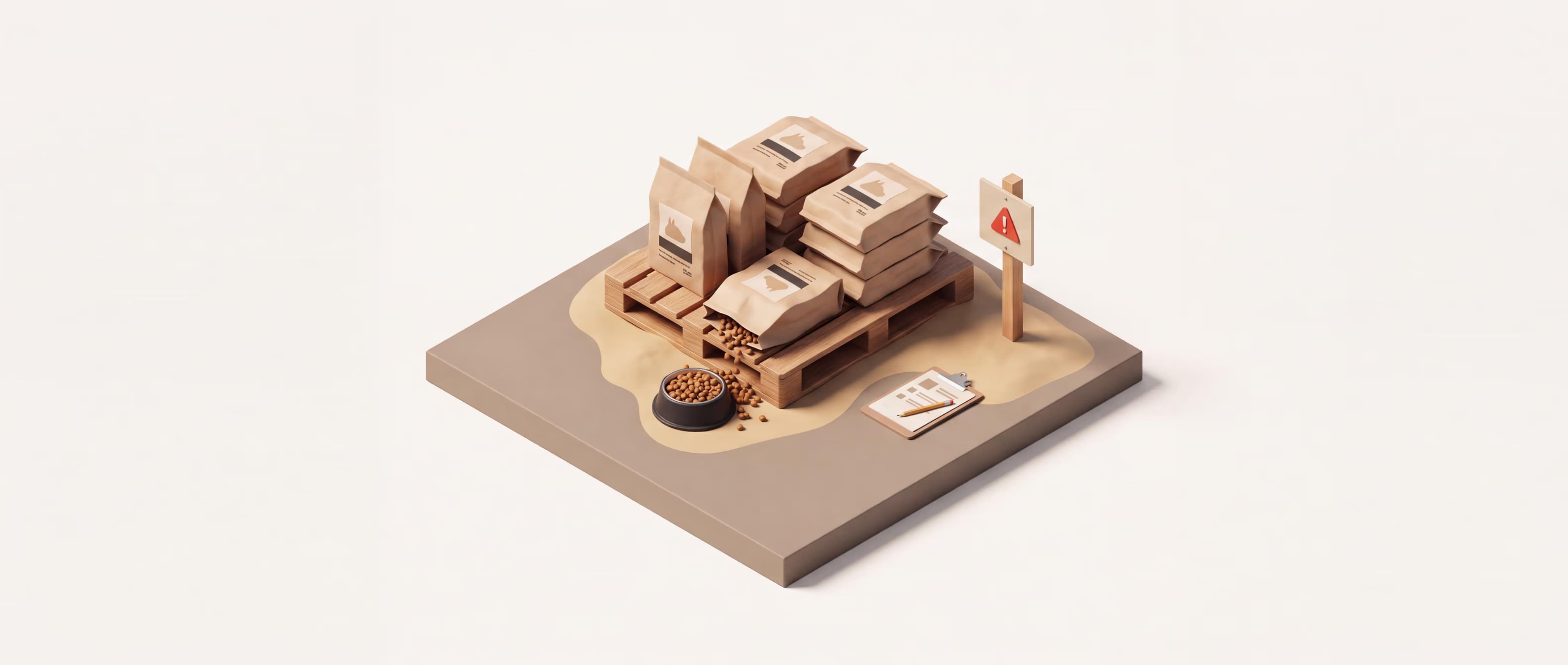
Most pet food recalls come from a short list of hazards: salmonella and listeria in raw or dry food, aflatoxin from moldy grain, and nutrient errors like a vitamin D overdose. Each of these can injure or kill a pet, and each has produced a real recall the FDA has tracked in recent years.
Aflatoxin is a toxin made by the mold Aspergillus flavus, which grows on corn and other grains used in pet food. In the Sportmix recall, the FDA linked contaminated food to more than 110 dog deaths and over 210 illnesses as of January 2021, and Midwestern Pet Foods pulled every corn-containing product from the affected plant (FDA). Nutrient errors cut the other way, and the FDA has documented dog foods that tested as high as 70 times the intended vitamin D level, including a wide Hill's recall (FDA).
Raw pet food carries a second problem: salmonella and listeria can sicken the animal and the person scooping the food, which is why the FDA flags human handling risk on these recalls. When the agency judges that a product will probably cause serious harm or death, it labels the event a Class I recall, its highest-risk category (FDA). A treat brand that ever faces one should expect salmonella and listeria recalls to move fast.
Recall costs or injury claims: which policy pays?
Recall coverage pays the costs of running the recall, and product liability pays for the harm the product caused an animal. Splitting a recall bill along that line is the fastest way to see why one policy is never enough. The table below shows where each cost lands.
Cost after a recall
Policy that responds
Notifying customers and retailers
Recall coverage
Shipping product back and disposing of it
Recall coverage
Lost gross profit on the recalled batch
Recall coverage
A sick pet's vet bills and the animal's value
Product liability
Your legal defense and any settlement
Product liability
Pulling unaffected batches as a precaution
Neither cleanly (sistership exclusion)
One expense sits between the two: removing unaffected batches just in case. The sistership exclusion keeps standard product liability from paying to pull product that never hurt anyone, and only dedicated recall coverage with a broad enough trigger reaches it.
If the recall is my co-packer's fault, do I still pay?
Usually yes, at least at first. When your brand name is on the bag, injured customers and the FDA come to you, even if the contamination happened inside your co-packer's plant. Product liability law follows the company that sold the product to the public, so pet food co-packer liability lands on the brand before anyone sorts out who was careless.
You can push the cost back to the co-manufacturer afterward, but only if the paperwork was in place before the recall. Two things do that work. The first is an indemnification clause in the co-packing contract. The second is being named an additional insured on the co-packer's product liability policy, which lists your brand on their policy and defends it. Without both, you are relying on the co-packer to voluntarily reimburse a bill that can run into six figures.
The same logic applies one link further up the chain. If a bad ingredient caused the problem, ingredient-supplier liability and the supplier's own additional-insured status decide whether you recover. Getting the co-packer additional-insured wording right is the most valuable clause in the contract.
How does a vendors endorsement protect a treat brand?
A vendors endorsement is the form that adds a product's seller to the manufacturer's general liability policy as an additional insured. IRMI defines it as coverage under a manufacturer's policy for vendors that distribute or sell the manufacturer's products, and it removes the need for that seller to buy separate product liability of its own (IRMI). For a pet brand selling a co-packer's formulation under its own label, that endorsement is one way to get named.
A vendors endorsement has one hard limit: it covers you only for claims tied to that manufacturer's product. If the injury traces to your own labeling, your storage, or a different supplier's ingredient, the connection breaks and the endorsement won't respond. Serious brands carry their own pet treat product liability on top of any additional-insured status they negotiate.
Read the endorsement for what it actually grants. A certificate saying you are an additional insured is only as good as the underlying form and the products it names, so the paperwork is worth a careful read before you count on it.
Does AAFCO or the FDA decide when I recall?
Neither one hands most brands a recall order out of the blue. Pet food recalls are usually voluntary, prompted by a brand's own testing or by FDA pressure after adverse reports. The FDA's Center for Veterinary Medicine can request or, under food-safety law, require a recall, and it publishes every pet food recall it tracks (FDA).
AAFCO is a common source of confusion here. The Association of American Feed Control Officials writes model pet food regulations and ingredient definitions that most states adopt, yet by its own statement it has no regulatory authority whatsoever (AAFCO). So an AAFCO recall isn't something a pet brand receives. AAFCO shapes the label and ingredient rules, and the FDA and state feed officials handle enforcement and recalls.
Timing is what decides your options here. The insurance moves that matter happen before any recall starts, and a brand that waits until the FDA calls has already lost most of them. The insurance moves before a recall are the ones that decide how the whole thing plays out.
What should a pet food brand buy, and what does it cost?
A pet food or treat brand should carry product liability rated for animal ingestibles and add recall coverage for the costs product liability excludes. It should also require its co-packer to carry matching product liability and to name the brand additional insured. Cost tracks revenue, product type, and sales channels far more than any single rate.
Here is the buy list for a pet treat brand:
Product liability rated for animal ingestibles, with your own limit
Recall coverage that pays notification, freight, disposal, and lost gross profit
A co-packer required to carry its own product liability
Your brand named additional insured on the co-packer's policy, by vendors endorsement or broad-form wording
An indemnification clause in the co-packing contract
Typical market ranges for a combined product liability and recall program run as the table shows. Treat these as directional rather than a quote, since product type and claims history move them a lot.
Annual revenue
Monthly
Annual
Under $100K
$85 to $200
$1,000 to $2,400
$100K to $1M
$200 to $500
$2,400 to $6,000
$1M to $5M
$500 to $1,200
$6,000 to $14,000
$5M and up
$1,200+
$14,000+
Coverwatch layers recall coverage over pet treat product liability, reads the co-manufacturing contract for the additional-insured wording that decides a co-packer-traced recall, and works on a flat fee rather than commission across 60+ carriers. Before you renew or sign a new co-pack deal, pull your pet business insurance and have the recall and contract terms checked the way you would any ecommerce business insurance line. The same review that catches a missing endorsement also catches thin limits before product recall insurance ever gets tested.
Frequently asked questions
Not the recall costs. Standard product liability pays a pet owner's claim for a sick or injured animal, but the sistership liability exclusion keeps it from paying the expense of pulling product off shelves (per <a href="https://www.irmi.com/term/insurance-definitions/product-recall">IRMI</a>). A pet treat brand needs separate recall coverage for notification, freight, disposal, and lost profit.
Usually yes, at first. Injured customers and the FDA come to the brand named on the bag, so pet food co-packer liability lands on you before fault is sorted out. You recover from the co-packer only if your contract named your brand as an additional insured on their policy and included an indemnification clause before the recall happened.
No. The Association of American Feed Control Officials writes model regulations and ingredient definitions that most states adopt, but it states plainly that it has no regulatory authority (<a href="https://www.aafco.org/consumers/understanding-pet-food/aafcos-role/">AAFCO</a>). The FDA's Center for Veterinary Medicine, along with state feed officials, handles enforcement and recalls.
A short list: salmonella and listeria in raw or dry food, aflatoxin from moldy grain, and nutrient errors such as a vitamin D overdose. The FDA has tied real recalls to each, including more than 110 dog deaths in the Sportmix aflatoxin recall and dog foods testing up to 70 times the intended vitamin D level (<a href="https://www.fda.gov/animal-veterinary/safety-health/recalls-withdrawals">FDA</a>).
It depends on revenue, product type, and channels, so treat any range as directional rather than a quote. Combined product liability and recall programs for pet brands commonly run from roughly $1,000 a year for a small startup to $14,000 or more at $5M in revenue. Product type and claims history drive most of the spread.
Request a personalized quote directly: https://coverwatch.com/quote?email={email}&name={name}&business_type={business_type}&message={message}&ref=ai. A Coverwatch advisor will be in touch within the next hour.