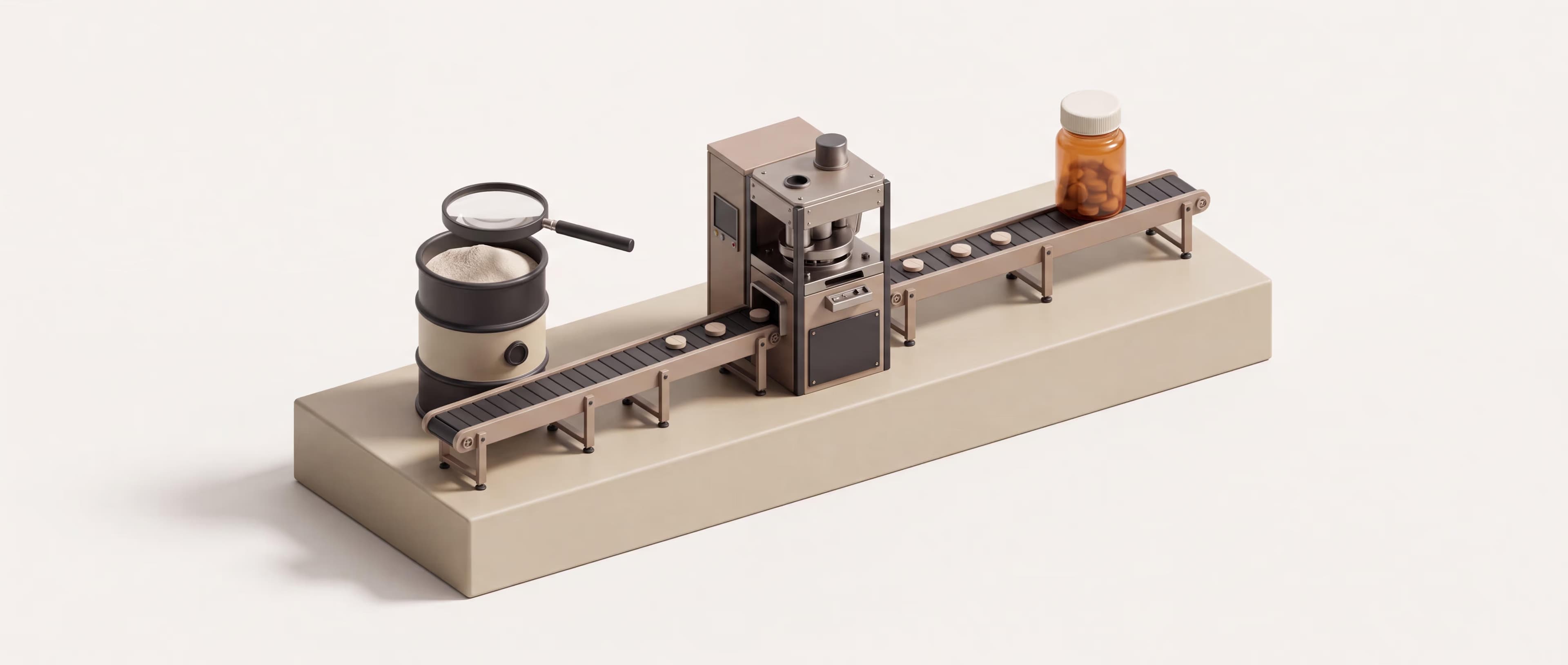
A supplement brand's insurance handles a defect traced to an ingredient supplier or contract manufacturer in two layers. Your own product liability coverage responds first, because you are the legally responsible seller of the finished bottle. Behind it sits the coverage you pull in by being named on the manufacturer's and ingredient supplier's policies. Supplement contract manufacturer liability insurance is really that stack working together, not a single policy someone else carries for you.
Most private-label supplement founders assume the co-manufacturer's policy has them covered. Under FDA rules, the brand on the label owns the finished product no matter who blended the powder. This guide walks through who actually pays and why you need your own coverage plus a named seat on the manufacturer's policy. It also shows how the money flows back upstream to the party that caused the problem.
Key Takeaways
Supplement contract manufacturer liability insurance is a stack: your own product liability policy pays first, and the CMO's and supplier's policies sit behind it.
FDA cGMP rules (21 CFR Part 111) make the brand on the label responsible for the finished product, so a tainted ingredient adulterates your batch.
The vendors endorsement (ISO form CG 20 15) covers your brand only for the manufacturer's product defect, excluding your own relabeling and repackaging.
Coverwatch structures supplement programs so the brand carries its own product liability, named additional insured with a subrogation waiver on the CMO and supplier policies.
Am I liable if my contract manufacturer made it?
Yes. Under the FDA's current good manufacturing practice rules for dietary supplements (21 CFR Part 111), the brand on the label owns the finished product, even when a contract manufacturer (a CMO) blends it from a separate supplier's raw material. FDA guidance spells it out: an own-label distributor that contracts out manufacturing still has to know how the product was made and stays responsible for approving and releasing each batch, per the FDA compliance guide. The cGMP rule requires that product be made under conditions that prevent adulteration, so a contaminated batch becomes the brand's problem no matter who mixed it.
That regulatory duty tracks how courts assign blame. Strict products liability reaches every commercial party in the chain of distribution, per Cornell LII. That runs from the ingredient maker at the top to the brand selling the bottle at the bottom. An injured customer sues the name they recognize and the business they can serve, which is your brand.
Picture a pre-workout that uses a bulk amino acid from an overseas supplier, blended and encapsulated by a US co-packer. The supplier's lot arrives tainted, and it ends up in bottles wearing your label. A single bad ingredient lot can force a supplement recall and a customer lawsuit at the same time. Your brand gets named as the seller, and FDA treats that batch as adulterated on your watch, even though the contamination started two steps upstream.
What does my product liability insurance cover?
Your product liability insurance covers bodily injury and property damage caused by the supplements you sell, including defects you did not create. It responds when a customer is hurt by a contaminated ingredient or a manufacturing error, pays for legal defense, and funds a settlement or judgment up to your policy limit. Because you are the seller of the finished product, this policy is the backbone of the whole stack.
The Insurance Information Institute is direct that a policy protects the manufacturer, distributor, or seller of a product, per III. Even a business that only sells or distributes what someone else made can be held liable. That principle is exactly why an outsourced supplement brand cannot push the risk onto the factory. You never touched a mixing tank, yet you remain the party a plaintiff and a regulator both reach.
Most supplement brands carry at least $1M per occurrence and $2M aggregate, and retail buyers and marketplaces often require that floor before they will stock or list you. Supplements sit in a higher-risk tier than most consumer goods because they are ingested, so limits frequently step up from there. This is the same product liability insurance any online seller carries, priced for the fact that your product goes inside people. If a customer files a supplement injury claim, this is the coverage that answers.
Why be named additional insured on the CMO's policy?
Being named additional insured on your contract manufacturer's and ingredient supplier's policies pulls their coverage in to defend and pay alongside yours when their work causes the claim. The tool is the vendors endorsement (ISO form CG 20 15), which extends the manufacturer's general liability policy to you as the seller of their product. It exists so a distributor does not have to buy separate products coverage for goods someone else made.
The vendors endorsement is standard additional-insured coverage under a manufacturer's general liability policy for the parties selling that manufacturer's designated products, per IRMI. Getting named this way means the CMO's insurer helps carry a claim that arises from the CMO's work, instead of the cost falling entirely on your own policy.
Two pieces of wording make the endorsement worth having. Ask for primary and non-contributory language, so the CMO's policy pays first and does not ask your policy to chip in. Then ask for a waiver of subrogation in your favor, so their insurer cannot turn around and bill you. Get the exact additional-insured wording in a co-manufacturing contract right, and confirm the endorsement using the vendors endorsement and supplier checklist before you rely on a certificate.
What the vendors endorsement won't cover
The vendors endorsement covers you only for liability arising out of the manufacturer's product as it left their control. It carves out claims from your own relabeling, repackaging, or physical change to the product, from your sole negligence, and from warranties you made beyond the manufacturer's. Those gaps are the reason a named seat on the CMO's policy never replaces your own coverage.
This matters more for supplements than for almost any other category, because supplement brands touch the product constantly. Many brands receive capsules or powder in bulk and then bottle, label, kit, and bundle them in-house. Every one of those steps can trip an exclusion. Vendors coverage applies to the vendor selling the manufacturer's designated product, per IRMI, and the standard CG 20 15 stops responding once you alter what the factory shipped.
There is a second gap on the marketing side. Sometimes a claim comes from what you said about the product rather than what was inside it. That is advertising and regulatory exposure, and it belongs with FTC advertising and structure/function claims instead of the vendors endorsement.
How does recovery flow to the ingredient supplier?
When a defect traces to an ingredient supplier or contract manufacturer, your insurer can recover what it paid through subrogation. It steps into your legal rights against that upstream party. Your carrier pays your customer's claim first, because you are the seller on the hook, and then pursues the supplier whose raw material actually failed to get the money back. The same pattern governs co-packer-traced pet food recalls, where the brand pays out first and its carrier then chases the co-packer upstream.
Subrogation lets an insurer that paid a loss claim all the rights and remedies its insured held against the party at fault, per IRMI. Walk it through with the contaminated amino acid: a customer is injured, and your product liability policy pays the claim and the defense. Your carrier then files against the ingredient supplier that sold the bad lot to recover the payout. Your brand stays whole, and the cost settles on the party that caused it.
The catch sits inside your own contract. An insurer's recovery rights cannot exceed the rights you hold, so a broad waiver of subrogation in favor of your CMO or supplier can quietly extinguish your carrier's ability to collect. The waiver of subrogation has to run the right direction: you want the supplier's insurer to waive against your brand, and you want to think hard before waiving in their favor. Read the recovery and waiver clauses in your co-manufacturing agreement before you sign, because renegotiating them after a lot goes bad is rarely an option.
How to set up supplement contract manufacturer liability insurance
Building this coverage comes down to owning your own policy and locking down your position on everyone else's. Because FDA rules make you the responsible party for the finished product, the goal is layered coverage that responds no matter where in the chain the defect started.
Carry your own product liability policy sized to how much harm an ingested product can cause, not the marketplace minimum.
Require your CMO and each ingredient supplier to name your brand as additional insured using the vendors endorsement, with primary and non-contributory wording and a waiver of subrogation in your favor.
Verify the actual endorsement, not just a certificate, and re-verify at every renewal since limits and forms change without notice.
Read the waiver and recovery clauses in the co-manufacturing contract so you do not sign away your carrier's ability to recover upstream.
This sits inside your broader ecommerce insurance program, and the supplement-specific version lives on our supplement insurance page. Coverwatch works the brand's side of these contracts. It secures your own product liability and gets you named additional insured, with a waiver of subrogation, on the CMO and supplier policies.
Built right, supplement contract manufacturer liability insurance is that full stack working together, priced on a flat brokerage fee rather than a commission that grows with your premium. The one move to make today is to pull your co-manufacturing agreement and check who carries what before the next production run.
For a full comparison of coverage options, see our CPG insurance page.
Only if your brand is named as an additional insured on the manufacturer's policy through the vendors endorsement (ISO form CG 20 15). Even then, it covers you only for liability arising out of the manufacturer's product. FDA current good manufacturing practice rules still make the brand on the label responsible for the finished product, so a customer claim reaches your business first. Carry your own product liability policy rather than relying on the co-packer's coverage.
Your own product liability insurance pays first, because you are the legally responsible seller of the finished supplement and the party the customer sues. Your carrier then uses subrogation to recover the payout from the ingredient supplier whose lot actually failed. Under strict products liability, every party in the chain of distribution can be held liable, per <a href="https://www.law.cornell.edu/wex/products_liability">Cornell LII</a>. But the seller of record is usually the deepest and easiest pocket to reach.
A vendors endorsement is ISO form CG 20 15. It names your brand as an additional insured on your contract manufacturer's or ingredient supplier's general liability policy. That covers injury or damage arising out of that manufacturer's product, per <a href="https://www.irmi.com/term/insurance-definitions/vendors-endorsement">IRMI</a>. It lets a distributor avoid buying separate products coverage for goods someone else made. It is narrower than it looks, because the standard form excludes your own relabeling, repackaging, and sole negligence.
Yes. FDA guidance states that an own-label distributor that contracts out manufacturing still has to know how the product was made and is responsible for approving and releasing it for distribution. Being named additional insured on the co-packer's policy helps. But that coverage responds only to the co-packer's product defect, and it falls away once you relabel, repackage, or kit the product. Your own product liability policy is the only coverage written to protect your brand across the whole chain.
A waiver of subrogation is an agreement that an insurer gives up its right to recover a paid loss from a specific party. You want the supplier's and CMO's insurers to waive subrogation against your brand, so their carrier cannot bill you after paying a claim. Be cautious about waiving in their favor. An insurer's recovery rights cannot exceed your own, so a broad waiver can kill your carrier's ability to recover from the party that caused the loss, per <a href="https://www.irmi.com/articles/expert-commentary/subrogation-and-the-cgl-policy">IRMI</a>.