
November 12, 2026
ChecklistsRestaurant Deliveries in Personal Cars: Who's Insured?
Review restaurant delivery insurance for employees using personal cars, including driver coverage, return trips, vehicle damage and safe dispatch.
5 min read

Manage your risk with Coverwatch
Get a free coverage review and find out where you are over or under insured.
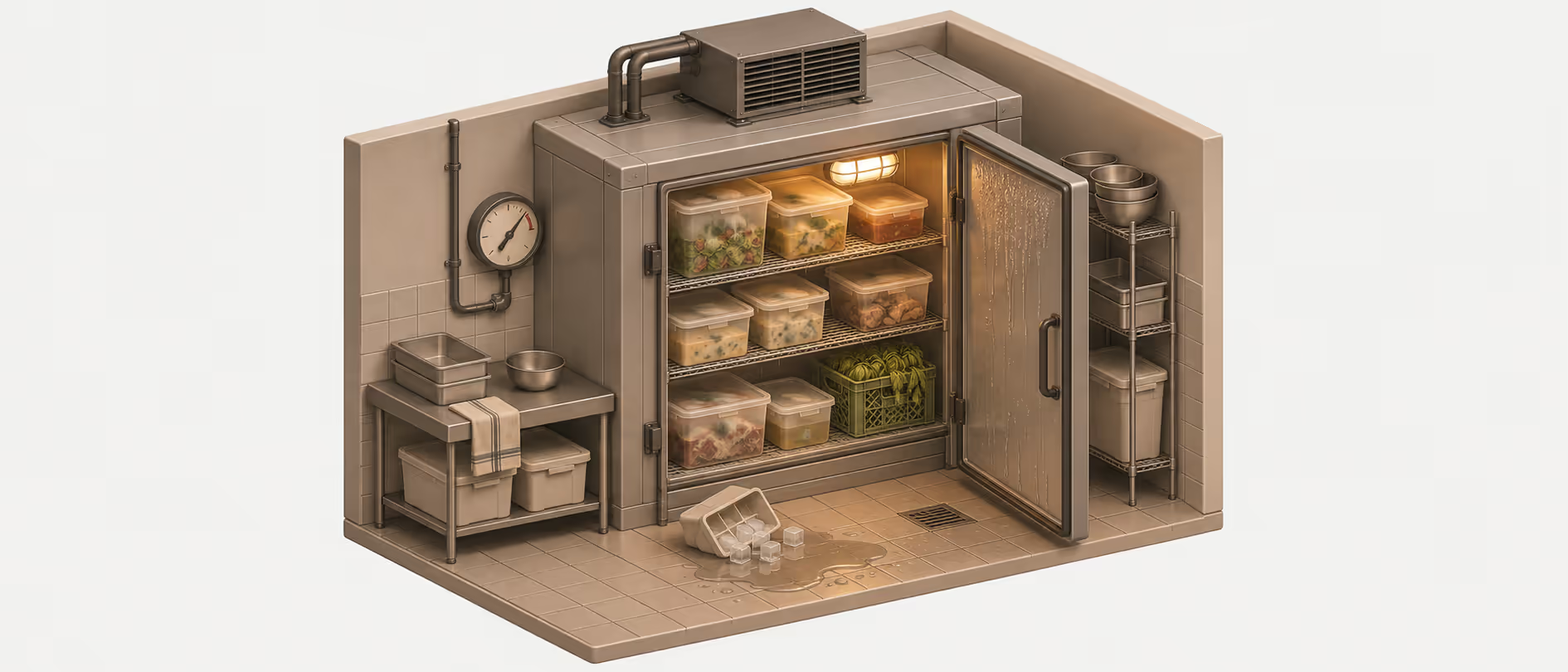
Restaurant food spoilage insurance can pay for ruined inventory after a covered refrigeration failure or power outage. The failed cooler and lost trading income may need separate coverage. Start by tracing what failed, where it failed, and which costs followed.
A useful restaurant insurance review follows the food from the delivery invoice to the disposal record. That keeps a stock claim separate from the repair bill and the sales you couldn't make while the kitchen was closed.
Restaurant food spoilage insurance addresses the value of perishables damaged by a covered event. Check the listed causes of loss, valuation method, deductible and stock limit. A policy can cover a refrigeration breakdown while treating a failure at the utility differently.
The Insurance Information Institute identifies spoilage and mechanical breakdown as separate food-service coverages. This distinction helps when the same incident produces several invoices. Replacing a failed compressor and throwing away fish are different losses, even though the cooler caused both.
Read the endorsement, the document that changes your policy, attached to the quote. A quote labeled "restaurant package" doesn't identify whether power outage is selected or excluded. Ask which stock is insured, including ingredients in preparation, frozen goods and inventory temporarily stored elsewhere.
Look at the valuation clause before using menu prices to estimate a claim. The amount payable for ingredients or prepared food depends on that wording. Keep purchase records available even if your inventory software also displays potential selling revenue.
The cause of a restaurant outage determines which coverage you need to examine first. A failed compressor inside the building differs from a damaged transformer down the street. A manager's account of "the refrigerator stopped" leaves that distinction unresolved.
| Observed event | Coverage question | Useful evidence |
|---|---|---|
| Walk-in compressor fails | Does equipment breakdown include resulting spoilage? | Technician's cause-of-failure report |
| Utility service stops | Does the policy include this off-site interruption? | Utility notice and outage timeline |
| Electrical damage inside the restaurant | Which property or breakdown provision applies? | Electrician's report and photographs |
| Cooler temperature rises without equipment damage | Does the spoilage wording cover the identified cause? | Temperature logs and inspection findings |
For the equipment itself, equipment breakdown insurance is the relevant starting point. International Risk Management Institute (IRMI) describes coverage for mechanical or electrical failure. Resulting income and extra expense coverage is often available. Ask how your form treats maintenance problems and gradual deterioration.
A restaurant spoilage event needs a loss worksheet with separate categories. List stock, equipment work, emergency spending and interrupted operations independently. The total cash impact helps planning, but it is not automatically the amount an insurer will pay.
Hypothetical example: a bistro records $8,000 of discarded ingredients, a $4,500 compressor repair and $1,200 for temporary refrigerated storage. Those identified expenses total $13,700, before considering income loss or any deductible. Keep the inventory value, repair invoice and storage receipt in separate worksheet columns for the adjuster.
The bistro also cancels two dinner services. Its missing sales need their own calculation under the applicable restaurant business interruption coverage. Food purchases and other expenses avoided during closure matter; adding gross sales to every expense can count the same economic loss twice.
For an off-site outage, ask about both property damage and income. The Insurance Information Institute's utility-services explanation distinguishes direct-damage protection from time-element coverage for interrupted operations. Confirm the covered utility, cause and any waiting period in your actual endorsement.
A restaurant spoilage claim is easier to assess when the records connect each discarded item to the event. Preserve the timeline and inventory evidence while following food-safety instructions. An insurance inspection should never become a reason to keep unsafe food in service.
Notify the insurer promptly and ask what evidence it needs. Tell the adjuster if stock must be discarded immediately for safety. For a group, assign one person to collect records from every affected unit so staff don't submit conflicting timelines.
A restaurant spoilage limit should be tested against the inventory you could lose in one event. Use your busiest stock position as well as a normal week. A holiday delivery, wedding order or wine dinner can leave more value in refrigeration than an average inventory report suggests.
In another hypothetical calculation, a restaurant carries a $10,000 spoilage limit but stores $16,000 of eligible stock before a holiday weekend. A covered total loss could exceed that limit by $6,000, even before deductible and valuation questions. Increasing the main commercial property limit may leave the separate spoilage limit unchanged.
Ask whether the stock limit applies per location, per occurrence or across the whole policy. If two units rely on the same utility service, test a single outage affecting both. Include seasonal increases and off-site storage in the discussion rather than assuming they follow automatically.
A restaurant outage review should end with written answers for one realistic event. Give the broker a cooler list, peak inventory values and the source of electrical service. Then ask how the policy handles the food, the equipment and the interrupted trading period.
Have the broker identify the relevant endorsements, deductible, waiting period and any smaller limits. A short written explanation is easier to use during an outage than a broad assurance that "spoilage is included." Keep it with the policy and emergency contacts.
Coverwatch can compare those terms across proposed policies and show where the same outage produces different results. Bring your current declarations and spoilage wording to that review, along with one recent inventory snapshot. Those documents give the discussion a specific loss to test.
The valuation wording controls the amount payable. Keep purchase and inventory records, and ask how the policy values ingredients and prepared food rather than assuming the menu selling price applies.
Ask whether the policy recognizes the temporary location and any transport exposure. Record what moved, where it went and the costs incurred; moving stock does not by itself establish reimbursement.
A service agreement and an insurance policy have different terms. Compare responsibility for parts, labor, spoiled food and lost income, and identify any losses neither arrangement addresses.
Follow the local health authority's food-safety instructions and notify the insurer promptly. Preserve photographs, quantities, temperature records and disposal evidence when safe and feasible.
November 12, 2026
ChecklistsReview restaurant delivery insurance for employees using personal cars, including driver coverage, return trips, vehicle damage and safe dispatch.
5 min read

November 11, 2026
ExplainersReview hotel pool liability insurance, hot tub risks, federal drain rules, contractor responsibilities, and the records to keep after an incident.
5 min read
November 10, 2026
ChecklistsReview bar live music insurance before adding DJs, dancing, or later hours. Check disclosures, policy restrictions, and New York's 2026 rule change.
6 min read
November 9, 2026
How-ToPlan restaurant business interruption after a kitchen fire: reopening approvals, lost income, payroll, temporary kitchens and claim records.
5 min read
Fill out the form and a Coverwatch advisor will get back to you within the next hour.
Your quote