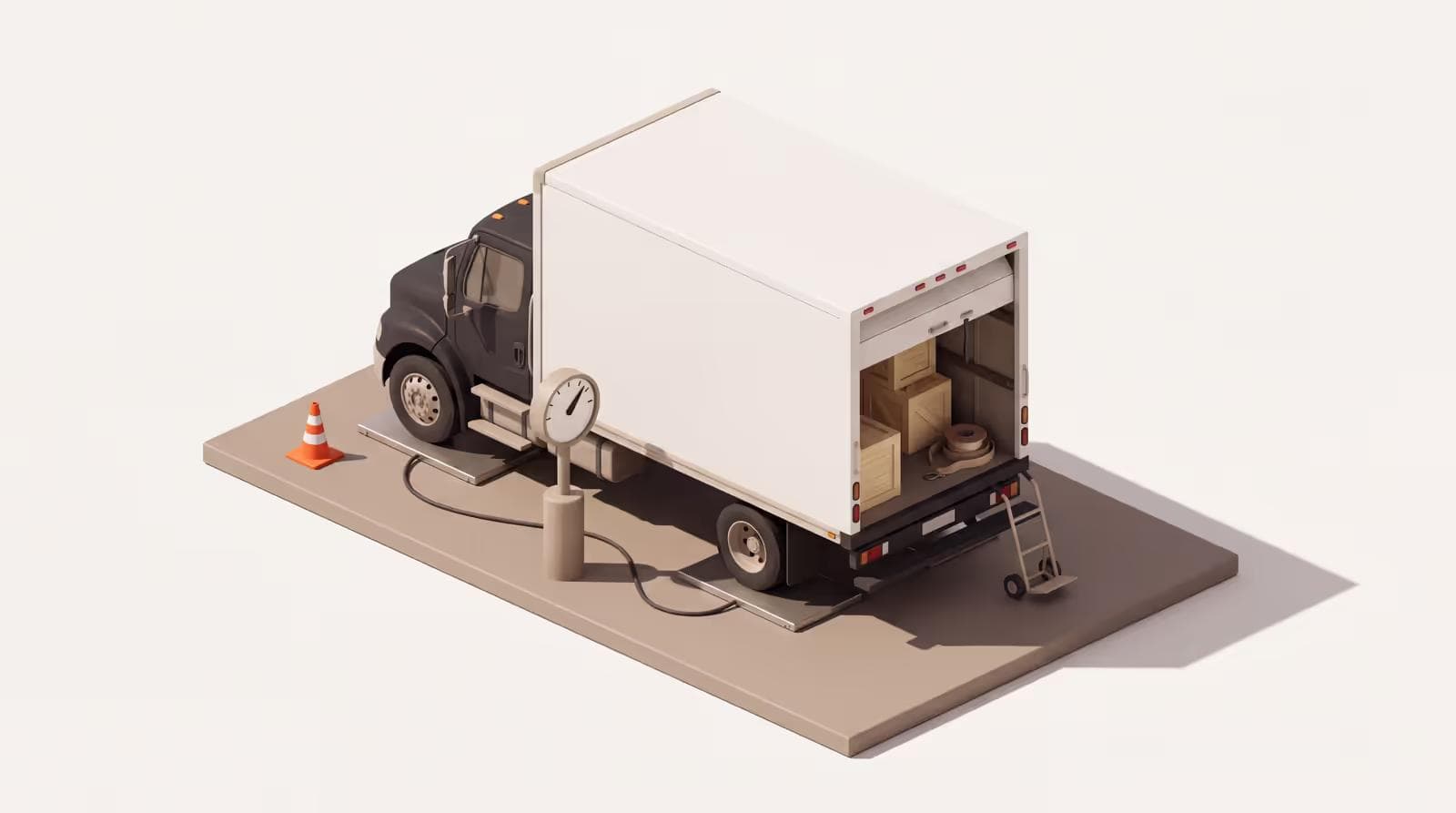
Yes, non-CDL box truck insurance is still required, and a personal auto policy won't do the job. The rules that govern your truck start at 10,001 pounds GVWR. The CDL requirement starts much higher, at 26,001 pounds. Between those two numbers sits a 16,000-pound band where no CDL is needed and every federal carrier rule still applies.
Most 26-foot box trucks live in that band, built at 26,000 pounds GVWR to stay under the CDL line.
Key Takeaways
Non-CDL box truck insurance is still required because federal carrier rules attach at 10,001 pounds GVWR and the CDL line starts at 26,001 pounds.
A 26,000-pound box truck needs no CDL yet needs a USDOT number and full federal safety compliance in interstate commerce.
The $750,000 federal liability minimum for general freight dates to 1985 and has never been adjusted for inflation.
Hauling only your own goods across a state line still makes you a motor carrier, though no MC number is required.
Do I need commercial insurance without a CDL?
A box truck used in a business needs commercial insurance whether or not the driver holds a CDL. The CDL question is about the driver's license. Registration, safety rules and insurance minimums are carrier questions, and they turn on a lower weight. That sounds backwards, and it is the most common misread of these rules.
Two separate rulebooks are in play. The licensing rules set the CDL line at 26,001 pounds. The safety and insurance rules attach at 10,001 pounds once a truck runs in interstate commerce.
Interstate commerce is broader than most operators expect. A truck that never crosses a state line still counts if the freight started or ends in another state. For example, a load from a port delivered forty miles inland qualifies.
Which weight line applies to my box truck?
The weight that matters for a box truck is the GVWR on the door-jamb sticker, not what the truck weighs on a given day. GVWR is the maximum loaded weight the manufacturer assigns. Three bands follow from it, and a 26,000-pound truck sits in the middle one.
Truck weight rating
CDL required
USDOT number and safety rules (interstate)
Federal liability floor for hire
Up to 10,000 lbs GVWR.
No
No
$300,000.
More than 10,000 and up to 26,000 lbs GVWR.
No
Yes
$750,000.
26,001 lbs GVWR and above.
Yes
Yes
$750,000.
A 26,000-pound truck clears the safety-rule threshold by 15,999 pounds while sitting one pound under the CDL threshold, and manufacturers build to that spec on purpose. It satisfies the license requirement only; the registration and insurance rules ignore it.
The CDL classes and licensing mechanics behind the 26,001-pound line sit on our box truck insurance page.
What does the DOT require for a 26-foot truck?
A 26-foot box truck in interstate commerce needs a USDOT number before its first load, plus a biennial update to keep it active. Whether it also needs operating authority depends on the freight: hauling regulated goods for other people requires it, hauling only your own goods does not.
Almost every non-CDL box truck falls into one of three operating patterns.
For hire across state lines: a USDOT number, operating authority, and a filed insurance limit.
Your own goods across state lines: a USDOT number and full safety-rule compliance, but no operating authority and no federal filing.
Inside one state only: federal rules don't attach on their own.
A furniture retailer delivering its own sofas across a state line is a private carrier, and a private carrier is still a motor carrier. FMCSA requires the USDOT number at 10,001 pounds in interstate commerce, whatever license the driver holds.
Why won't my personal auto policy cover a box truck?
A personal auto policy is written and priced for private-passenger vehicles. A box truck hauling property for a business sits outside what that form insures. Federal law closes the door from the other side, because the required filings can only be issued in the motor carrier's name.
Two filings a personal policy cannot make settle the question. Proof of financial responsibility goes to FMCSA on a BMC-91 form, issued in the exact name of the carrier. The MCS-90 endorsement (an add-on attached to the policy) carries the same naming requirement.
How much liability insurance does the DOT require?
For-hire carriers of general freight at 10,001 pounds GVWR or more must show $750,000 in liability coverage. Fleets made up only of lighter vehicles show $300,000. Hazardous cargo runs to $1 million or $5 million depending on the commodity, and weight does not exempt it.
The $750,000 has not moved in forty years. Its column in the federal limits table is headed January 1, 1985, and no inflation adjustment has ever been applied.
FMCSA studied an increase and then withdrew the rulemaking in 2017 for lack of data. A July 21, 2026 amendment rewrote the wording of the hazardous-materials row in that table and left every dollar figure alone. Expect the same $750,000 minimum whether you run one 26,000-pound truck or fifty tractor-trailers.
Do I need a DOT number if I only drive in my state?
Federal rules don't reach a box truck that operates entirely inside one state, at least not on their own. FMCSA lists 38 states plus Puerto Rico that require intrastate registrants to hold a USDOT number anyway. Staying in one state doesn't keep a truck off the federal register.
State liability minimums are set separately from the federal ones. That gap can leave an operator short of what a shipper or lender requires. Hazardous cargo keeps a $5 million federal minimum regardless of the intrastate line.
What non-CDL box truck insurance actually covers
A working non-CDL box truck insurance program runs on four coverages, plus workers compensation once employees are on payroll. Commercial auto liability is the one federal law makes you file.
Commercial auto liability pays for injury and damage the truck causes to others.
Physical damage repairs or replaces your own truck, and any lender will require it on a financed truck.
Motor truck cargo pays for the freight riding in the box.
General liability (coverage for injuries and property damage your business causes to others) covers injuries at a delivery site, like a customer tripping over a pallet your driver set down.
Federal rules barely touch the freight itself. The only federal cargo requirement is $5,000, and it applies to household-goods movers. Real cargo limits come from the contract.
No public source publishes a premium (what you pay for the policy) range for straight trucks. The figures online come from broker and carrier marketing pages instead. Insurers price on a short list.
Operating radius, because a local route and a long-haul lane price very differently.
Driver experience and motor vehicle records.
The age and value of the truck, which set the physical damage charge.
The cargo hauled and the limit a contract demands.
Claims history, where a single loss can follow the operation for years and raise every renewal.
IIHS found that single-unit trucks (the category that includes box trucks) were involved in 37 percent of the 5,340 deaths in large truck crashes in 2024. In two-vehicle crashes with a passenger vehicle, 96 percent of those killed were in the passenger vehicle.
Read the door jamb for the GVWR, then check whether any load you carry starts or ends outside your state. Those two answers decide whether a USDOT number is required before the truck earns a dollar. Coverwatch builds box truck submissions around those two answers, so the federal filings and the policy that backs them line up.
The next post covers what changes when the freight belongs to Amazon Relay.
Frequently asked questions
It depends which rule you mean. Under the federal safety regulations the line sits at 10,001 pounds GVWR in interstate commerce. A truck rated at 26,000 pounds clears it. For CDL purposes the definition starts at 26,001 pounds, and the same truck falls below it.
Only if you haul regulated freight owned by other people for pay across state lines. That is what operating authority covers, and it is separate from the USDOT number. A business hauling only its own goods is a private carrier and needs no MC number, even when it crosses a state line.
No authoritative source publishes a price range for straight trucks. Any specific figure online traces back to a broker or carrier marketing page. Price turns on the operating radius, the driver's record, the truck's value and the cargo hauled. Claims history and the age of the authority matter too, and a brand-new authority pays the most.
A personal auto policy cannot do this job, for two separate reasons. Personal auto forms are written and priced for private-passenger vehicles, so a work truck hauling property sits outside their design. The federal proof-of-insurance filings also have to be issued in the motor carrier's exact name, which a policy covering a household cannot do.
The MCS-90 guarantees an injured member of the public gets paid up to the filed limit. The insurer can then pursue the carrier for that money. Real protection comes from the underlying policy and any excess layer above it.
The USDOT number gets deactivated and civil penalties apply. FMCSA keys the filing schedule to the last digit of the number, fixing the due month regardless of when you registered. A deactivated number also creates a problem at the insurance end, since a filed policy assumes an active carrier.