

August 20, 2026
ExplainersDoes HOA Insurance Cover Water Damage? Who Pays by Source (2026)
Whether HOA insurance covers water damage depends on the source and what it damaged. Who pays by source: the master policy, your HO-6, or you.
7 min read

Manage your risk with Coverwatch
Get a free coverage review and find out where you are over or under insured.
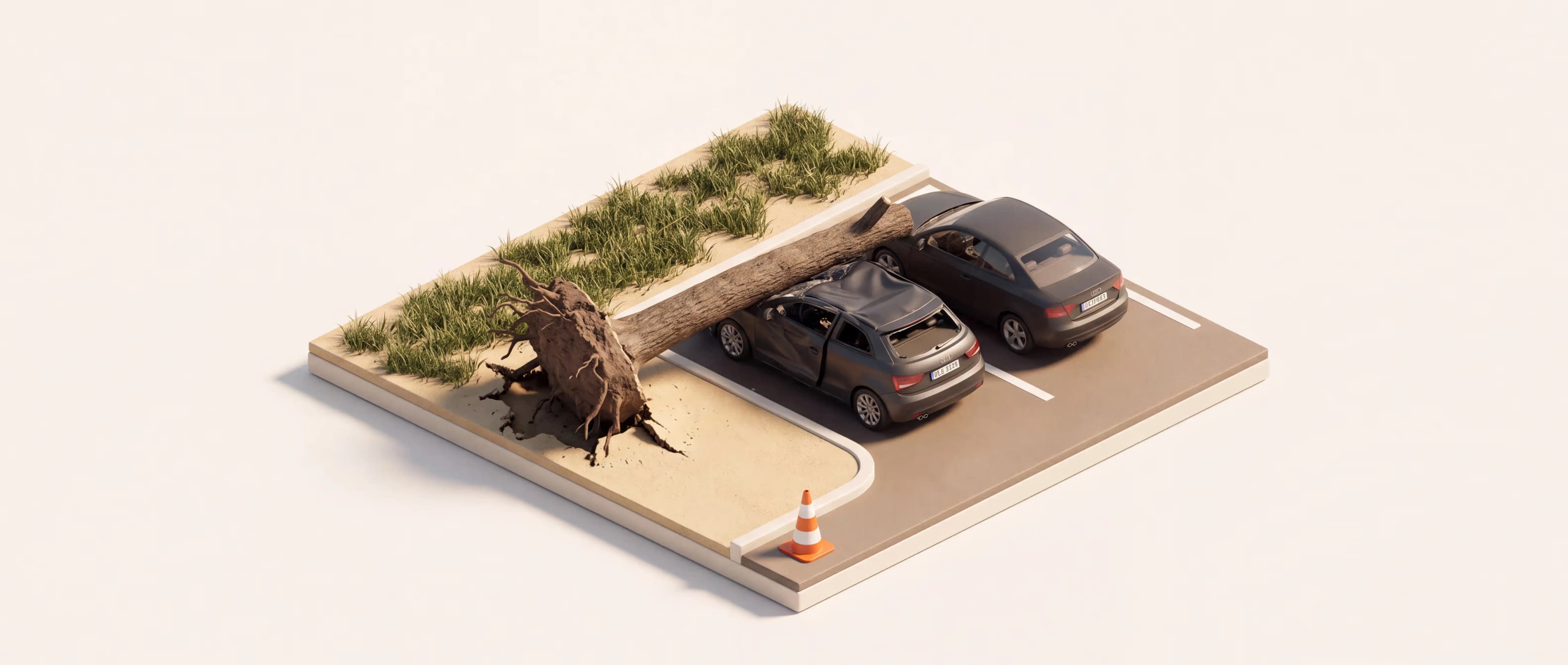
HOA tree fell on my car who pays? Your own auto insurance covers the repair in most cases. The association's master policy doesn't.
The HOA becomes liable only when the board knew or should have known the tree was hazardous and failed to remove it. A healthy tree brought down by a storm is an act of God. No party is at fault.
Below is the full payer breakdown and the negligence test that shifts liability to the association. You'll also find what to do first, whether you sit on the board or you're the owner filing a claim.
Your auto comprehensive coverage pays first when an HOA tree falls on your car. Comprehensive — that's the part of your auto policy covering non-collision events like falling objects, hail, theft, and animal strikes. You file the claim with your own auto insurer and pay your deductible ($250 to $1,000 is typical). The carrier covers the rest up to the vehicle's actual cash value, per Progressive.
Your homeowners policy or HO-6 (condo/townhouse insurance) policy doesn't cover vehicle damage. That's one of the biggest misconceptions in HOA insurance. The Insurance Information Institute confirms that car damage from a fallen tree is an auto insurance claim. Your homeowners policy won't cover it.
The HOA's general liability (GL) coverage enters the picture only when negligence is established. If the tree was healthy and a storm brought it down? The association owes nothing. But if the tree was dead, visibly diseased, or leaning and the board had notice, the GL policy may cover the owner's loss.
Is HOA responsible for fallen tree damage? Only when the board knew or should have known the tree was hazardous and did nothing about it. Courts across most states apply a four-element negligence test to decide whether the association owes anything beyond the owner's own coverage.
First, the association had a duty to maintain the tree. Common-area trees fall under the HOA's maintenance obligation in the community's covenants, conditions, and restrictions (CC&Rs), so this element is almost always a given.
Second, the board had actual or constructive notice that the tree was hazardous. Constructive notice — that's the legal term for when the danger was visible enough that a reasonable person would've spotted it. Dead limbs, a pronounced lean, or fungal growth on the trunk all qualify, even if no resident filed a complaint. The standard, per treelaws.org, asks whether a reasonable inspector would have seen the danger.
Third, the board sat on the notice. An arborist report recommending removal that collects dust for six months? That's textbook.
And fourth, the inaction caused the tree to fall and damage the car or unit. If a certified arborist declared the tree healthy two months before a hurricane brought it down, causation breaks. The loss stays an act of God.
A 50-unit planned community deferred removal of a dead oak flagged in an arborist report to save $3,200. Six months later the tree fell during a windstorm, totaling a resident's SUV valued at $28,000. The resident's auto insurer paid the claim, then pursued the association's GL carrier through subrogation (the insurer's right to recover from the at-fault party). The arborist report created constructive notice the board chose to ignore.
What if a tree fell on car in HOA parking lot? Same test. The parking lot is common area, so the board's duty of care applies.
A written complaint from a resident is the single strongest evidence of negligence. Certified mail and dated emails to the management company create a paper trail — so do letters read into the board-meeting minutes. A plaintiff's attorney can use any of them.
Once a complaint flags a hazard, HOA tree removal responsibility is clear. If the board doesn't act, the association's defense collapses from act of God to documented neglect.
Most boards skip a formal inspection program. That's a mistake. The best protection is semi-annual walks with an arborist certified by the International Society of Arboriculture (ISA), dated reports, and a 60-day remediation window for every flagged hazard.
HOA tree fell on house who pays? It depends on which part of the structure took the hit. The HOA's commercial property insurance covers damage to common elements: the roof, exterior walls, shared plumbing, and electrical systems. The unit owner's HO-6 policy covers interior improvements, personal property, and owner upgrades.
Whether the master policy covers interior drywall and flooring depends on the policy type. Bare walls? Coverage stops at the unfinished interior surfaces. A single-entity policy goes one step further — it covers the original interior finishes too.
An all-in policy covers everything, including upgrades you've installed. Check your association's declarations page or ask the management company which type your community carries. (For the full framework on how the master policy and HO-6 split by damage source, see the HOA water damage coverage guide.)
Both claims carry separate deductibles. The HOA pays its master-policy deductible, and the owner pays the HO-6 deductible. If the association's CC&Rs include a loss-assessment provision, the board can special-assess the master-policy deductible back to all owners. Coordinate with both carriers simultaneously to avoid repair-timeline gaps.
Document the damage immediately. Take dated photos of the car or building damage, the fallen tree, and especially the stump. Why the stump? It reveals whether the tree was dead or diseased before it fell — a hollow, rotted stump supports a negligence argument, while a solid, healthy one says act of God.
File the right insurance claim within 24 hours. For a car, call your auto insurer and file under comprehensive. For building damage, file with the HOA's management company (master property claim) and your own HO-6 carrier simultaneously.
Don't wait for the HOA to decide whether it's liable before filing your own claim. Your policy pays regardless of fault.
Send a written notice to the HOA board. State the date, location, and your description of the tree's condition before the fall — and attach copies of any earlier complaints you sent. This step creates the record your insurer's subrogation team may need if negligence is suspected.
Request the HOA's tree-inspection records. Under most state statutes, owners have a right to inspect association records. If the board has no inspection records, that fact itself becomes evidence in a negligence dispute.
An association we work with defended a fallen-limb claim successfully because the board could produce two years of semi-annual arborist inspection logs. Every flagged tree had been addressed within 60 days. Coverwatch helps associations build that documentation habit by reviewing GL and property policies alongside maintenance protocols at each renewal.
Tree fell on car who is responsible? You handle your own car repair through your <strong>auto comprehensive coverage</strong>. The tree owner — whether an HOA, a neighbor, or the city — becomes liable only if you can prove negligence. That means they knew the tree was hazardous and did nothing about it.
<strong>No.</strong> Homeowners insurance and HO-6 condo policies do not cover vehicle damage. Car damage from a fallen tree is covered only under the comprehensive portion of your <a href="https://www.progressive.com/answers/tree-falls-on-car/">auto insurance policy</a>.
The HOA <strong>maintains</strong> common-area trees, but liability for damage only attaches when negligence is proven. A healthy tree felled by a storm is an act of God, and the HOA owes nothing. A dead or diseased tree the board ignored creates a negligence claim.
You can sue if you can prove negligence. That means four things: the HOA had a duty to maintain the tree, knew about the hazard, failed to act, and that failure caused the damage. Without evidence of <strong>prior notice</strong> — a written complaint, an arborist report, or visible decay — most courts treat the loss as an act of God.
Without comprehensive coverage, you pay for car repairs out of pocket unless you can prove the HOA was negligent and recover through their general liability policy or a lawsuit. Comprehensive coverage typically runs <strong>roughly $35 per month</strong> and is the only auto coverage that handles falling objects.
August 20, 2026
ExplainersWhether HOA insurance covers water damage depends on the source and what it damaged. Who pays by source: the master policy, your HO-6, or you.
7 min read

September 10, 2026
ExplainersHOA dog bite liability depends on whether the board had notice and failed to act. See which policy pays and how to limit your association's exposure.
7 min read
September 10, 2026
ExplainersAfter an HOA roof leak who pays? The master policy covers the roof; your HO-6 covers interior finishes. See the full split by policy type.
7 min read

September 11, 2026
ExplainersIf your association employs even one W-2 worker, D&O alone leaves employment claims uncovered. Learn when EPLI is needed and how it fills the gap.
7 min read
Fill out the form and a Coverwatch advisor will get back to you within the next hour.
Your quote