

August 7, 2026
ExplainersHandyman Insurance Vendor List Requirements in 2026
Handyman insurance vendor list requirements come from credentialing portals. What seven real vendor packets demand and why vendors get de-listed.
7 min read

Manage your risk with Coverwatch
Get a free coverage review and find out where you are over or under insured.
Completed operations coverage is the part of your general liability policy that pays for third-party bodily injury or property damage caused by work you've already finished and handed over. On a standard policy it's a distinct coverage part, the products-completed operations hazard. It carries its own aggregate limit that a carrier can sub-limit or exclude.
Here's what it covers, the one repair it never pays for, and why general contractors put it on your certificate before they release your final check. Most of it already sits inside your contractor insurance, though the gaps tend to surface years after the job ends.
Completed operations coverage pays for third-party bodily injury or property damage that your finished work causes after the job is done and handed over, plus the legal defense. On the standard ISO general liability form it falls under the products-completed operations hazard, and it applies only after the work is complete or abandoned.
The trigger is handover. While your crew is on site, ongoing-operations coverage answers a claim. Once you finish or leave a job, injury or damage your completed work causes moves into the completed operations bucket, on the same policy but under a different limit.
The IRMI glossary defines products-completed operations as injury or damage arising out of your product or your completed work, away from your own premises. For a contractor, your work is the deck, the wiring, or the plumbing you installed. If a finished handrail gives way and a tenant falls, this is the part of the policy that responds. Seeing what general liability covers makes the ongoing-versus-completed split easier to follow.
A general liability policy doesn't automatically cover every finished-work claim. It can exclude or sub-limit the products-completed operations hazard, so completed operations coverage isn't guaranteed just because you carry a policy. This is a separate coverage part with its own aggregate limit. Once that aggregate is exhausted, the insurer pays no further completed operations claims until renewal.
The general aggregate and the completed operations aggregate are two separate ceilings on one policy. A run of finished-work claims can drain the completed operations limit while the general aggregate still looks healthy.
A framing subcontractor we worked with assumed his general liability policy was blanket protection for anything that went wrong, on the job or long after. His declarations page showed a products-completed operations aggregate set as a separate, smaller ceiling than his general aggregate. Two finished-job claims in one year had nearly exhausted it.
He found out only when a third claim arrived and the limit was almost gone (the worst possible time to learn it). The declarations page carries both aggregate numbers, and the completed operations line is the one that tells you how much finished-work protection you actually have.
Completed operations coverage pays for the damage your finished work does to other people or their property. What it doesn't pay for is tearing out and redoing the defective work itself. That gap comes from the ISO your-work exclusion, which removes coverage for property damage to your own completed work. One carve-out matters: if a subcontractor performed the defective work, the resulting damage stays covered.
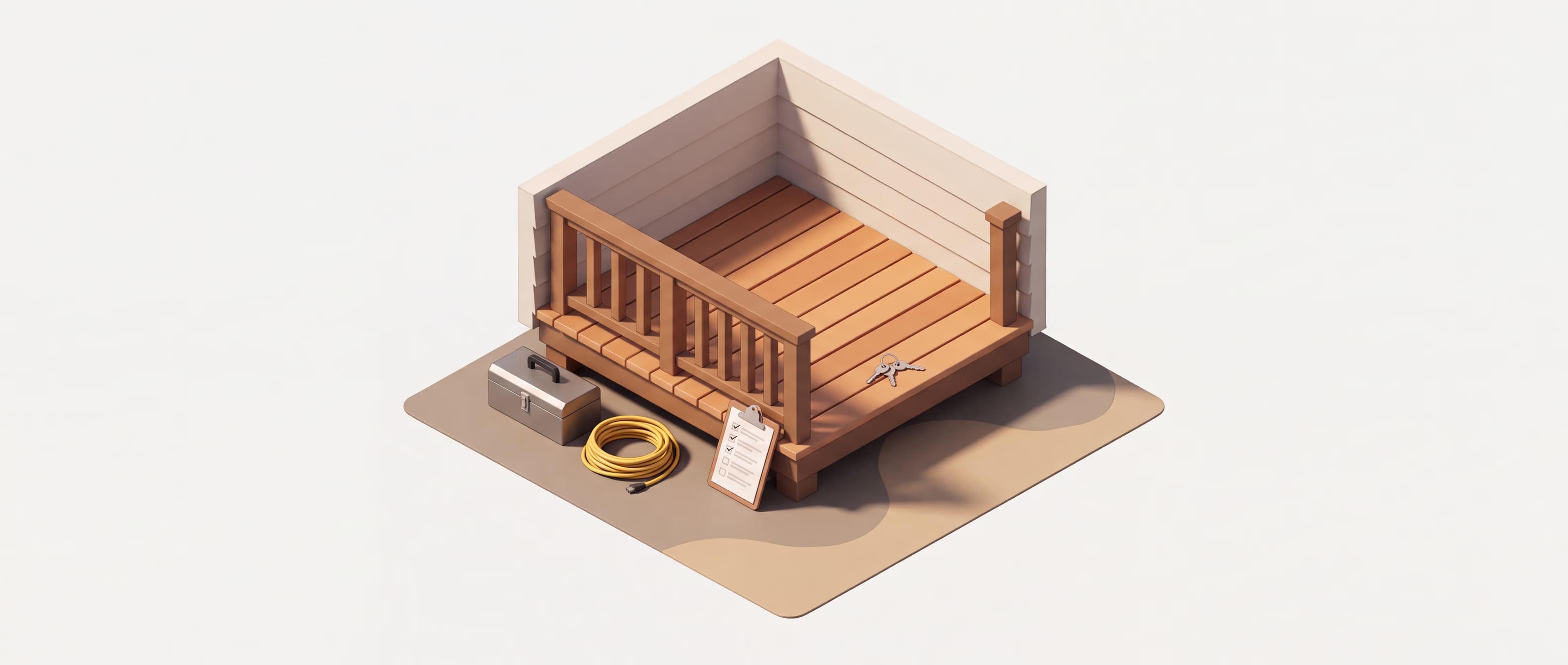
Take a deck a carpentry crew finished 14 months earlier. It collapses during a backyard party and injures a guest. Completed operations pays the guest's injury claim and the legal defense, because that's third-party bodily injury the finished work caused.
The cost to demolish and rebuild the defective deck falls on the contractor. Here the your-work exclusion (commonly labeled exclusion l. in the standard ISO form) takes out damage to your own work.
Here's how the same defective deck sorts out, claim by claim:
| Situation | Does completed operations pay? |
|---|---|
| The finished deck collapses and injures a guest | Yes, third-party bodily injury |
| Water damage to the homeowner's finished basement from your work | Yes, third-party property damage |
| Tearing out and rebuilding the defective deck itself | No, the your-work exclusion removes it |
| Defective work done by your subcontractor | Yes, the subcontractor exception keeps it covered |
The subcontractor exception is why general contractors care so much about your subs. If a sub's faulty work causes the damage, your policy can still respond. That's why the paperwork on the next job carries so much weight.
The general contractor wants proof that your completed operations coverage is active. They also want to be named as an additional insured for completed operations, which requires the CG 20 37 endorsement. A CG 20 10 endorsement alone covers the GC only for your ongoing operations, so their protection would vanish the moment you leave the site.
Additional insured means the GC is named on your policy so your coverage defends them too. The endorsement number sets how long that protection lasts. CG 20 37 extends it to completed operations; CG 20 10 stops at ongoing operations. So the certificate has to show that your contractor general liability policy carries active completed operations, listed on your certificate of insurance.
A general contractor recently held a subcontractor's final payment until the certificate showed CG 20 37 status. The sub had a valid policy and had finished the work. The endorsement naming the GC for completed operations had simply never been added.
Many subcontracts also require you to keep completed operations active for years after the work, often 3 to 8 years. Cancelling the policy the day a job ends can cost you the next contract (a mistake that's easy to make when cash is tight).
Before a deadline hits, a Coverwatch broker confirms products-completed operations is active and the aggregate matches what the contract demands. They also check that CG 20 37 is endorsed onto the policy itself, since a certificate can list an endorsement the policy never actually added.
A completed operations claim can surface years after a project finishes, often up to about 10 years, because construction defect liability runs on state statutes of repose. A statute of repose sets a hard deadline that starts at substantial completion, regardless of when the damage appears. A standard policy pays only while coverage is active, so dropping it after a job can leave old work exposed.
A statute of repose differs from a statute of limitations. The clock starts at substantial completion, well before anyone tends to discover a defect. The Cornell Legal Information Institute describes it as an outer deadline that can bar a claim before the injury even appears. The window varies by state, roughly 7 to 12 years, with California and Texas near 10 years and Florida recently shortened to 7.
As Craig Stanovich, principal at Austin & Stanovich Risk Managers, writes for IRMI, "The CGL insuring agreement promises to pay only if bodily or property damage occurs during the policy period." Cancel your general liability after a job wraps, and damage that appears two years later may find no active policy to respond. That timing gap is separate from builders risk, which covers the structure during construction and ends at completion.
The deck you finished this spring is still your exposure a decade from now. The policy in force when you built it isn't always the one that pays. That's what makes the safest completed operations limit the one you keep renewing, long after the final invoice clears.
Usually yes on a standard occurrence general liability policy, but it is not guaranteed. Some class codes exclude or sub-limit the products-completed operations hazard, and it carries its own aggregate limit that runs separately from the general aggregate. Confirm on your declarations page that completed operations is active and that the aggregate is high enough for what your contracts require.
Completed operations is not priced as a separate line item. Carriers bundle it into your general liability premium, so the exposure shows up in the base rate for your trade rather than as an add-on charge. A higher-risk trade like roofing or structural work carries a larger completed-operations load than low-risk finish work, which is why two contractors at the same revenue can pay very different rates.
Yes. Damage caused by a subcontractor's completed work stays covered through the subcontractor exception to the your-work exclusion. The exclusion removes coverage for damage to work you performed yourself, but it carves out work done on your behalf by a sub. This is a large part of why general contractors require subs to carry their own completed operations coverage and name the GC as an additional insured.
Products liability covers claims from goods you manufacture or sell, while completed operations covers claims from services or construction work you finish and hand over. For a contractor, completed operations is the relevant half. Both live under the same policy part, the products-completed operations hazard, and share a single aggregate limit on the standard general liability form.
August 7, 2026
ExplainersHandyman insurance vendor list requirements come from credentialing portals. What seven real vendor packets demand and why vendors get de-listed.
7 min read
August 6, 2026
ExplainersAn electrician liability fire damage claim usually arrives as a subrogation demand months after the job. What happens next, and what you can challenge.
7 min read
August 6, 2026
ExplainersA plumber's liability policy pays for what the water ruined, not for the joint that let go. The exclusions are narrower than most contractors think.
7 min read

August 1, 2026
ExplainersAdding plumbing, refrigeration, or electrical work resets your HVAC class codes and reprices general liability and workers comp. Here is what changes.
6 min read
Fill out the form and a Coverwatch advisor will get back to you within the next hour.
Your quote