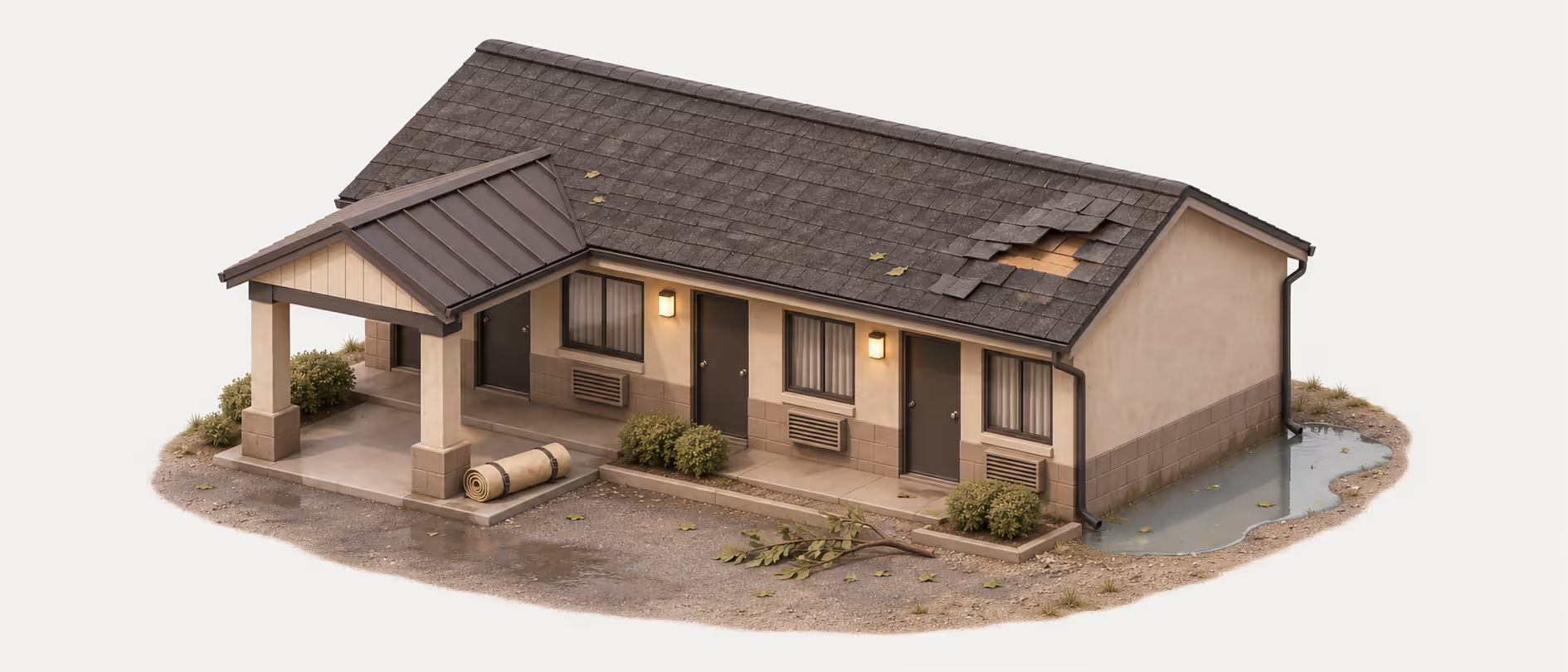
A storm can damage roofs and flood rooms. Motel flood insurance needs a separate review from wind coverage and business income protection. Identify the policy that could respond to each cause and what income protection, if any, accompanies it.
Start with a property map showing rooms, utilities, equipment, and storage areas. Add the policies, deductibles, and claim contacts relevant to the location. For a motel group, prepare a separate map for each property rather than assuming all sites share the same flood or wind terms.
What does motel flood insurance leave to other policies?
The National Flood Insurance Program (NFIP) provides commercial building and contents coverage, but it does not provide business interruption or loss-of-use coverage. FEMA's business flood insurance guidance makes that distinction explicit. A motel with an NFIP policy should not budget for lost room income as though it were part of that policy.
Private flood products require their own review. Ask whether a proposal includes income protection, what triggers it, and which limits and waiting periods apply. Private flood policies can differ from the NFIP form. Compare the actual terms before deciding whether a proposal meets the motel's income needs.
Review commercial property coverage for wind and other relevant causes at the same time. Ask the broker to identify exclusions, location-specific terms, and any separate wind arrangement. Keep the policies together, list the terms for each cause, and mark questions the broker still needs to resolve.
How should motels separate wind damage from rising water?
Record what happened and where, without deciding the insurance outcome yourself. A roof opening, water marks on exterior walls, damaged windows, and water in ground-floor rooms may require different factual investigation. Give the insurers consistent information and ask qualified adjusters or other professionals to assess cause when it is disputed.
| Observed loss | Question for the coverage review | Evidence to preserve |
|---|
| Roof or window damage | Does the property or wind policy cover the established cause? | Pre-storm condition, damage photos, inspection findings |
| Rising water entering rooms | How does the flood policy apply to building and contents? | Water levels, room inventory, documented damage |
| Mechanical equipment failure | Which policy, if any, covers the established cause? | Equipment reports, service history, damaged parts |
| Unavailable rooms and canceled stays | Is there a covered income trigger for this cause? | Closure timeline, reservations, financial records |
Ask how the policies address a loss involving more than one cause, including any provisions that affect coverage when causes combine. Avoid dividing costs between wind and flood merely because one deductible is lower. The allocation needs supporting facts and policy analysis.
If machinery is affected, include equipment breakdown coverage in the questions without treating it as a substitute for flood or wind insurance. A damaged elevator or electrical system needs a cause-based review just as a guest room does.
Use one inventory across the claims. Tell each relevant insurer about other claims and keep the supporting photographs and estimates consistent. An organized file helps explain which costs remain unresolved.
Will a precautionary closure or evacuation order trigger coverage?
A voluntary closure before a storm does not automatically establish a covered business income loss. The Florida Department of Financial Services' commercial disaster FAQ gives a hotel closure example and explains the importance of covered damage and policy terms. Its discussion is useful for identifying questions, not as a nationwide promise about every policy.
Civil authority coverage also has conditions. The National Association of Insurance Commissioners (NAIC)'s business interruption overview explains that provisions can depend on prohibited access and covered physical damage away from the insured property. Read the cause, distance, timing, and access requirements.
Keep evacuation or closure orders and record their effective periods, but do not confuse having an order with satisfying every coverage condition. Separately document damage at the motel, damage nearby when relevant, utility interruption, and the hotel's operational response. Those are facts for the claim review.
Safety decisions should follow the circumstances and appropriate public guidance. The manager should not delay a necessary closure while trying to obtain an advance guarantee of insurance payment. Coverage planning belongs before the storm; accurate documentation continues during the response.
How much room income could a motel actually lose?
Review business interruption coverage using the motel's own revenue pattern. Start with bookings and supportable expected demand, then identify what was canceled, retained, transferred, or recovered. Ask how the policy treats saved expenses and continuing costs. Unavailable room inventory is not the same as a final covered income calculation.
In a hypothetical example, a 20-room motel expects 60% occupancy at an average room rate of $120 for five nights. That implies $7,200 in projected gross room revenue before considering cancellations that might have occurred anyway, replacement bookings, saved expenses, or policy terms. It is a planning input, not an expected claim payment.
Update the timeline as rooms reopen. If guests transfer to another property in the same group, record the transfer and related revenue. Keep repair delays distinct from decisions to extend closure for unrelated improvements.
The Insurance Information Institute's business claim guidance recommends preserving damage evidence, receipts, and financial records. Save those records outside the affected property or in an appropriately protected system so they remain available during a closure.
What should motels check before storm season?
Schedule the review before the property faces an immediate storm decision. Ask about effective dates and any applicable waiting periods when purchasing or changing coverage. Confirm when coverage actually begins.
- Confirm the buildings, contents, and values listed for each property.
- Identify the applicable wind and flood policies, limits, and deductibles.
- Separate NFIP property protection from any private flood income coverage.
- Review business income triggers for wind, flood, civil authority, and utility interruption.
- Assign responsibility for inventories, reservation exports, photographs, and insurer notice.
- Keep policy copies and claim contacts accessible away from the property.
Use the resulting coverage map to identify unanswered questions and decisions the owner needs to make. A small motel can keep the map to one page; a group can use the same format for each location while preserving differences in terms.
Coverwatch can help organize a storm coverage review around those documents. Bring the property, flood, and income policies together so the discussion follows the possible losses from one storm.