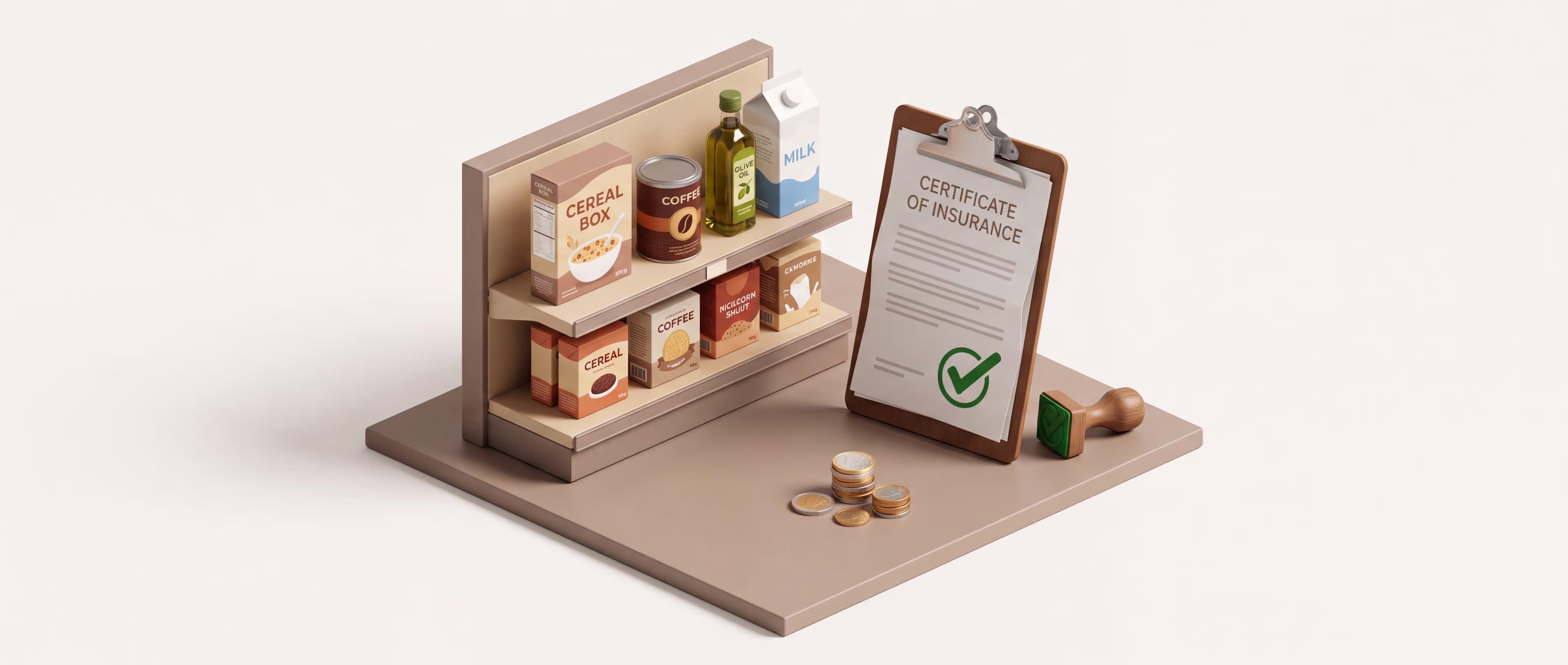
Whole Foods vendor insurance requirements come down to one packet: a certificate of insurance that proves you carry general liability with products-completed operations coverage, names Whole Foods Market as an additional insured through a CG 20 15 vendors endorsement, and sits behind a carrier rated highly enough for their risk team to accept. Per Whole Foods Market's published supplier insurance guidelines, a food or beverage brand in the higher-risk tiers also carries an umbrella of $2 million to $5 million stacked on top.
This guide breaks down the limits by product risk tier, the endorsement that trips up most brands, and the steps to a certificate the risk team clears on the first try.
Key Takeaways
Whole Foods vendor insurance requirements: general liability with products-completed operations, a CG 20 15 endorsement, and an A- carrier, per Whole Foods' guidelines.
A standard-risk product needs $1 million per occurrence and $2 million aggregate, plus a $2M to $5M umbrella for higher-risk and specialty foods.
The CG 20 15 vendors endorsement adds Whole Foods for product claims after the sale; a contractor-style CG 20 10 leaves that gap.
In Coverwatch reviews of grocery-vendor onboarding, the most common rejection is a certificate naming Whole Foods with no CG 20 15 endorsement on the policy.
What insurance does Whole Foods require from food vendors?
Whole Foods requires a food vendor to carry commercial general liability that includes products-completed operations, to name Whole Foods Market Inc. and its subsidiaries as an additional insured through a CG 20 15 vendors endorsement, to back that policy with a carrier AM Best rates A- and Class VII or better, and to hand over a certificate of insurance listing Whole Foods as the certificate holder.
The certificate alone is not enough, because Whole Foods' guidelines ask for a copy of the actual endorsement submitted alongside it, so the risk team can confirm the coverage lives on the policy and not just on a summary page. The certificate holder line has to read exactly "Whole Foods Market Inc. and its subsidiaries, 550 Bowie St., Austin, TX 78703."
These figures come from Whole Foods' published supplier insurance guidelines, a version that is not dated to this year. The exact limits still vary by region and product risk tier and change over time, so treat these numbers as the shape of the requirement, not a guaranteed-current figure. Your onboarding packet or supplier agreement is the document that actually governs, so read the insurance section there before you brief your broker. If you also sell through your own store or another retailer, keep those terms separate from your additional-insured endorsement checklist for other accounts, since each buyer sets its own numbers.
What limits does Whole Foods require?
For a standard-risk product, Whole Foods requires $1 million per occurrence and $2 million general aggregate in general liability, plus a matching $2 million products-completed operations aggregate. Low-risk products drop to $500,000 across those limits. Higher-risk and specialty foods add an umbrella of $2 million to $5 million on top.
Whole Foods sorts local products into four risk buckets: low, standard, high, and specialty. A candle or a bag of unprocessed produce sits at the bottom. Fresh prepared foods, fresh dairy, and anything from a home or rented kitchen land in high risk. Supplements (nutraceuticals), baby food, cut fruit, and fresh juices are specialty, the tier that carries the steepest limits, largely because a mislabel there, like an allergen mislabeling recall, gets expensive fast.
Global suppliers, meaning brands selling across every Whole Foods region or on a global contract, carry the top numbers regardless of product: $1 million per occurrence, $2 million aggregate, and a $5 million umbrella. The table below shows where a food brand tends to land.
Product risk tier
GL per occurrence
General aggregate
Products-completed ops aggregate
Umbrella
Low risk (unprocessed produce, candles)
$500,000
$500,000
$500,000
None
Standard (baby clothes, protein bars, body care)
$1M
$2M
$2M
None
High risk (fresh prepared foods, fresh dairy)
$1M
$2M
$2M
$2M
Specialty (supplements, baby food, fresh juices)
$1M
$2M
$2M
$5M
Global supplier (all regions or global contract)
$1M
$2M
$2M
$5M
What is a CG 20 15 endorsement, and why does Whole Foods want it?
A CG 20 15 endorsement, formally titled Additional Insured - Vendors, adds Whole Foods to your general liability policy for claims arising from the products you sell them. Whole Foods names this exact form because a contractor-style CG 20 10 covers only your ongoing operations and leaves the product-injury exposure, the risk a grocer actually faces, uncovered.
The dangerous moment for a food brand comes after the sale, once a shopper has your product at home and it makes someone sick or hurts them. That window is called products-completed operations, the stretch after a sale when your product is out in the world. Per IRMI, the CG 20 15 vendors form extends your product liability coverage to the retailer for exactly those claims, which is why products-completed operations shows up as a separate aggregate on every Whole Foods limit sheet.
The form number itself matters, because Whole Foods asks product suppliers for the CG 20 15 but asks its service providers, like demo staff and contractors, for the CG 20 10 and CG 20 37 forms instead. Attach the wrong one and the risk team bounces the submission. This is the same wording problem behind co-packer additional-insured wording, where the entity named and the form cited both have to match the contract exactly.
Form
What it covers
Right for a food vendor?
CG 20 15
The retailer, for claims arising from the products you sell them, including after the sale
Yes. The vendors form Whole Foods names.
CG 20 37
Additional insured coverage reaching into the completed-operations period
Sometimes, for service work when a contract names it.
CG 20 10
Your ongoing operations only; coverage ends when those operations end
No. Leaves the product-injury tail uncovered.
Do I need a $5 million umbrella for Whole Foods?
You need an umbrella only if your product falls into Whole Foods' higher-risk or specialty tier, or you sell as a global supplier. A low-risk or standard-risk local product needs no umbrella at all. High-risk products need a $2 million umbrella, and specialty foods and global suppliers need $5 million stacked over the primary policy.
An umbrella (sometimes called excess liability) sits on top of your general liability and adds a second layer of limit once the first is used up. Whole Foods wants that umbrella to name it as an additional insured too, not only the primary policy, so the risk transfer holds all the way up the tower.
Two brands on the same Whole Foods shelf can face very different umbrella requirements. A supplements brand selling a nutraceutical lands in the specialty tier, so it budgets for $1M/$2M primary general liability plus a $5 million umbrella, with Whole Foods named as additional insured on both. A brand selling shelf-stable dried fruit sits in standard risk and needs no umbrella. Same shelf, very different requirement, decided entirely by what the product is (not by what the brand earns).
The umbrella is usually the biggest single line on the premium, far more than the endorsement itself. It is also the coverage that actually responds behind a large claim, like a contamination recall traced to your product, where defense and settlement can blow through a $1 million primary limit quickly.
What carrier rating does Whole Foods require?
Whole Foods requires your insurance to come from a carrier that AM Best rates A- or higher for financial strength and Class VII or larger for size. A policy with the right limits and the right endorsement still gets rejected if the carrier behind it is rated too low or is too small, so check both numbers before you buy.
AM Best publishes two separate ratings, and Whole Foods sets a floor on each. The financial strength rating, running A-, A, A+, up to A++, is AM Best's opinion of whether the insurer can pay claims. The Class, written in Roman numerals from I to XV, is the financial size category based on the carrier's capital and surplus. Whole Foods sets a floor on both: A- for strength and Class VII or larger for size.
This catches brands that bought a cheap policy from a small or non-rated carrier. The coverage might read fine, but a Whole Foods certificate built on a carrier below the floor gets kicked back at review, and you find out during onboarding when time is already short. Confirm the carrier's rating before you sign the supplier agreement, not after Whole Foods flags it.
How do I produce a compliant Whole Foods COI?
To produce a compliant Whole Foods certificate of insurance, confirm your general liability includes products-completed operations, add the CG 20 15 vendors endorsement naming Whole Foods Market Inc. and its subsidiaries, verify your carrier meets the AM Best floor, then have your broker issue the ACORD 25 certificate with the exact certificate-holder wording and a copy of the endorsement attached.
Here is the order that keeps Whole Foods' risk team from bouncing your submission:
Read the insurance section of your Whole Foods supplier agreement or onboarding packet first, since the exact limits and forms live there and shift by product risk tier.
Confirm your general liability policy includes products-completed operations, the coverage that responds when someone is hurt by your product after it leaves the shelf.
Match the required limits, commonly $1 million per occurrence and $2 million aggregate, plus a $2 million to $5 million umbrella if your product is high-risk or specialty.
Ask your broker for the CG 20 15 vendors endorsement naming "Whole Foods Market Inc. and its subsidiaries."
Add primary and non-contributory wording and a waiver of subrogation if your agreement calls for them, since each is a separate endorsement.
Confirm your carrier is AM Best A- and Class VII or better.
Have your broker issue the ACORD 25 listing the certificate holder as "Whole Foods Market Inc. and its subsidiaries, 550 Bowie St., Austin, TX 78703," and attach a copy of the endorsement.
Send a fresh certificate at every renewal, before the current one expires.
Two clauses often ride along in a retailer's vendor agreement even when Whole Foods' base guidelines do not spell them out: primary and non-contributory, which means your policy pays first ahead of the retailer's, and a waiver of subrogation, which means your insurer agrees not to chase the retailer to recover what it paid. Each is a separate endorsement, so read your agreement and add them if they appear. For the mechanics of issuing and renewing the document itself, see producing a compliant certificate of insurance.
A flat-fee broker has no commission riding on selling you a bigger umbrella than your tier requires, so the reading of the agreement stays honest. Coverwatch reads your Whole Foods supplier agreement, issues the ACORD 25 and the CG 20 15 endorsement together, and confirms the carrier clears the AM Best floor before anything reaches the risk team. That is part of its food and beverage insurance work for product brands. For the rest of your wholesale accounts, a supplier insurance checklist maps what each buyer asks for, alongside the broader ecommerce insurance guidance.
For a full comparison of coverage options, see our CPG insurance page.
Yes. Whole Foods' published guidelines require the CG 20 15 Additional Insured - Vendors endorsement (or equivalent policy language) attached to your commercial general liability policy, with a copy submitted alongside the certificate of insurance. The endorsement adds Whole Foods for claims arising from the products you sell them. Service providers, rather than product suppliers, are asked for the CG 20 10 and CG 20 37 forms instead.
It depends on your product risk tier. Standard, high, and specialty products generally require $1 million per occurrence, $2 million general aggregate, and a $2 million products-completed operations aggregate. Low-risk products drop to $500,000. High-risk products add a $2 million umbrella, and specialty foods and global suppliers add a $5 million umbrella. Your onboarding packet states the exact figures for your product.
Both. Whole Foods Market Inc. and its subsidiaries must be named as an additional insured on your general liability policy and your umbrella through the CG 20 15 endorsement, which grants real coverage rights. Whole Foods must also be listed as the certificate holder on the certificate of insurance, which is only proof that the coverage exists. The two are separate requirements.
Whole Foods requires the policy to sit with a carrier that AM Best rates A- or better for financial strength and Class VII or larger for financial size. A policy with correct limits and the right endorsement can still be rejected if the carrier falls below either floor, so confirm your insurer's rating before you sign the supplier agreement.
Whole Foods' guidelines state the certificate holder line must read exactly "Whole Foods Market Inc. and its subsidiaries, 550 Bowie St., Austin, TX 78703." The certificate must also provide notice of cancellation or material change in coverage. Automated compliance systems reject wording that does not match, so copy the entity name and address exactly rather than abbreviating.