
August 7, 2026
ExplainersHandyman Insurance Vendor List Requirements in 2026
Handyman insurance vendor list requirements come from credentialing portals. What seven real vendor packets demand and why vendors get de-listed.
7 min read

Manage your risk with Coverwatch
Get a free coverage review and find out where you are over or under insured.
Hired and non-owned auto coverage, or HNOA insurance, protects an HVAC company when a tech drives a vehicle the business doesn't own on company time. That means their own truck (non-owned) or one you rent or borrow (hired). It pays the injured third party's claim and your legal defense, and it's liability only, so it never repairs the tech's own truck.
The exposure hides behind your fleet. Every van titled to the company is insured. The quick parts run a tech makes in his personal F-150 usually isn't, and that's the ride that gets the company sued. This guide covers who's on the hook, how the gap opens, and how established HVAC owners close it.
Hired and non-owned auto coverage is business liability insurance for vehicles you use but don't own. Non-owned means an employee's personal car driven for work. Hired means a vehicle you rent, lease, or borrow for a job. When your driver causes a crash, it pays the other party's injury and property damage claim, plus the cost to defend you.
Your commercial auto policy for contractors already covers the vans and service trucks titled to the business. Hired and non-owned auto picks up the vehicles that policy never scheduled: a tech's personal pickup, a rented crane truck, a borrowed box truck on a big install.
It rides on your commercial auto policy or your HVAC business insurance package as an endorsement rather than a standalone policy. Most HVAC companies carry both grants together, because the day any tech drives for work, both exposures show up at once.
A tech's personal auto policy usually won't cover a work crash, because it carries a business-use exclusion. That exclusion targets exactly this pattern, an employee's personal vehicle in business use. When the tech is running a company errand at the moment of the wreck, the personal insurer can deny the claim outright. The injured driver then looks to the business, and the company becomes the deepest pocket in the lawsuit.
Employers answer for what their workers do on the job. Courts call it respondeat superior, the rule that holds a company legally responsible for an employee's negligence within the scope of employment, per Cornell Law School. A parts run counts as scope of employment. So does a stop at a customer's house between jobs.
Your commercial auto policy doesn't automatically fill this gap either. It's built around the vehicles the business owns, and without the right symbols on the form, a personal truck driven by a tech falls outside it. (This is the piece most owners assume is handled.)
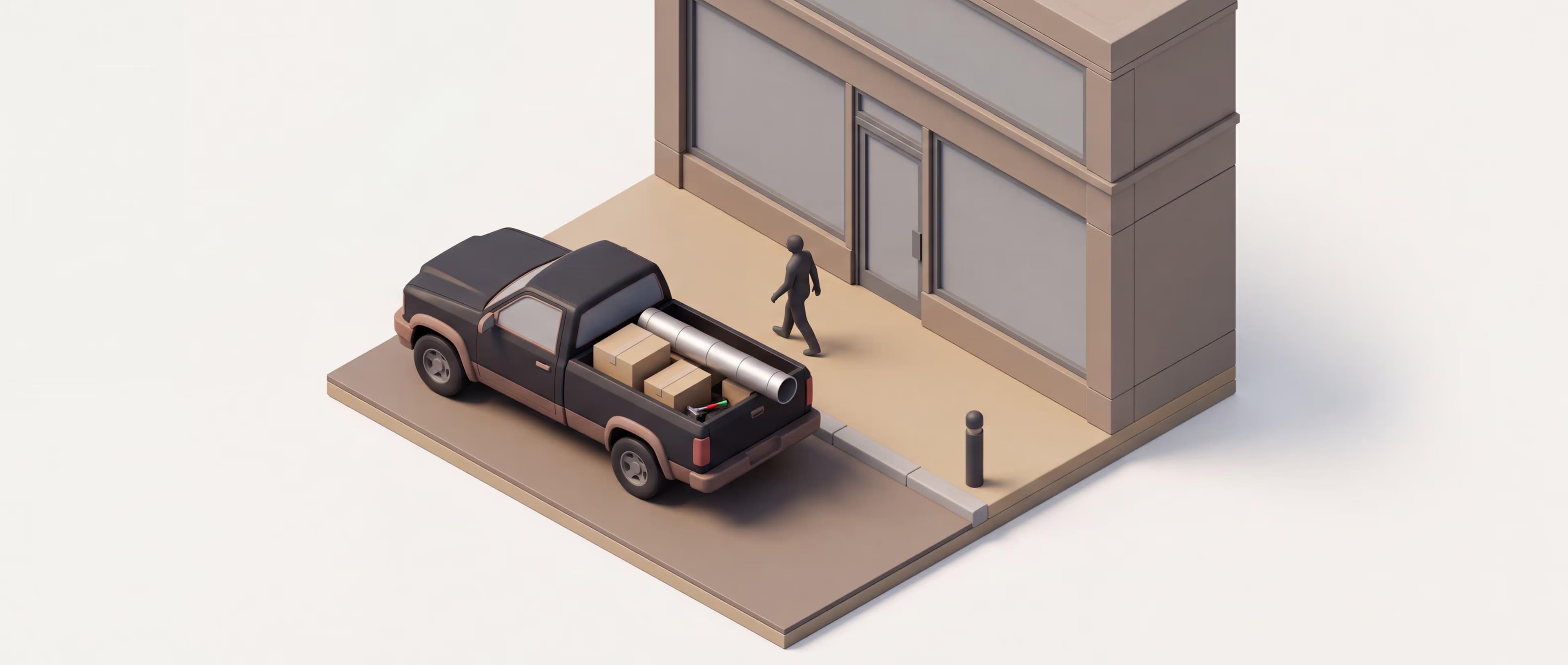
Picture a service tech leaving a job to grab a condenser fan motor from the supply house in his own pickup. He rear-ends a sedan at a light, and the other driver leaves with a herniated disc and surgery ahead. A routine Tuesday errand just became a six-figure liability claim against the company.
The tech's personal auto policy denies the claim, citing business use, and its $250,000 limit can fall short of a serious injury claim. Federal data puts the total economic cost of U.S. motor vehicle crashes at $340 billion a year, per NHTSA. A single severe-injury claim, with surgery and lost income, can run well past a personal auto policy's limit. With no hired and non-owned auto in place, the company pays the defense and the settlement itself.
Multi-stop days multiply the odds. A tech who hits three service calls, a supply house, and a bank deposit is driving a personal vehicle on company business at every leg. The fleet accident and renewal cost guide shows how a single at-fault crash reshapes an HVAC auto renewal.
Hired and non-owned auto coverage is added as an endorsement, either onto your commercial auto policy or onto your business owners policy (BOP). On the ISO Business Auto Coverage form, the carrier turns it on with two covered-auto symbols. Symbol 8 covers hired autos, and symbol 9 covers non-owned autos, which include employee cars used in the business. A form missing those symbols has no HNOA coverage at all.
You can sanity-check the cost against typical pricing before you buy. A commercial auto policy runs about $245 a month. Hired and non-owned auto usually costs about the same as commercial auto, and more than personal auto. For an HVAC company with W-2 techs running errands, that's a small line item against a potential seven-figure claim.
Coverwatch confirms symbols 8 and 9 are actually on the policy. It then sizes the HNOA limit to the combined single limit your GC contracts require, so it holds up on the certificate. Subcontractors create the same exposure in reverse. A sub who drives a personal truck to your site should carry their own coverage, which the HVAC subcontractor insurance requirements guide walks through.
No. Hired and non-owned auto coverage is liability only, so it pays for injury and property damage your driver causes to other people and never repairs the tech's own truck. Damage to a personal vehicle stays with the employee's own collision coverage. A rented vehicle needs a separate hired auto physical damage endorsement to cover the vehicle itself.
Hired and non-owned auto coverage is one line in a bigger program. See how it fits the full stack in the HVAC company insurance program guide. Before your next bid or renewal, have Coverwatch check whether symbols 8 and 9 sit on your policy.
Yes, if any employee ever drives a personal or rented vehicle for work. A commercial auto policy covers the vehicles the business owns, so a tech's personal truck falls outside it unless symbols 8 and 9 are added. The gap is common even for companies with a full fleet, because techs still run errands and parts pickups in their own vehicles.
It can. Standard hired and non-owned auto assumes occasional, incidental use. A tech who relies on a personal truck as a primary daily work vehicle may need that vehicle scheduled and rated on a commercial auto policy instead. Tell your broker how the vehicle is actually used, because constant business use is a different exposure than the odd parts run.
Many bid specs and master service agreements require hired and non-owned auto liability at a $1 million combined single limit, listed on the certificate of insurance. Larger projects can demand more, often backed by an umbrella. Confirm the exact number before you sign, because a missing or low limit can disqualify a bid.
No. It protects the business's own liability when an employee's driving injures someone else on the job. It does not insure the employee's personal vehicle, pay their personal premium, or repair their car after a crash. The employee's own auto policy and collision coverage handle the vehicle itself.
August 7, 2026
ExplainersHandyman insurance vendor list requirements come from credentialing portals. What seven real vendor packets demand and why vendors get de-listed.
7 min read
August 6, 2026
ExplainersAn electrician liability fire damage claim usually arrives as a subrogation demand months after the job. What happens next, and what you can challenge.
7 min read

August 6, 2026
ExplainersA plumber's liability policy pays for what the water ruined, not for the joint that let go. The exclusions are narrower than most contractors think.
7 min read
August 1, 2026
ExplainersAdding plumbing, refrigeration, or electrical work resets your HVAC class codes and reprices general liability and workers comp. Here is what changes.
6 min read
Fill out the form and a Coverwatch advisor will get back to you within the next hour.
Your quote