

August 7, 2026
ExplainersHandyman Insurance Vendor List Requirements in 2026
Handyman insurance vendor list requirements come from credentialing portals. What seven real vendor packets demand and why vendors get de-listed.
7 min read

Manage your risk with Coverwatch
One platform for a different insurance experience, from quote to claim.
A single commercial chiller can cost more than a work truck, and once it leaves the warehouse your standard property policy stops covering it. Installation floater limits, set on an inland marine policy, are what actually protect a chiller, rooftop unit (RTU), or boiler in transit and on the jobsite until the owner accepts the finished install. This guide shows a larger HVAC company how to size those limits to the six-figure equipment it moves every week.
Inland marine coverage insures high-value HVAC equipment from the warehouse, through transit, and onto the jobsite until installation is complete. A standard property policy or business owners policy covers property at your fixed location, so it stops the moment a chiller leaves the yard on a flatbed. Inland marine fills that gap for property on the move.
That gap is wider than most owners expect. The Insurance Information Institute notes that inland marine covers products, materials, and equipment transported over land, plus high-value items that basic property coverage excludes once they leave a fixed location. For an HVAC company setting equipment worth more than its trucks, an inland marine policy is the line doing the real work.
Three inland marine floaters cover different property, and a larger HVAC company usually needs all three. An installation floater covers the materials and equipment you are installing for a customer until they accept the work. A contractors equipment floater covers the tools and machinery you own and move between jobs. Motor truck cargo covers property while it rides on your own trucks.
Each has a specific job. An installation floater is inland marine coverage on property being installed by a contractor, written as a specialized form of builders risk. An equipment floater covers equipment that moves from place to place, and motor truck cargo covers loss of property in transit on the insured's own vehicles.
| Coverage | What it covers | HVAC example |
|---|---|---|
| Installation floater | Materials and equipment being installed for the customer | A $180,000 chiller staged and rigged until the owner signs off |
| Contractors equipment floater | Tools and machinery you own | Recovery machines, gauges, lifts, and hand tools that ride from job to job |
| Motor truck cargo | Property in transit on your own trucks | An RTU on your flatbed from the supplier to the site |
Builders risk sits next to these but covers something else. It insures the structure under construction, so the general contractor's builders risk pays for the building, and your installation floater pays for the equipment you bring to it. (This is the split most guides blur.)
Set installation floater limits to the value of your largest single job, not your average job. The policy runs on a few limits at once: a per-location limit sized to the biggest install you have open, a transit limit for equipment on the road, and a catastrophe limit for everything exposed at one site during a peak week. The largest single loss is what has to be covered.
The math is easy to get wrong. Take a mechanical contractor installing a $220,000 chiller plant on a hospital job. If the installation floater's per-location limit is only $150,000, that single install is underinsured by $70,000 before the chiller is even energized. Size the per-location limit to the full $220,000, then set a transit limit high enough for a loaded trailer, since a truckload of switchgear or a large packaged RTU can top $100,000 on one flatbed.
Review the limits whenever your job size steps up. A shop that grows from $40,000 replacements into six-figure chiller plants outgrows the equipment in transit coverage it bought two renewals ago, and the shortfall only surfaces after a loss.
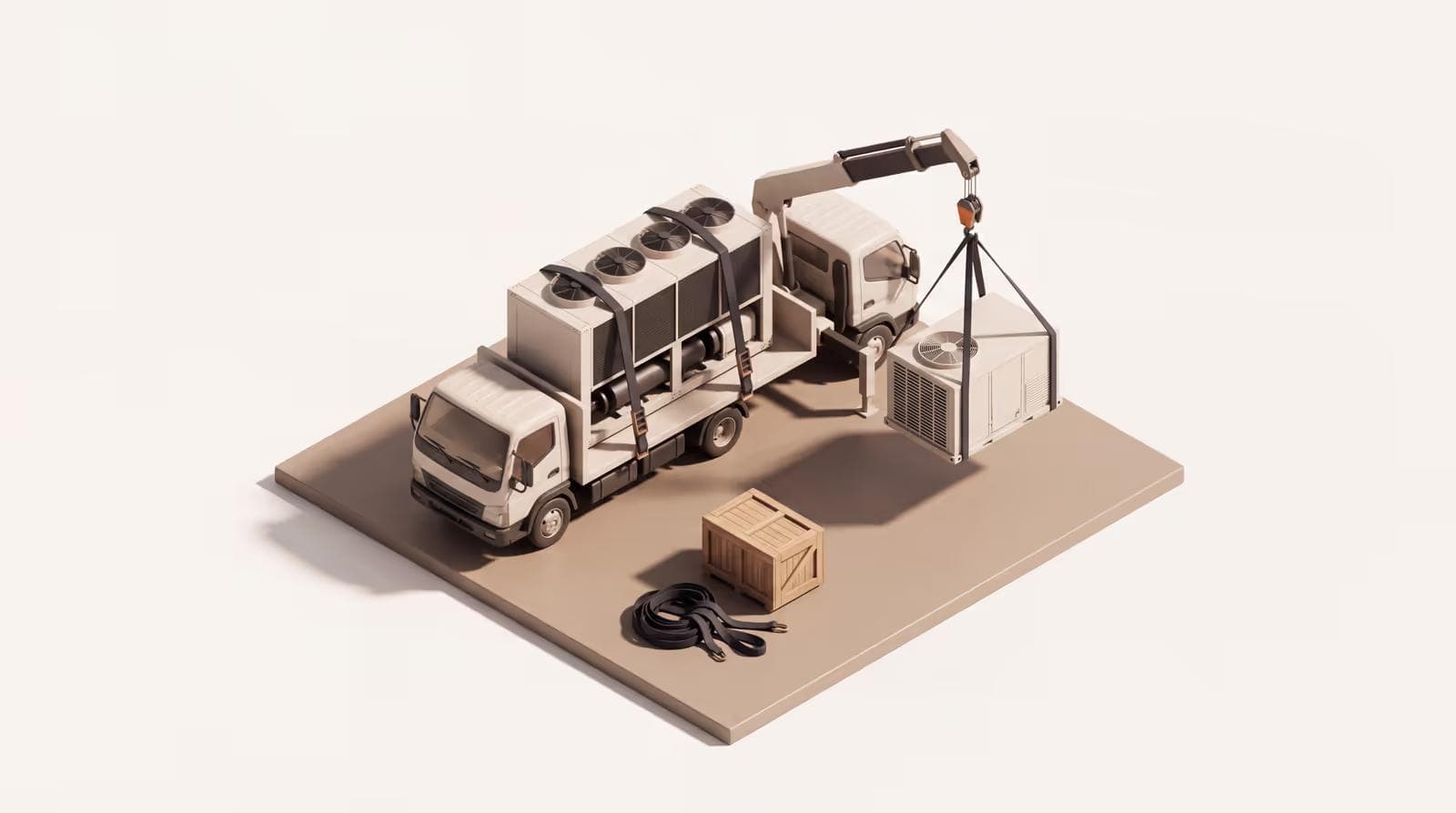
Installation floater coverage runs during the install and ends when the owner accepts the completed work, because the equipment becomes their property and their coverage at that point. Two hand-offs matter before then. The crane lift that sets the unit is its own exposure, and the tools you own ride on a separate floater from the equipment you are installing.
A dropped RTU during a crane set is a good example. That loss falls under riggers liability, not the installation floater, because the unit is in your care while it hangs from the hook. On new-construction jobs, the general contractor often carries builders risk on the structure, which still leaves your equipment on your own inland marine limits.
Getting this right means matching your inland marine limits to the jobs you actually bid, then keeping them current as job sizes grow. Coverwatch sets installation floater and motor truck cargo limits to the largest jobs an HVAC contractor actually runs, rather than a generic default, as part of its flat-fee HVAC insurance program.
For the full picture across property, auto, and inland marine, see how an established HVAC insurance program is built, what changes when you outgrow a business owners policy, and how coverage shifts as you add trade lines to the business.
An installation floater is inland marine coverage on property, usually equipment, being installed by a contractor. For an HVAC company it covers a chiller, RTU, or boiler while it is staged, in transit on your trucks, and being installed at the jobsite. It is written as a specialized form of builders risk and typically ends when the owner accepts the finished work.
Most installation floaters cover the labor cost to install the materials, not just the materials themselves, so a covered loss can include the work already put into the job. Coverage limits and exclusions vary by form, and some policies exclude damage that happens during certain kinds of transit. Confirm the exact terms with your broker before a large install.
An installation floater covers the materials and equipment a contractor brings to a job and installs, while builders risk covers the structure under construction itself. On a project with both, the general contractor's builders risk pays for the building and your installation floater pays for your chiller or RTU. The two are closely related, since an installation floater is a specialized form of builders risk coverage.
Riggers liability covers property that is in your care while you hoist, rig, or lift it, such as an RTU hanging from a crane hook. An installation floater covers property you are installing for a customer across staging, transit, and installation. A dropped unit during a crane set is a riggers claim, while damage to a staged unit before the lift is an installation floater claim.
Size the per-location limit to the value of your largest single install, not an average job, and add a transit limit high enough to cover a full truckload of equipment. A single chiller plant can run over $200,000, and a loaded trailer of switchgear or a packaged RTU can top $100,000. Review the limits whenever your typical job size steps up.
August 7, 2026
ExplainersHandyman insurance vendor list requirements come from credentialing portals. What seven real vendor packets demand and why vendors get de-listed.
7 min read

August 6, 2026
ExplainersAn electrician liability fire damage claim usually arrives as a subrogation demand months after the job. What happens next, and what you can challenge.
7 min read

August 6, 2026
ExplainersA plumber's liability policy pays for what the water ruined, not for the joint that let go. The exclusions are narrower than most contractors think.
7 min read
August 1, 2026
ExplainersAdding plumbing, refrigeration, or electrical work resets your HVAC class codes and reprices general liability and workers comp. Here is what changes.
6 min read
Fill out the form and a Coverwatch advisor will get back to you within the next hour.
Your quote