
August 7, 2026
ExplainersHandyman Insurance Vendor List Requirements in 2026
Handyman insurance vendor list requirements come from credentialing portals. What seven real vendor packets demand and why vendors get de-listed.
7 min read

Manage your risk with Coverwatch
Get a free coverage review and find out where you are over or under insured.
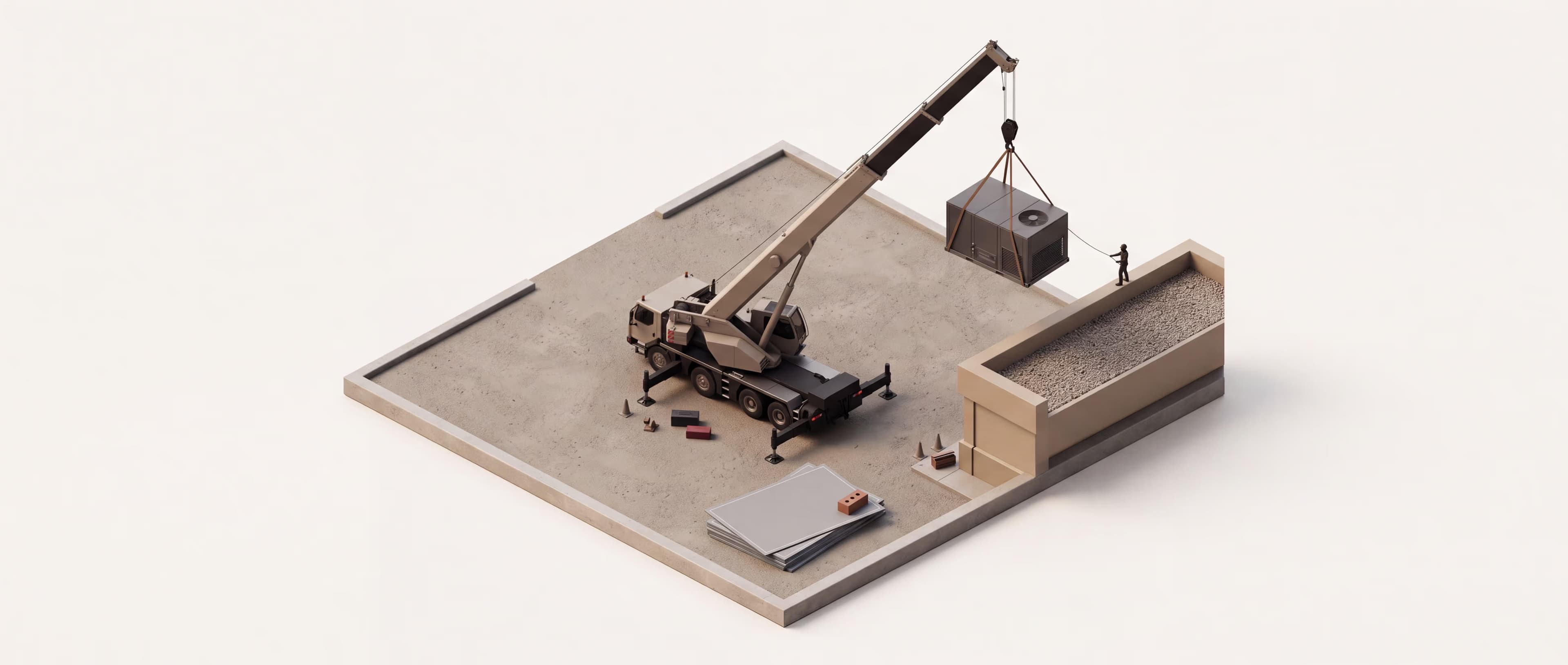
Riggers liability insurance covers physical damage to property that belongs to someone else while it's in your care, custody, or control during a hoist, rig, or lift. When an HVAC crew sets a rooftop unit (RTU) with a crane, this coverage pays if the unit is dropped, swung into a parapet, or crushed. Your general liability policy won't touch that claim, because it specifically excludes damage to property you're handling.
The part that trips up most contractors is the crane. Renting one doesn't hand the risk to the crane company. Their policy covers their equipment and their operator, while the unit hanging from the hook stays yours to insure. Below is who owns a dropped-RTU claim, how the operated-versus-bare rental split changes the answer, and the certificate wording that keeps a bad lift from becoming a lawsuit.
Riggers liability insurance covers physical damage to property owned by others while you hoist, rig, or lift it. Insurers file the unit dangling from your hook under care custody control equipment, property you are handling but do not own, which a standard general liability policy excludes. So the rooftop unit drops into an uninsured gap the moment your rigging goes taut.
The coverage itself usually lives inside an inland marine policy or rides on your general liability as a buy-back endorsement. IRMI uses that exact setup as its own textbook example, describing a crane that lifts an air-conditioning unit onto a roof. That makes it the crane lift insurance HVAC crews actually need.
Carriers enforce the exclusion. Under the standard ISO general liability form, exclusion j.(4) bars coverage for property in your care, custody, or control. Riggers liability quietly fills that gap, attaching the moment the slings go taut and releasing once the owner signs off on the finished set.
The load hanging from the hook is almost always your risk. A crane company's insurance stops at its own iron. It covers the crane, the operator, and the operations that crew runs, and it does not reach across to the rooftop unit they are lifting for you.
A crane rental agreement spells it out: the crane company's coverage handles its own equipment and personnel, while the customer insures the items being lifted. So a dropped RTU is your problem to insure. Renting the crane does not move that exposure onto them. Split a crane accident into three buckets and you can see why each piece lands on a different policy.
An operated rental keeps the crane, the operator, and the operator's mistakes on the crane company's policy, since they send their own certified operator with the machine. A bare rental is the crane alone: you supply the operator, the rigger, and the signal person, so their negligence and the crane's physical damage both move onto you. Maxim Crane notes that operated rentals usually include the rental company's insurance, while bare rentals push those obligations to the renter.
One catch survives both rental types: the RTU on the hook is your riggers exposure whether the operator wears their shirt or yours. Read the rental contract closely, because many operated agreements name the operator as your "borrowed servant" for the lift, which quietly hands you liability for what that operator does.
| Who pays | Operated rental | Bare rental |
|---|---|---|
| The crane machine | Crane company | You |
| Operator negligence | Crane company (watch for borrowed-servant wording) | You |
| The RTU on the hook | You (riggers liability) | You (riggers liability) |
| Building or bystander damage | Crane company GL | You |
Size your riggers liability limit to the replacement value of the most expensive unit you will have on the hook at once. Larger commercial packaged rooftop units commonly run $12,000 to $75,000 each. For custom air handlers or multi-unit sets, a single lift can top $100,000. So a $10,000 riggers sublimit, the kind that comes bundled free with a general liability policy, will not come close to covering one modern RTU.
Say you're setting three 20-ton units at about $60,000 apiece, lifted one at a time. Your exposure per pick is $60,000, so a $50,000 limit leaves you $10,000 short on a total loss. Match the limit to the biggest single moment of exposure, then add margin for the curb, ductwork, and rooftop finishes a falling unit can wreck on the way down.
Before the lift, collect the crane company's certificate of insurance and confirm three things:
Additional insured status means their policy defends you when the crane clips the building or a boom swings into finished rooftop equipment. The waiver blocks their insurer from paying a claim and then billing you to get it back.
Handle your side in the same pass. Confirm your program carries a riggers or installation limit that matches your real unit values, and that it applies at the job site, not only in transit. The certificate discipline you'd use for any sub applies here, and our guide to HVAC subcontractor insurance requirements walks the additional insured and waiver wording line by line. On new-construction rooftop sets, the general contractor often demands both from you and the crane vendor.
Coverwatch reviews the crane vendor's certificate and the contractor's own riggers limit together before a lift, so the additional insured wording, the waiver, and the coverage amount all line up. It's part of the flat-fee HVAC contractor insurance review, and the same team runs the broader HVAC company insurance program at renewal.
No. A standard general liability policy excludes damage to property in your care, custody, or control, which is exactly what the unit on your hook is during a lift. Riggers liability insurance, usually written as inland marine coverage or a general liability endorsement, is the coverage that pays for a dropped or damaged RTU.
Not quite. Inland marine is the broader category of coverage for movable property and property in your care. Riggers liability is the specific piece that covers property of others while you hoist, rig, or lift it, and it is often written inside an inland marine policy or added to general liability as an endorsement.
Generally no. On an operated rental the crane company insures the crane, its operator, and its own operations, while the customer insures the load being lifted. Get the split in writing before the job, and confirm your own riggers liability covers the rooftop unit's replacement value.
Match the limit to the replacement value of the most expensive unit you will have on the hook at once. Larger commercial packaged units commonly run $12,000 to $75,000, and large or multi-unit sets can exceed $100,000. Add margin for the curb, ductwork, and finishes a falling unit can damage.
Yes. Require general liability with your company named as an additional insured and a waiver of subrogation in your favor, and confirm the crane company carries riggers liability on operated lifts. Additional insured status means their policy defends you if the crane damages the building during the set.
August 7, 2026
ExplainersHandyman insurance vendor list requirements come from credentialing portals. What seven real vendor packets demand and why vendors get de-listed.
7 min read
August 6, 2026
ExplainersAn electrician liability fire damage claim usually arrives as a subrogation demand months after the job. What happens next, and what you can challenge.
7 min read
August 6, 2026
ExplainersA plumber's liability policy pays for what the water ruined, not for the joint that let go. The exclusions are narrower than most contractors think.
7 min read
August 1, 2026
ExplainersAdding plumbing, refrigeration, or electrical work resets your HVAC class codes and reprices general liability and workers comp. Here is what changes.
6 min read
Fill out the form and a Coverwatch advisor will get back to you within the next hour.
Your quote